
A pool permit is not a single approval. For public pool design, Florida checklists identify the 2023 Florida Building Code, 8th edition, and a building permit does not replace the Florida Department of Health operating permit. The Florida Building Code for swimming pools sets the construction framework, while separate health requirements apply to public-pool operation.
It’s easy to focus on a pool’s visible design and overlook how code editions, permitting steps, and safety provisions fit together. In Florida, these details shape the path from approved plans to occupancy and operation.
This guide explains which rules apply to public pools, when construction and operating approvals are required, and what to consider for barriers, gates, electrical safety, and bonding. It also covers how to identify the relevant code edition, giving you a clearer view of the regulatory requirements for a Florida pool project.
Key Takeaways
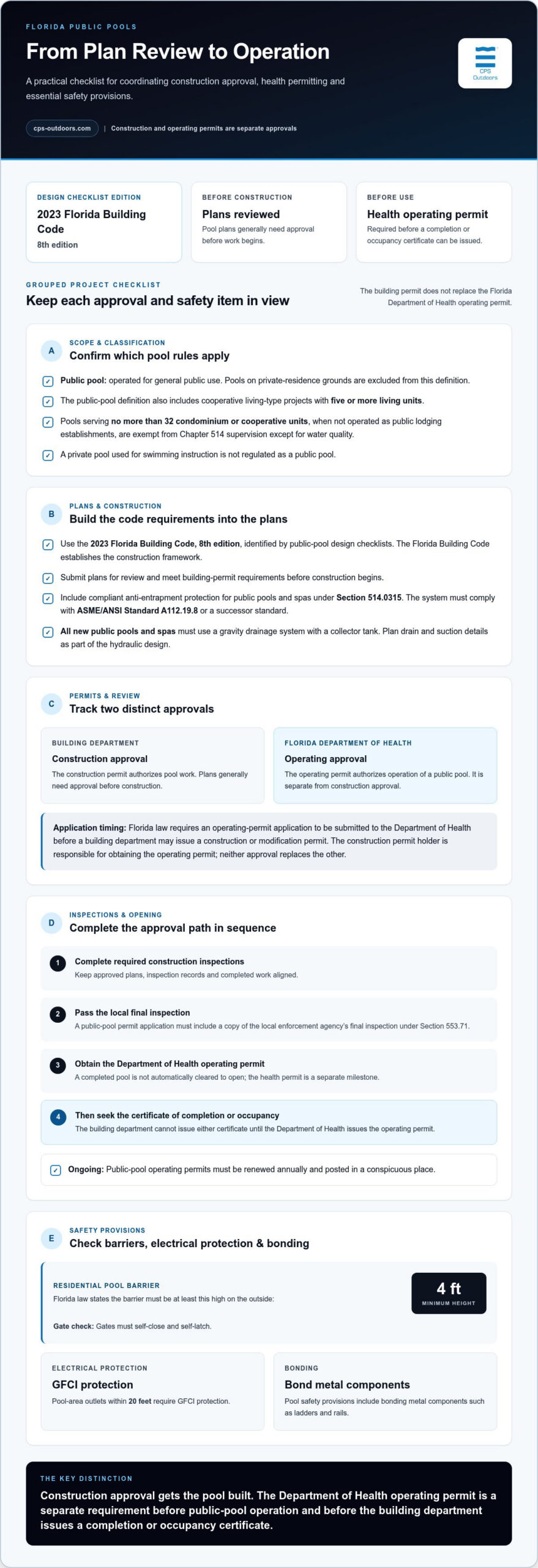
- Public pool construction approval and the Florida Department of Health’s operating permit are separate steps, and both shape the route to opening.
- A building department cannot issue a certificate of completion or occupancy for a public pool until the Department of Health issues its operating permit.
- The Florida Legislature states that a residential swimming pool barrier must be at least 4 feet high on the outside; gates must also self-close and self-latch.
- Pool-area electrical safety includes GFCI protection for outlets within twenty feet and bonding metal components such as ladders and rails.
- Use the 2023 Florida Building Code, 8th edition, as the edition identified for public pool design checklists.
Florida Building Code authority over public pool construction
Florida assigns public-pool construction standards to the Florida Building Commission through the Florida Building Code. Public-pool design checklists identify the 2023 Florida Building Code, 8th edition, as the applicable edition.
Permits and Plan Review
A public-pool construction permit is the building department’s approval for pool work. It is separate from the health approval required to operate the pool. Pool plans generally need approval before construction begins.
Florida law requires an operating-permit application to be submitted to the Florida Department of Health before a building department may issue a construction or modification permit for a public pool. The construction permit holder is responsible for obtaining the operating permit, and neither approval replaces the other. Design checklists can help organize plan review under the applicable code edition. The sequence matters: submit plans for review, meet building-permit requirements, then obtain health approval before operation.
Residential and Public Pool Code Applicability
Pool-code applicability is the distinction between rules for private residential pools and standards governing pools operated for public use. According to The Florida Legislature, a public swimming pool is operated for general public use, while pools on private-residence grounds are excluded.
Florida’s public-pool definition also includes cooperative living-type projects of five or more living units. Pools serving no more than 32 condominium or cooperative units, when not operated as public lodging establishments, are exempt from Chapter 514 supervision except for water quality. A private pool used for swimming instruction is not regulated as a public pool. Classification matters because it determines which construction, health, and operating requirements apply.
Drain, Suction Outlet, and Anti-Entrapment Requirements
Anti-entrapment protection is a safety system or device designed to reduce hazards at pool drains and suction outlets. Florida law requires public swimming pools and spas to have a compliant system or device under Section 514.0315.
The system must comply with ASME/ANSI Standard A112.19.8 or a successor standard. All new public pools and spas must use a gravity drainage system with a collector tank. These provisions shape the pool’s hydraulic design, so drain and suction details belong in the construction plans rather than being treated as late-stage equipment choices. Florida law provides several entrapment-protection options for public pools and spas built before January 1, 1993.
Code Violations and Local Variations
Code enforcement is the inspection and oversight process for identifying and addressing noncompliant pool conditions. In Florida, county health departments oversee routine water-quality surveillance, inspections, complaint investigations, enforcement, and operating permits for public pools and bathing places.
There is no single penalty figure that applies to every violation; the issue and its effect on compliance guide enforcement. For local variation, the statewide Florida Building Code establishes public-pool construction standards, while local enforcement agencies participate in project review. Public-pool permit applications must include a copy of the local enforcement agency’s final inspection under Section 553.71. That makes local review part of the approval path, even as the state code supplies the construction framework.
Certificate of completion and occupancy requirements
A certificate of completion records that permitted construction has passed the required local review. A certificate of occupancy authorizes use of a building or facility. For a Florida public swimming pool, neither document replaces the Florida Department of Health operating permit. The building department cannot issue either certificate until the Department of Health issues that permit.
The operating permit is the Department of Health’s approval to run a public pool. It is a separate milestone from construction approval, so a completed pool is not automatically cleared to open. Florida public-pool operating permits must be renewed annually and posted in a conspicuous place. Plan for both the initial permit and recurring renewals when scheduling a public facility’s opening and ongoing operation.
Final inspection documentation connects local construction review with the public-pool permit process. Under Section 553.71, a Florida public-pool permit application must include a copy of the local enforcement agency’s final inspection. Construction inspections may occur at multiple stages, and they are not optional. Keep the approved plans and inspection records aligned with the work performed, so reviewers can evaluate the finished pool against the permitted project.
The approval sequence is straightforward: complete required construction inspections, pass the local final inspection, and obtain the Department of Health operating permit before seeking the certificate. The local final inspection documents building review, but does not replace health approval. Keep approved plans and completed work consistent, including any safety features or areas intended for children. The inspection record is not an operating authorization.
For a public pool, treat “ready for use” as a coordinated approval status, not a visual judgment. A finished deck, filled basin, or functioning recreational space does not show that the Department of Health has issued its operating permit. Confirm the permit is issued before relying on a certificate of completion or occupancy, and track annual renewal and conspicuous posting as ongoing duties. This helps owners plan opening preparations around required approvals, not just the construction finish date.
Barrier height and gate latch requirements
A pool barrier is an access-control feature that separates a swimming pool from surrounding areas. According to The Florida Legislature, a residential swimming pool barrier must be at least 4 feet high on the outside. The Florida Building Code also defines an effective barrier with a required fence height of at least 48 inches. These requirements make barrier height a design dimension, not merely a landscaping choice.
An effective barrier is a structure that restricts access to the pool area. Florida residential pool barriers should be climb-proof, and openings must not allow a 4-inch-diameter sphere to pass through. When reviewing a proposed fence, consider its height, openings, and nearby features together. A barrier that meets the height measure may still need attention if its configuration creates an easy climbing route.
A pool barrier gate is a controlled opening that must close and latch without remaining open. Florida pool barrier gates must self-close and self-latch, with the latch 54 inches from the ground. Residential pool access doors have a related requirement: the self-closing, self-latching device must be installed at least 54 inches above the threshold. Treat gates and doors as separate access points in the plan and inspection.
Removable child barriers are temporary barriers positioned near a pool’s water edge. Florida rules place them at least 20 inches from that edge. Pool exit alarms have a separate stated performance threshold: a minimum sound pressure rating of 85 dBA at 10 feet. These measures address different access conditions, so they should not be treated as substitutes for a compliant permanent barrier or gate.
A screened pool enclosure is an enclosure whose lower portion must meet a hardening requirement. In Florida, screened pool enclosures must be hardened on the bottom 3 feet. A safety cover meeting ASTM F1346-91 (Reapproved 2003) does not satisfy Florida’s screened enclosure fencing requirement. A cover may provide an additional layer of pool safety, but it should not be treated as a substitute for other access-control measures.
Before construction or renovation, show the barrier line, gate swing, latch position, and door access on the plans. During inspection, check installed heights and openings, then test that gates self-close and self-latch. The applicable department and enforcement process may differ for residential and public facilities, while special purpose pools have their own classification context. Clear plans help establish which access features need review before use.
Electrical safety and bonding
Electrical safety means planning and installing pool wiring and equipment to reduce electrical hazards. The National Electrical Code (NEC) provides guidance for pool electrical safety, and Florida pool wiring and equipment should be installed by a licensed electrician. Include electrical components in the project design rather than treating them as last-minute details.
GFCI protection interrupts electrical power when a ground fault occurs. Pool-area outlets within around twenty feet require GFCI protection. When laying out the pool and surrounding facilities, account for nearby outlets, lighting, and equipment. Mark their locations on the plans so the electrical design can be coordinated with the pool’s other systems.
Bonding electrically connects metal components to help maintain a common electrical potential. In Florida pools, metal components such as ladders and rails should be bonded together. Identify metal features early, including those incorporated into the pool structure or deck. A licensed electrician can coordinate their bonding with the wiring and equipment layout.
Public-pool electrical planning should also fit into the broader construction plan. All new public pools and spas in Florida require a gravity drainage system with a collector tank. This is a drainage requirement, not an electrical-bonding rule, but coordinating both systems during design helps prevent disconnected planning. Keep drainage and electrical layouts clear in the project documents.
For a practical review, trace each electrical item on the plans: pool equipment, nearby outlets, lighting, and metal features such as rails. Compare outlet locations with the GFCI requirement and identify components that need bonding. Clear drawings and installation instructions help the project team understand what belongs where. The NEC guidance and Florida pool requirements are separate references to consider.
For public facilities, pool design and construction involve multiple code considerations, including requirements in the Florida Building Code and Chapter 64E-9 of the Florida Administrative Code for public-pool sanitation and safety. Keep electrical coordination within the project’s overall code review, without confusing a gravity drainage requirement with electrical protection. This distinction helps owners and design teams discuss each system accurately during planning and construction review.
Florida Building Code editions
A code edition is the published version of construction requirements used to review a project. Florida public-pool design checklists identify the 2023 Florida Building Code, 8th edition, specifically the Florida Building Code, Building. This is the edition to use as the starting reference when organizing a public pool’s drawings and specifications. The Florida building code for swimming pools provides a construction framework, while separate health rules govern public-pool sanitation and safety.
Florida Administrative Code Rule 64E-9 was effective June 11, 2023, and addresses public-pool sanitation and safety. That administrative rule and the building-code edition serve different roles in project review. Identify both in the project documents so reviewers can see which construction provisions and health requirements inform the design. The relevant checklist also depends on whether the pool is public or private.
Florida private pools must conform to listed ANSI/APSP/ICC standards, including ANSI/APSP/ICC 3, ANSI/APSP/ICC 4, ANSI/APSP/ICC 5, ANSI/APSP/ICC 6, and ANSI/APSP/ICC 7. Public pools have additional construction and health requirements. Wading pools, for example, are among the public-pool categories covered by Florida’s sanitation rules. Classifying the facility early helps establish which references belong in the design package.
Edition review also means comparing actual design details with applicable requirements. Florida pool construction standards require a minimum 4-inch tile line at the water line, with each tile at least 1 inch on all sides. Public pools must provide an unobstructed wet deck area at least 4 feet wide around the outside of the pool water perimeter and specified features. These dimensions show why a checklist review should consider the deck and finish details alongside the pool basin.
Mechanical specifications matter too. Florida pool piping must pass a static water or air pressure test of at least 35 psi for 15 minutes. Pool filter components must provide complete water turnover in 12 hours or less. Public swimming pools and spas also require anti-entrapment protection under Section 514.0315, compliant with ASME/ANSI Standard A112.19.8 or a successor standard.
For a practical review, identify the pool or spa type, find the applicable checklist, and compare drawings and specifications with each cited requirement. Keep building-code provisions separate from administrative health rules. The Florida building code for swimming pools is one part of the review, alongside pool-specific standards and applicable public-health requirements. Clear project documents help keep those references aligned through design and construction.
For support planning a pool project around its design requirements, plan your pool project with CPS Outdoors.
CPS Outdoors: Residential Pool Construction
CPS Outdoors helps homeowners turn pool concepts into carefully planned residential projects through pool design and engineering. For a new pool, the design phase is the time to align the layout with applicable Florida requirements, including barriers, access, and safety provisions.
For an existing property, CPS Outdoors offers residential pool renovations to rework or update a pool. Its Commercial Aquatics service supports projects intended for public use, where construction approvals and health operating requirements also shape planning. The starting point depends on whether you’re planning a new residence, a renovation, or a commercial facility.
Contact CPS Outdoors to discuss your pool project and the design or construction support it needs.
Turn Code Requirements Into a Project Plan
The next step is to turn regulatory requirements into clear design decisions. Before plans take shape, define the pool’s purpose, intended users, site constraints, and desired features. Applying the Florida building code for swimming pools begins with a project scope that gives designers and engineers a shared framework.
CPS Outdoors provides Pool Design and Engineering, Residential Pool Construction, and Commercial Aquatics. Homeowners planning a new pool and organizations developing a public aquatic facility can connect their design vision with the construction scope. A well-prepared project brief helps clarify priorities before detailed drawings and decisions move forward.
Bring your goals and project context into the conversation, whether you’re planning a residential pool or a commercial aquatic space. Contact CPS Outdoors about your pool and take the next step toward a thoughtfully planned project.
Frequently Asked Questions
What Florida Building Code edition and sections apply to swimming pools?
The relevant public-pool checklist identifies the 2023 Florida Building Code, 8th edition, while health and safety rules also apply. Florida Administrative Code Rule 64E-9 governs public-pool sanitation and safety; Section 514.0315 addresses anti-entrapment protection. A project’s classification matters because public pools and private residential pools don’t follow an identical regulatory path. Identify the pool type and intended use before setting the design basis.
What are Florida pool barrier and fence requirements, including height and gate rules?
Residential pool barriers must meet Florida’s height, opening, and access-control requirements. The Florida Legislature states that a residential swimming pool barrier must be at least 4 feet high on the outside. Barrier openings must not allow a 4-inch-diameter sphere to pass through, and gates must self-close and self-latch. A removable child barrier has a separate placement rule, so don’t treat it as interchangeable with a permanent fence.
What safety requirements apply to pool doors, windows, alarms, and access?
Pool access doors require a self-closing, self-latching device installed at least 54 inches above the threshold. Pool exit alarms must have a minimum sound pressure rating of 85 dBA at 10 feet. Include each door and window opening onto the pool area in the access plan, showing how it relates to the barrier. This helps reviewers distinguish an access point from a feature that doesn’t provide pool-area entry.
What are Florida requirements for pool construction, circulation, and electrical systems?
Florida requirements cover structural details, circulation performance, and electrical protection as distinct design elements. For example, a collector tank must have a water surface area of at least 2.25 square feet, and its vent must have an area of at least 12.56 square inches. Pool-area outlets within around twenty feet require GFCI protection; metal components such as ladders and rails should be bonded together.
What permits and inspections are required to build or remodel a pool in Florida?
Public-pool construction or modification requires building-department review and a separate Department of Health operating permit. The operating-permit application must be submitted before the building department may issue a construction or modification permit. Inspections may take place at multiple construction stages, and the public-pool application must include the local enforcement agency’s final inspection. For scheduling, the Department of Health recommends allowing at least five working days for engineering-office review.
How can I find Florida pool permit requirements and code guidance for my local jurisdiction?
First identify whether the pool is residential or public, then match its planned use to the applicable state code and permit path. Local enforcement agencies take part in construction review, and their final inspection is part of a public-pool permit application. County health departments oversee public-pool operating permits and inspections. For a public-pool opening, the Department of Health recommends contacting its program office at least two weeks beforehand.