What if a pool cover could strengthen safety without becoming the first thing you notice in the design? It’s a reasonable question: a visible cover can feel at odds with a carefully composed outdoor space. But a pool cover for safety and aesthetics isn’t a one-size-fits-all decision. Cover types serve different purposes, and a solar or winter cover shouldn’t be mistaken for a safety cover designed to bear weight.
The right choice starts with understanding what a cover is designed to do, how it operates, and how it looks both open and closed. For Florida projects, consider those decisions alongside the pool’s shape, finishes, coping, and surrounding landscape, rather than treating the cover as an afterthought. This guide compares cover functions and operating styles, then outlines the design and planning details to weigh when integrating an automatic pool cover into a custom pool plan. You’ll have a practical framework for balancing safety considerations with the outdoor setting you want to create.
Key Takeaways
- Match a cover’s intended function to your priorities. Appearance alone doesn’t establish whether it’s designed for safety.
- Compare manual and automatic systems by how they operate, how visible they are, and how they fit your pool plan.
- Plan a pool cover for safety and aesthetics alongside pool geometry, finishes, and the surrounding outdoor space.
- Account for Florida’s sun, humidity, storms, and debris when considering cover use and project design.
- Coordinate automatic pool cover planning with custom pool design and engineering.
Pool Covers for Safety and Aesthetics: What Should They Do?
A well-planned pool cover has two considerations: the function it was designed for and how it fits the visual composition of the space. Safety and appearance don’t have to compete, but homeowners do need to distinguish a documented safety function from a cover’s general protective role. The cover’s construction, specifications, and intended use all matter.
A pool cover’s safety role depends on its design and specifications. Its visual impact depends on how it is integrated with the pool and landscape. That distinction is central to choosing a pool cover for safety and aesthetics. A cover may form one layer of a broader safety plan, but it doesn’t replace adult supervision or other applicable safety measures.
What does a pool cover contribute to safety?
Rely on a cover for a safety function only when its specific design and documentation support that purpose. Covers intended mainly to protect water or limit debris are not automatically safety covers. Their appearance, or their ability to span the pool, doesn’t establish that they’re designed to serve as a barrier against access or to bear weight.
Performance depends on more than the cover itself. Correct specification, installation, and use are essential to its intended function. Product documentation and operating instructions explain what a particular system is designed to do and identify its limitations. Keep those distinctions clear in household routines, especially when children or guests are present.
How can a cover complement the pool’s appearance?
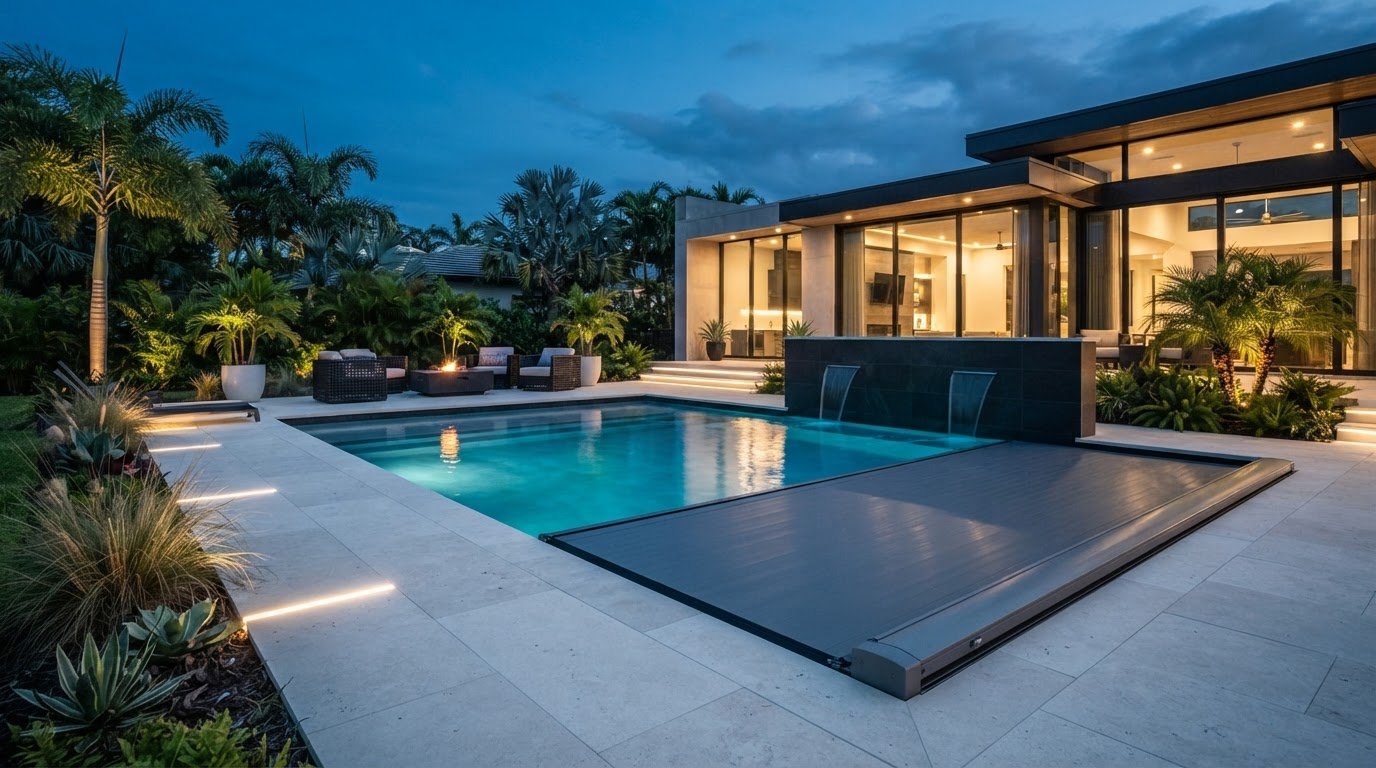
Visual integration starts with the whole composition: pool geometry, deck materials, landscape edges, and the home’s architectural character. Plan the cover as part of that arrangement instead of selecting it after construction. For example, consider where the cover sits in relation to the pool’s lines and deck layout, and how the closed pool looks from the house and main outdoor seating areas.
That coordination can reduce visual interruption without making assumptions about how a cover performs. The aim is a deliberate transition between water, hardscape, and planting. Paving, coping, and circulation also shape the view. The guide to luxury pool hardscape design explores how these elements connect the pool to its setting.
Before settling on a system, define what it needs to accomplish, then assess how it will look both open and closed. A discreet appearance doesn’t indicate safety capability, just as a safety designation doesn’t determine whether the cover suits the overall design. Evaluate each goal separately, then coordinate the choices through the pool’s design and engineering.
How Pool Cover Systems Work: Safety, Operation, and Design
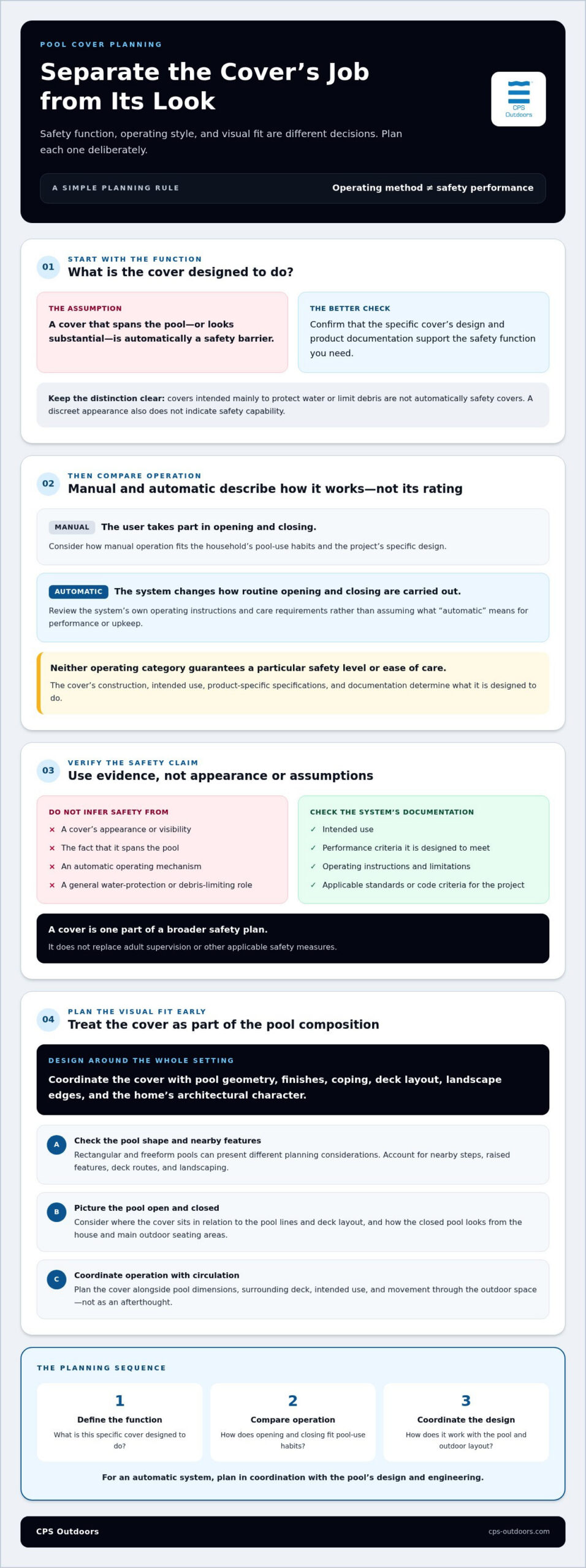
Pool covers are often grouped by how they’re operated: manually or automatically. That distinction describes the user experience, not the cover’s safety rating. The cover’s construction, operating method, intended use, and product-specific specifications determine what it’s designed to do. Comparing these factors helps homeowners make a practical choice and coordinate it with the pool plan.
Cover type alone doesn’t establish safety performance. The specific system’s design and documentation show what function it is intended to serve. An automatic system isn’t automatically a safety cover, and manual operation doesn’t by itself indicate that a cover lacks a safety function. Treat the operating category and intended performance as separate questions.
Manual and automatic pool covers: what differs?
A manual system requires the user to take part in opening and closing the cover. An automatic system changes how those routine actions are carried out, which may affect how the cover fits into a household’s pool-use habits. Neither category guarantees a particular level of performance or ease of care. Those details depend on the specific design and project.
CPS Outdoors offers automatic pool covers as part of its custom aquatic work. Planning a cover alongside pool construction and engineering allows the system to be considered in relation to the pool’s dimensions, surrounding deck, and intended use. Review the system’s own operating instructions and care requirements rather than making assumptions based on the word “automatic.”
What determines whether a cover is a safety cover?
Start with the product-specific documentation. It should identify the cover’s intended use and the performance criteria it is designed to meet. Don’t treat a cover marketed for reducing debris or protecting water as a safety barrier unless its documentation supports that function. Likewise, don’t infer a safety rating from an automatic operating mechanism.
Standards and code references also require care. Their current editions and relevance can depend on the system and project, so verify applicable criteria before making a compliance claim. Regardless of cover type, a cover isn’t a substitute for supervision or other appropriate safety measures.
Design coordination matters, too. A rectangular pool and a freeform pool can present different planning considerations. Nearby steps, raised features, deck routes, and landscaping can also affect how a cover fits into the layout. Considering these elements early helps align operation with circulation and preserve a coherent appearance when the pool is closed. It also avoids treating the cover as an isolated add-on after key design decisions are settled.
CPS Outdoors coordinates automatic pool cover planning with custom pool design and engineering. Explore CPS Outdoors’ pool design and engineering as part of a considered aquatic plan.
Pool Cover Safety vs. Appearance: Which Trade-Offs Are Real?
A discreet cover isn’t automatically less capable, and a more visible cover isn’t automatically safer. Appearance and performance are separate considerations. A smooth, unobtrusive finish may suit a refined outdoor design, but looks alone can’t show whether a particular cover is intended to perform a safety function or meets relevant criteria. Base safety decisions on evidence, not assumptions about appearance.
Does a discreet cover compromise safety?
Visibility alone can’t establish a cover’s safety. Look at the product-specific documentation, including its stated purpose and applicable performance criteria. Correct specification and installation matter, as does using the system as intended. Avoid blanket assurances based on appearance, and don’t infer child safety, load capacity, or code compliance without supporting documentation.
There isn’t a universal trade-off between visual restraint and safety performance. A cover might be visually integrated while serving a documented purpose, or visually prominent while being intended mainly to protect water or limit debris. Neither description establishes a safety rating. Ask what the specific system is designed and documented to do, rather than judging whether it looks secure.
What should homeowners compare beyond appearance?
Compare purpose and operation first, then assess how the system fits the pool and outdoor plan. Keep evidence about product performance separate from aesthetic preference. This makes it easier to identify practical design constraints, such as the pool’s shape or the way deck circulation meets the pool edge, without treating visual style as a proxy for safety.
Intended function: Is the cover documented for a safety role, or is its primary purpose another form of pool protection?
Visibility: How does the cover look when the pool is open and closed? Does that suit the desired view across the outdoor space?
Operation: What user actions are involved, and how does opening and closing fit the household’s typical pool routine?
Project coordination: How do the pool configuration, deck edges, nearby features, and circulation relate to the planned system?
These comparisons clarify the difference between documented capability and design preference. For example, a homeowner may prefer a cover that is less noticeable when closed. That preference can guide visual coordination, but it doesn’t establish the system’s safety function. Likewise, documentation of a safety purpose doesn’t determine whether the cover’s appearance will complement a particular home.
For a pool cover for safety and aesthetics, evaluate the project as a whole: confirm the intended function through system documentation, then coordinate the cover’s appearance and operation with the pool design. The right balance depends on the specific cover and site, not broad labels such as “discreet,” “automatic,” or “premium.”
Planning a Pool Cover for a Florida Home
In Florida, pool-cover planning belongs in the broader outdoor design, not just the final equipment selection. Sun exposure, humidity, storms, and windblown debris are practical site considerations, though their effects vary by property and system. A clear planning sequence helps keep the cover’s intended role, daily use, and visual integration in view without assuming one solution fits every pool.
- Define your goals. Clarify whether your priority is a documented safety function, keeping debris out, or another intended use. Separate those needs from appearance preferences.
- Review the pool geometry. Consider the pool’s dimensions and shape, along with edges, steps, and other features that may affect cover planning.
- Coordinate the design. Consider the cover alongside the deck, access routes, landscape, and how you expect to use the outdoor space.
- Verify specifications. Review product documentation for intended use and performance criteria. Check applicable state and local requirements against current authoritative sources.
- Plan operation. Account for how the cover will be opened and closed as part of the household’s regular pool routine.
Which project details affect cover planning?
Pool dimensions and shape are a starting point, but the surrounding layout matters as well. A deck passage, nearby seating area, or landscape edge can influence where the cover fits in the composition and how people move around the pool. These details guide design coordination; they don’t guarantee a particular technical result. For a broader perspective, explore custom residential pool design and engineering guidance.
Florida’s conditions also belong in the planning conversation. Consider where direct sun falls, how humidity and seasonal storms affect use of the space, and where leaves or other debris tend to collect. These observations can help shape design priorities and operating plans, but they don’t prove that a specific cover will provide a particular level of protection or performance.
How should homeowners assess safety and local requirements?
Keep two questions distinct: what the specific product documentation says the cover is designed to do, and what current Florida and local requirements apply to the project. Product claims don’t establish code compliance by themselves. Verify current requirements with authoritative state and local sources before making a compliance statement. A cover may contribute to a broader safety plan, but it doesn’t replace appropriate supervision.
A pool cover for safety and aesthetics works best when its function is assessed through documentation and its placement is considered within the complete design. CPS Outdoors integrates automatic pool covers into custom aquatic projects. Plan your custom pool and cover with CPS Outdoors.
Integrating an Automatic Pool Cover into a CPS Outdoors Project
Consider an automatic pool cover as part of the pool’s overall design and engineering, not as an isolated feature selected after the layout is settled. Its intended role, the pool’s form, and the character of the surrounding outdoor space all contribute to planning. CPS Outdoors designs custom residential and commercial pools and offers automatic pool covers as part of its aquatic construction work.
Early coordination connects the cover to the project’s design intent. A geometric pool, a sculptural form, and a setting shaped around outdoor entertaining each present a different visual context. Consider how the cover relates to the pool, deck, landscape, and architecture while keeping its documented function distinct from aesthetic preference.
What does integrated cover planning look like?
Integrated planning starts with the homeowner’s priorities and the pool’s intended use. The design team can consider the cover alongside pool form, finishes, circulation, and the surrounding outdoor environment, so those elements are addressed as a coordinated composition. This is especially useful when the pool is a central feature of the property and its appearance matters both during use and when closed.
For more context on shaping a custom pool around a residence and site, explore bespoke residential pool construction in Florida. A project-wide perspective also supports thoughtful cover coordination without presuming a specific technical outcome.
- Design intent: Identify the desired balance of function, visual presence, and outdoor use.
- Pool form: Consider how the cover plan relates to the pool’s shape and overall composition.
- Outdoor setting: Account for the deck, landscape, architecture, and movement around the pool.
- System documentation: Ground intended performance in the specific cover’s specifications.
What is a practical next step for a custom pool?
Begin with a clear description of how you want the pool to function and feel. Note who will use it, how the outdoor area supports daily life or entertaining, and what matters most when the pool is closed. Those priorities give the design conversation a useful starting point and connect the cover decision to the broader project vision.
For a pool cover for safety and aesthetics, treat design integration and documented performance as related but distinct considerations. CPS Outdoors brings custom pool design and engineering together with automatic pool cover planning as part of its aquatic work. Share your project priorities and intended pool use to begin shaping an integrated plan.
Explore a custom pool project with CPS Outdoors.
Shape a Pool Plan Around How You Want to Live
A pool’s design is an opportunity to make practical needs part of the vision from the outset. Think about how you want the space to feel during gatherings, quiet afternoons, and times when the pool isn’t in use. Those priorities can guide decisions about the pool’s form, the surrounding landscape, and how a cover fits into the overall composition.
For a pool cover for safety and aesthetics, treat your preferences as design inputs while grounding safety expectations in the specific system’s documented purpose. A clear sense of what matters most can make planning more focused, from the first concept through design and engineering.
CPS Outdoors designs and builds custom aquatic projects, with automatic pool covers among its pool offerings. Bring your project vision and intended use into the conversation, then explore custom pool design and engineering with CPS Outdoors to begin planning your Florida outdoor space.
Frequently Asked Questions
Are pool covers safe for children?
A pool cover can be part of a child-safety plan only if its specific design and documentation support that purpose. It isn’t a substitute for active adult supervision or other appropriate safeguards. Don’t assume a cover intended to keep leaves out can prevent access to the water. Make sure household members understand the cover’s limits and follow its operating instructions, especially when children are near the pool.
Can an automatic pool cover serve as a safety cover?
Some automatic covers may be designed for a safety function, but automatic operation alone doesn’t establish that they are safety covers. Check the documentation for the specific system’s intended use and applicable performance criteria. A control that opens and closes a cover describes its operation, not its safety rating. Keep supervision and other applicable safety measures in place even when a cover is closed.
Do pool covers make a pool look less attractive?
No, a cover doesn’t have to diminish a pool’s appearance. Its visual effect depends on how it relates to the pool, deck, and broader outdoor setting. Consider the view from key areas of the home and yard, not only the poolside perspective. A design review can account for how the space looks both with the cover in use and with the pool open.
What type of pool cover is best for a Florida home?
There isn’t one best option for every Florida home. Start with your priorities, such as a documented safety function, limiting debris, or fitting a cover into a particular pool design. Then consider the pool’s shape, how the space is used, and the property’s exposure to sun, storms, and falling leaves. Choose based on the specific system’s intended use and fit with the project, not a broad label.
Can a pool cover be added to an existing pool?
It may be possible, but suitability depends on the existing pool and surrounding layout. Pool dimensions, shape, deck configuration, and available space all affect how a cover could be coordinated. An existing-pool renovation provides an opportunity to assess those conditions alongside the desired function and appearance. CPS Outdoors’ residential renovation and automatic pool cover work can inform planning for an existing pool project.
Do Florida pool codes require a safety cover?
Florida’s residential pool safety requirements provide several options, so a safety cover isn’t the only possible feature. The Florida Residential Swimming Pool Safety Act identifies an approved safety cover among its options, alongside measures such as barriers and door alarms. Requirements can depend on the project and current state or local rules. Verify applicable requirements with authoritative Florida and local sources before relying on a compliance interpretation.
How does a pool cover work with a custom pool design?
A cover can be planned as part of the pool’s overall composition. For example, a homeowner designing a pool beside a terrace can consider how the cover relates to the pool outline, deck edges, and views from the house. Raising the question during design and engineering lets the team account for the cover alongside other project priorities, rather than treating it as a separate visual decision.
What should homeowners check before choosing a pool cover?
For a pool cover for safety and aesthetics, first identify the job you expect it to do, then check the specific product documentation for intended use and performance criteria. Consider how the system fits your pool configuration and household routine. Review operating instructions, installation requirements, and current applicable code guidance as part of the decision. Keep visual preference separate from evidence of safety performance, and don’t treat one as proof of the other.