The most advanced pool safety system is still only one layer of protection. Automatic covers, alarms, and monitoring technology can help reduce risk, but none replaces adult supervision or other required safeguards. Before adding automated pool safety solutions to a custom pool, understand what each feature is designed to do and where its limits lie.
It’s reasonable to ask whether technology will provide meaningful protection or simply create a false sense of security. The answer depends on the system, its operating limits, and how it works with the pool’s layout and surrounding barriers. In Florida, requirements can also depend on local rules and project details, so confirm what applies with the relevant authority before making design decisions.
This guide explains the main categories of automated safety features, what to assess for compatibility and limitations, and why safety planning belongs in the design and engineering process from the outset. You’ll have a clearer basis for discussing options such as automatic covers with a qualified pool design-build professional.
Key Takeaways
- Learn how covers, alarms, and monitoring features serve different purposes, so you can match each option to the risks it addresses.
- Compare automated pool safety solutions with physical barriers by considering their roles, strengths, and limitations together.
- Use a practical planning sequence to account for pool users, access routes, and how the space is used.
- Check current Florida and local requirements with the relevant authority before selecting or installing safety features.
- See why coordinating automatic covers and other safeguards with pool design and engineering can help avoid compatibility issues.
What Automated Pool Safety Solutions Can, and Cannot, Do
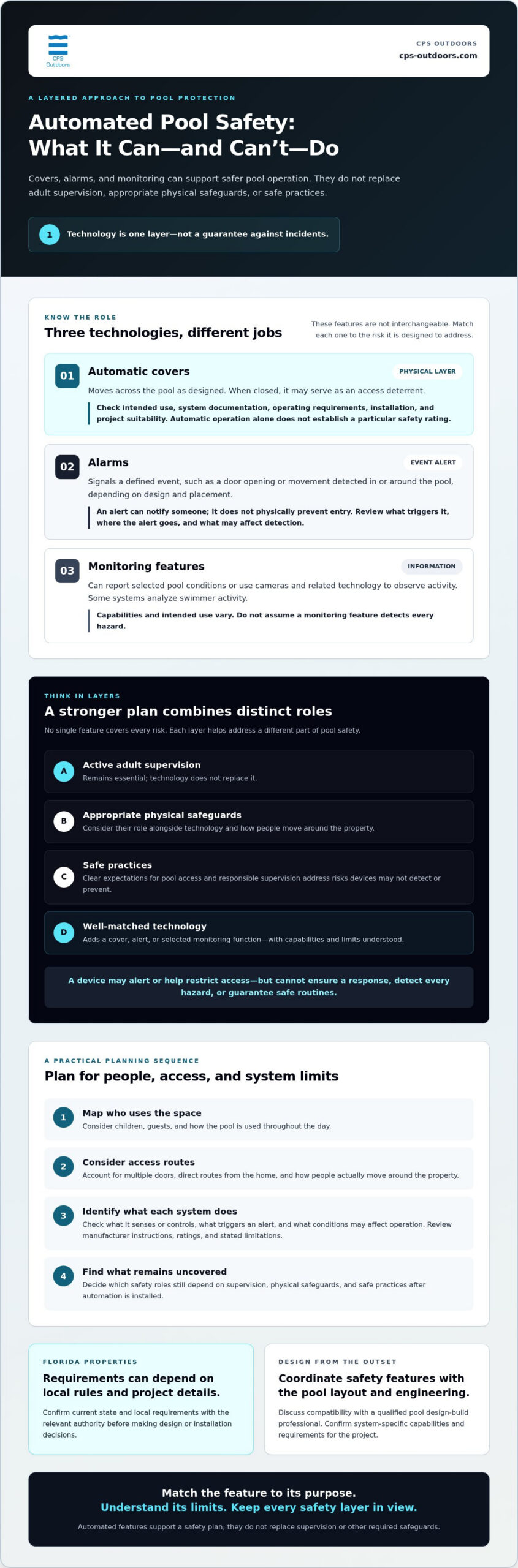
Convenient safeguards can support more considered pool operation, especially in a custom outdoor environment. But no single feature removes every risk. Automated pool safety solutions are technology-assisted features designed to support safer pool operation, not guarantees that an incident cannot occur. Their value depends on matching the feature to the property and understanding its limits.
A sound safety plan is layered. Active supervision, appropriate physical barriers, safe practices, and well-matched technology each play a distinct role. A device may provide an alert or help restrict access, but it cannot ensure that someone responds, that every hazard is detected, or that safe routines are followed.
What counts as an automated pool safety feature?
Automatic covers, alarms, and monitoring features serve different purposes, so they aren’t interchangeable. An automatic cover opens or closes over the pool as designed, helping secure the water when the pool isn’t in use. Its suitability and safety performance depend on the specific system, installation, and operating instructions.
Alarms are intended to signal a defined event, such as a door opening or movement detected in or around the pool. Monitoring features can track selected pool conditions or use cameras and related technology to observe activity. Some drowning detection systems analyze swimmer activity, but their capabilities and intended use vary. None should be assumed to detect every hazard.
Before selecting a feature, check what it senses or controls, what triggers an alert, and what conditions may affect operation. Review the manufacturer’s instructions, system ratings, and stated limitations as part of that assessment.
Why automation is only one layer of pool safety
Technology doesn’t replace active supervision or appropriate physical safeguards. A notification is useful only if it reaches someone who can respond, and a barrier is effective only as part of a plan that accounts for how people actually move around the property. Children, guests, multiple doors, and direct routes from the home to the pool can all influence the design.
Safe practices matter, too. Clear expectations for pool access and responsible supervision help address risks that a device may not detect or prevent. Consider how the pool is used throughout the day, who can reach it, and which safety roles remain uncovered after automation is installed.
For Florida properties, confirm current state and local requirements with the relevant authority before making design or installation decisions. A qualified pool design-build professional can help coordinate features with the pool layout and engineering. Verify system-specific capabilities and requirements for the project.
How Automatic Covers, Alarms, and Monitoring Features Work
These systems serve different purposes. An automatic cover creates a physical layer over the water when deployed, an alarm signals a particular event, and a monitoring feature provides information or alerts about selected conditions. Understanding the distinction helps homeowners evaluate automated pool safety solutions without assuming one device performs every safety function.
Automatic pool covers as a controlled physical layer
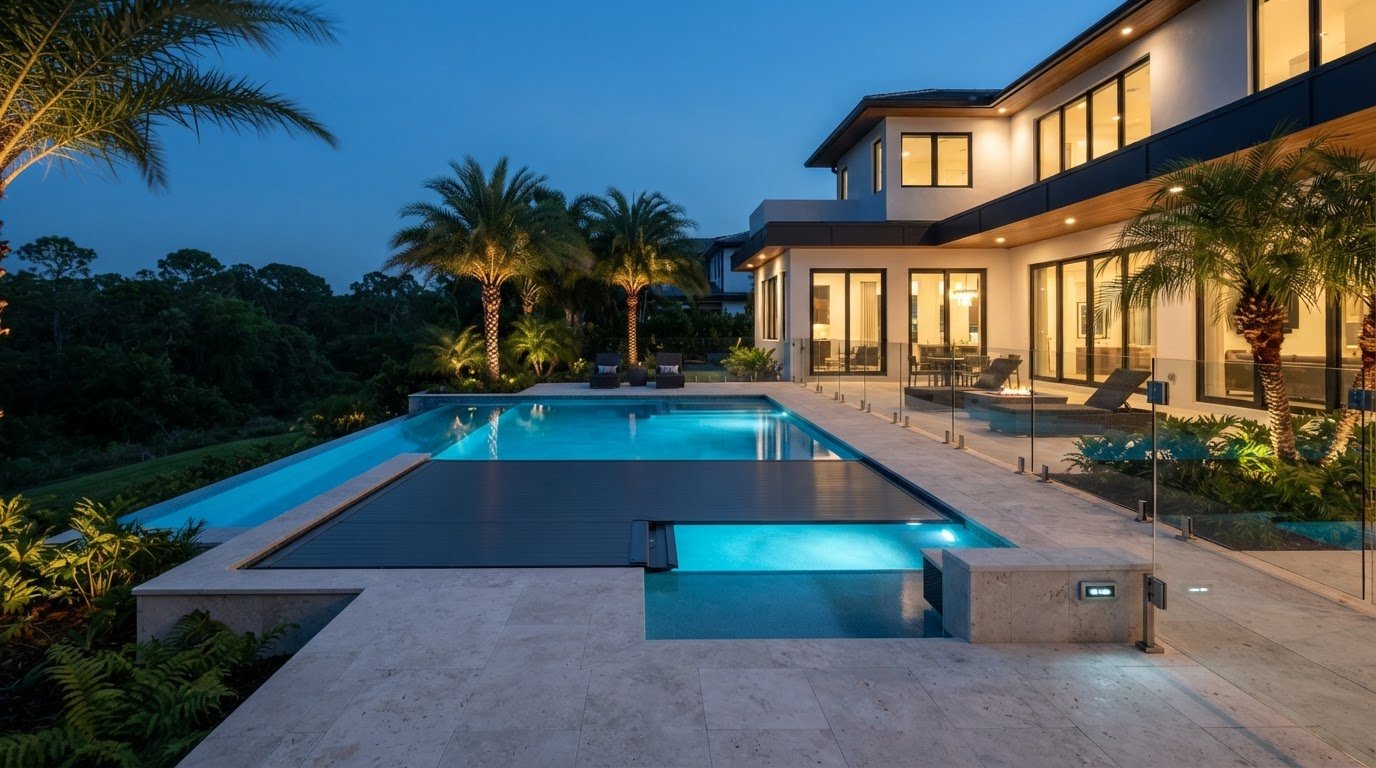
An automatic pool cover moves across the pool using its operating mechanism, following the system’s instructions for deployment and retraction. When closed, it may serve as an access deterrent, but automatic operation alone doesn’t establish that a cover is designed or rated for a particular safety purpose. Covers differ in construction, intended use, and limitations.
Before selecting a cover, ask the manufacturer and installer to clarify its intended use, operating requirements, documentation, and suitability for the project. The U.S. Consumer Product Safety Commission’s CPSC safety barrier guidelines offer additional context on barriers and safety covers, but the specifications of a particular system still need to be confirmed for the pool.
Pool alarms and monitoring: alerts are not barriers
An alarm detects or responds to a defined trigger, which may relate to a door, movement in the water, or another condition, depending on its design and placement. A door alert, for example, may notify someone when a pool-access point is opened, but it doesn’t physically prevent entry. Review what activates the alarm, where the alert is delivered, and what conditions may affect detection.
Monitoring systems can support awareness by reporting selected pool or activity conditions. Some pool automation also manages operational functions, such as equipment settings, but controlling pool operations isn’t the same as preventing access or identifying every hazard. Connectivity, power, configuration, and response time may affect how a connected feature works. Check the manufacturer’s instructions and operating limits rather than assuming a system is continuously connected or monitored.
In brief: covers provide a deployable physical layer, alarms signal defined events, and monitoring systems provide information about selected conditions. None should be treated as interchangeable or as a substitute for other safeguards. For custom construction or renovation, discuss how cover integration and equipment selection fit the pool’s design and engineering with a professional experienced in custom pool design and engineering.
Comparing Automated Pool Safety Options Without Overestimating Them
No automated feature can guarantee a safe pool. The practical question is which roles your design needs covered and how different safeguards can complement one another. Use this comparison as a starting point, not a universal ranking. The right combination depends on the pool, its access points, and the people who use the property.
| Layer | Primary role | Potential strength | Limitation to consider |
|---|---|---|---|
| Automatic cover | Creates a physical layer over the pool when deployed | Can help deter access while the pool is closed | Suitability and safety performance depend on the specific system, installation, and instructions |
| Alarm | Signals a defined event, depending on its design and placement | Can draw attention to a detected event or access point | It alerts rather than physically restricting access; triggers and response vary |
| Monitoring feature | Provides information or alerts about selected conditions or activity | Can support awareness of what the system is designed to monitor | May not detect every hazard, and connectivity or settings can affect operation |
| Physical barrier | Separates the pool area from surrounding spaces | Can help manage access independently of an alert or powered device | Design, condition, gates, and actual use affect its role |
| Supervision and safe access practices | Guide people’s behavior around the pool | Address human decisions and attention | Require consistent participation; technology cannot provide them |
Which safety feature addresses which concern?
Consider a residential pool with several routes from the home and regular visits from family and guests. A cover may serve as a physical layer when the pool is closed, a barrier can help manage access, and an alarm may alert someone to a defined event. Clear household expectations and active supervision remain essential. Each layer has a different function, so don’t assume any one of them will prevent a particular incident.
Organizations such as the Royal Life Saving Society UK describe a range of pool safety technology. That range reinforces the importance of identifying what a system is designed to sense or do, rather than treating all automated options as equivalent.
What to verify before relying on a system
Check the intended application, user instructions, installation conditions, and documented limitations. Confirm who will operate the feature and how household members, guests, or other property users will understand its role. If a product cites a standard, rating, or compliance status, verify the documentation for that specific system and confirm applicable requirements with the relevant Florida or local authority. Don’t assume a product label alone establishes suitability or compliance for your property.
Planning Automated Pool Safety for a Florida Property
Good planning begins with the people and movement patterns around the pool, not a product list. Children, guests, household routines, and multiple routes from the home or yard can all affect which safeguards are appropriate. Mapping these details early gives your design team a clearer basis for coordinating automated pool safety solutions with the property.
Questions to answer before choosing a system
Walk the routes between the home, yard, pool deck, and any other area that could provide access to the water. Note doors, gates, entertaining spaces, and places where children or guests may move between indoor and outdoor areas. Then identify who will operate each feature, who will inspect it, and who is responsible for following its instructions.
Ask manufacturers and qualified professionals for written guidance on intended use, operating limits, installation conditions, and maintenance. This helps clarify what a device is designed to do and what it requires from the people using it. Use these steps to organize the review:
- Identify regular users, occasional guests, and the level of supervision the pool’s use requires.
- Map every access route and decide what role each safeguard should serve.
- Confirm who will operate and inspect each system, and how users will learn its procedures.
- Request product documentation and maintenance guidance before making a selection.
Florida requirements and project coordination
Confirm current state and local requirements with the relevant authority having jurisdiction. Requirements can depend on the project and location, so don’t assume a particular feature or product label establishes compliance. Verify any stated standard or rating against the specific system documentation and the requirements that apply to your property.
Bring safety decisions into the design brief, not just the handover checklist. Planning safety during design allows access, equipment, and pool features to be coordinated before construction details are fixed. For example, an automatic cover’s operation may influence how the pool is configured, while equipment placement, circulation planning, and deck layout need to work together with the intended use of the space. Discussing these elements early can help surface practical constraints before they become harder to address.
For broader context on shaping a Florida pool project around its site and intended use, see The Art of Bespoke Aquatic Architecture. If you’re planning a custom pool or renovation, discuss pool safety integration with CPS Outdoors as part of the design and engineering process.
Integrating Automated Safety Into a Custom Pool Design
Automated features are most useful when considered alongside the pool’s architecture, engineering, and intended use. Adding equipment after major design decisions are set can limit placement options or introduce coordination challenges. For a new build or renovation, discuss the desired role of each feature early, then verify its requirements with the manufacturer and the professionals responsible for the project.
Coordinate the feature with the pool architecture
Pool geometry, surrounding surfaces, access routes, and how the space will be used all influence which systems may be suitable. An automatic cover, for example, needs to be considered in relation to the pool layout and its operating system. CPS Outdoors incorporates automatic pool covers into custom pool projects, but a specific system’s suitability and safety performance must be verified for the project.
Ask the design-build team which product specifications and installation conditions need to shape the design. Discuss how a selected feature may relate to the deck, nearby access points, and equipment placement. Circulation design also needs to be coordinated with the pool’s equipment plan. Architectural integration can support a coherent project, but it doesn’t establish regulatory compliance or certified safety performance.
Moveable pool floors also call for project-specific engineering and manufacturer information. Before assigning a safety function to one, request documentation on its intended use, operating conditions, and limitations. Don’t assume a feature’s appearance or movement alone establishes how it performs as a safeguard.
What to discuss with a pool design-build professional
For each proposed system, request a clear explanation of its function, operating steps, limitations, and ongoing care. Establish who is responsible for coordinating the product, installation, testing, and handover instructions. Confirm what documentation will be provided and which details require verification with the manufacturer or relevant authority.
For an existing pool, the same review can help determine how a proposed upgrade relates to current geometry, access, and equipment. The article Luxury Pool Renovation in South Florida offers additional context for planning an upgrade. Automated pool safety solutions should be selected as part of a broader project plan, not treated as stand-alone assurances.
Florida homeowners planning a custom pool or renovation can discuss how pool design and engineering, automatic covers, and other project features may fit their goals with CPS Outdoors. The right questions, raised early, help align the design intent with system requirements and user expectations.
Build Safety Into the Pool From the Start
Automated pool safety solutions are most useful when their roles and limitations are clear. Covers, alarms, and monitoring features serve different purposes, and none replaces active supervision, appropriate barriers, or safe access practices. The right plan begins with the people who use the pool, the routes they take, and the features that suit the property.
Coordinate those decisions during design or renovation, not only at handover. Confirm system documentation and operating requirements, and check applicable Florida and local requirements with the relevant authority. Early planning also helps align equipment selection with pool geometry, access, and intended use.
CPS Outdoors provides custom pool design and engineering for residential and commercial aquatic projects in Florida, with confirmed capabilities that include automatic pool covers and moveable pool floors. Each feature’s suitability depends on project-specific review. To explore how safety considerations can fit into your pool plans, discuss your custom pool project with CPS Outdoors. Thoughtful coordination can help you move forward with greater clarity and confidence.
Frequently Asked Questions
Are automated pool safety solutions a replacement for a pool fence or supervision?
No. Automated pool safety solutions can support a broader safety plan, but they don’t replace active supervision or appropriate physical safeguards. A cover, alarm, or monitoring feature has a specific function and limitations, so assess what it actually does rather than treating it as comprehensive protection. Consider who uses the pool, how people reach it, and which safeguards address those access patterns. Florida homeowners should confirm applicable requirements with the relevant authority.
Do automatic pool covers make a pool safe when nobody is using it?
Not automatically. A cover’s suitability and safety performance depend on its design, intended use, installation, and operating instructions. Confirm with the manufacturer and installer whether a specific cover is intended for the role you have in mind, and review its documented limitations. A cover also doesn’t replace supervision when people are using the pool or other safeguards that may apply to your property. Don’t assume every automatic cover is safety-rated.
What is the difference between a pool alarm and an automatic pool cover?
An automatic pool cover is deployed over the pool and may serve as a physical layer when closed, subject to its system specifications and intended use. A pool alarm signals a defined event, such as activity or an access point opening, depending on its design and placement. An alarm alerts; it doesn’t physically restrict access. Compare their functions and limitations, then decide what roles your pool’s broader safety plan still needs to address.
Can automated pool safety systems be added to an existing pool?
Some features may be suitable for an existing pool, but compatibility depends on the system and the pool’s configuration. Pool geometry, surrounding surfaces, access routes, and equipment placement can affect what can be integrated. Before choosing a feature, ask a qualified pool design-build professional and the manufacturer to assess installation conditions, operating requirements, and limitations. For a renovation, coordinate the proposed system with the project design rather than assuming it will fit as-is.
How do I choose an automated pool safety solution for a Florida home?
Start by identifying pool users, including children and guests, and mapping how they could reach the water from the home, yard, and deck. Then decide whether you need a feature that creates a physical layer, alerts someone to a defined event, or supports monitoring. Compare product documentation and operating limits, and confirm current Florida and local requirements with the relevant authority. A qualified professional can help assess fit within your pool design.
Do pool safety requirements vary by location in Florida?
Requirements may depend on the project and its location, so don’t assume information for one Florida property applies to another. Before selecting or installing a safety feature, confirm current state and local requirements with the authority having jurisdiction for your property. Ask what documentation may be needed for the specific system and project. A product rating or manufacturer description alone shouldn’t be treated as confirmation that local requirements are met.
What should I ask a pool builder about automated safety features?
Ask what each feature is designed to do, how it operates, and what limitations or maintenance needs the manufacturer documents. Clarify which product specifications affect pool geometry, equipment placement, access, and installation. Also ask who coordinates the system, handles installation and testing, and explains operation at handover. In Florida, confirm applicable requirements with the relevant authority. For a custom pool or renovation, discuss how safety features can be incorporated into design and engineering early.