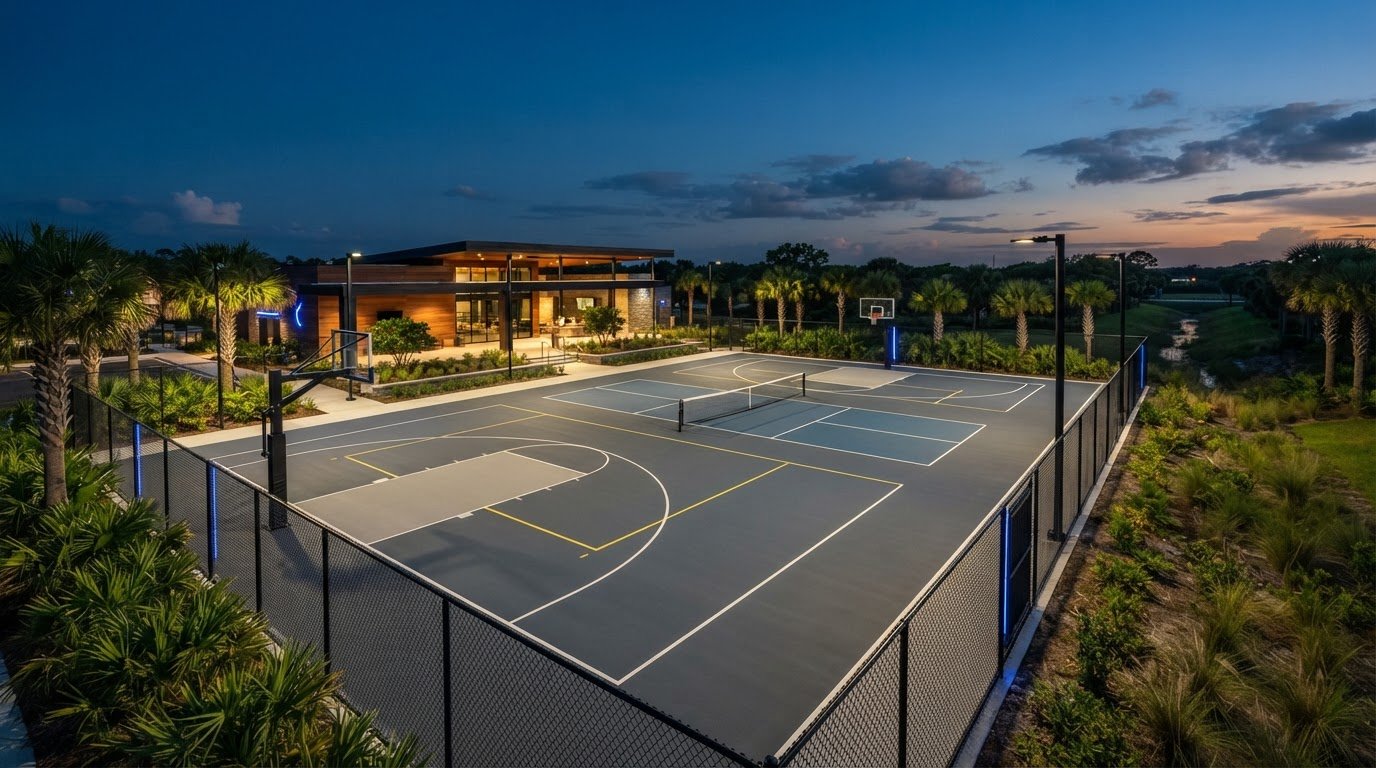
A court designed for multiple sports is not automatically practical for all of them. In commercial multi sport court construction Florida projects, the right layout depends on who will play, which sports matter most, and whether overlapping lines and play zones make each activity easy to use.
Sports and surfacing are only part of the decision. Florida’s sun, heavy rain, drainage, soil conditions, and coastal exposure can also affect site planning and construction. A useful project brief brings these considerations together before design decisions are made and responsibilities are assigned.
This guide explains how to define users, priority sports, schedules, and operating requirements; which site and surface questions need professional assessment; and what to ask when comparing project partners. It also covers line plans, construction scope, and proposal comparisons, so you can make decisions based on how the court will actually be used.
Key Takeaways
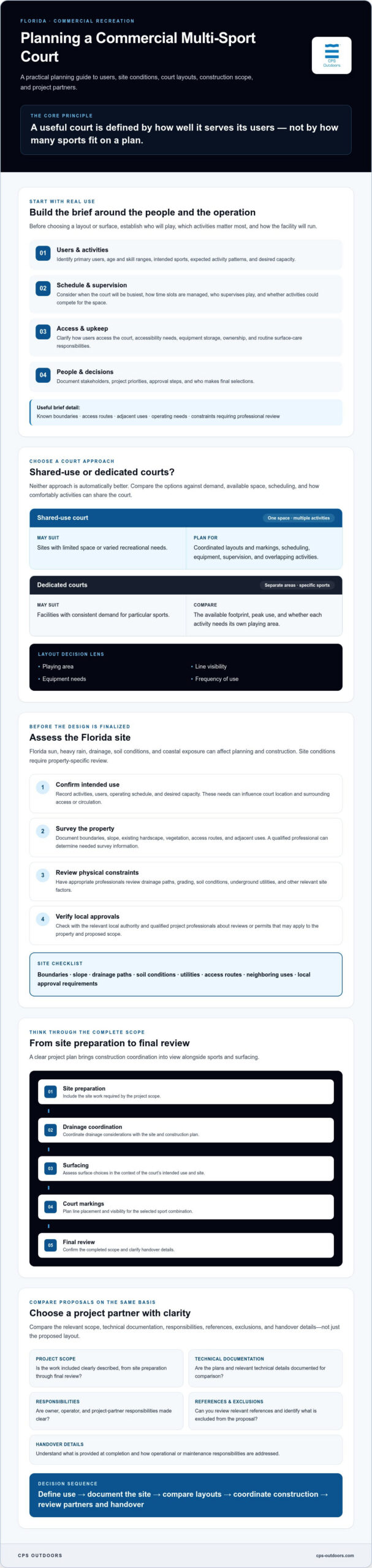
- Build the project brief around the people who will use the court, their priority sports, and the facility’s operating needs.
- Before design, define the intended use, document the site, identify constraints, and check local approval requirements.
- Compare sport combinations by playing area, line visibility, equipment needs, and how often each activity will be played.
- Plan commercial multi sport court construction Florida projects around site preparation, drainage coordination, surfacing, markings, and final review.
- Compare project partners on relevant scope, technical documentation, responsibilities, references, exclusions, and handover details.
What Commercial Multi-Sport Court Construction in Florida Needs to Deliver
Start with the facility’s operating priorities, not the number of sports that might fit on a plan. Who will play? Which activities are essential, and when will the court be busiest? A school serving different age groups may need to plan for capacity and supervision differently from a club scheduling organized play or a hospitality property offering casual recreation.
A commercial multi-sport court is one planned playing space configured for multiple activities and user groups. Its sport count matters less than whether each activity can be used safely, clearly, and practically.
A shared-use court fits several activities into one footprint, often with coordinated layouts and markings. Separate dedicated courts give each sport its own playing area. Neither approach is automatically better. A shared court may suit a site with limited space or varied recreational needs. Dedicated courts may be a better fit when demand for particular sports is consistent. Consider peak use, scheduling, equipment storage, supervision, and whether users can manage overlapping activities comfortably.
Which Florida facilities may benefit from a shared-use court?
Schools, parks, clubs, HOAs, and hospitality properties may consider shared-use courts when one space needs to serve different groups. The operating model shapes the brief. Children and adults may need distinct time slots, while beginners and experienced players may use the space differently. If demand peaks at the same time, the schedule may need to prevent activities from competing for the court. Decide who supervises play, how users access the space, and who handles routine surface care. For background on shared-use spaces, see this overview of a multi-use games area (MUGA).
What belongs in a commercial court project brief?
A focused brief helps owners, operators, and prospective project partners assess the same priorities. For commercial multi sport court construction Florida facilities, document:
- Use: Intended sports, primary users, age and skill ranges, expected activity patterns, and desired capacity.
- Site context: Known boundaries, access routes, adjacent uses, and constraints that need professional review.
- Operations: Scheduling approach, supervision expectations, accessibility needs, ownership, and maintenance responsibilities.
- Decision-making: Project priorities, key stakeholders, approval steps, and who will make final selections.
These details help determine whether a shared layout is more suitable than dedicated courts and keep early discussions grounded in actual use. They also give project professionals the context to assess the site and identify which design choices need further review.
How to Assess a Florida Commercial Court Site Before Design
A court concept may look feasible on a plan but encounter complications on site. Before selecting a layout or surface, assess the property, identify questions for qualified professionals, and check which local approvals may apply. This groundwork helps owners compare proposals based on the same site information rather than different assumptions.
- Confirm intended use. Record the planned activities, expected users, operating schedule, and desired capacity. These needs influence where the court should sit and what access or circulation may be required around it.
- Survey the site. Document boundaries, slope, existing hardscape, vegetation, access routes, and adjacent uses. A qualified professional can determine what survey information the project needs.
- Assess physical constraints. Have appropriate professionals review drainage paths, grading, soil conditions, underground utilities, and other relevant site factors before finalizing design decisions.
- Verify approval requirements. Ask the relevant local authority and qualified project professionals which reviews or permits may apply to the property and proposed scope.
Site checklist: What are the boundaries, slopes, drainage paths, soil conditions, utilities, access routes, neighboring uses, and local approval requirements?
Which site conditions can change a Florida court plan?
Florida’s rainfall, heat, humidity, and storm exposure are planning considerations, but they do not predict how a particular site will perform. Sun exposure, wind, nearby buildings, and vegetation may affect court location and intended use. Wetlands, flood concerns, easements, or utilities can also influence feasibility where present. Flag these conditions early for qualified local review rather than assuming they can be resolved without assessment.
Drainage and grading need project-specific attention. Water moving across or around a proposed court can affect site planning and the work required. Soil conditions and existing hardscape may also shape professional recommendations. A generic detail or a neighboring property’s solution is not a substitute for assessing the actual site.
Who should verify permitting and technical requirements?
Approval requirements can depend on jurisdiction, project scope, and site conditions. The owner, designer, contractor, and relevant local authority should coordinate early on what information is needed, who will prepare or review it, and which responsibilities each proposal includes. Confirm requirements for the specific property. A general checklist cannot establish that a particular permit applies or predict approval timing.
When comparing commercial multi sport court construction Florida proposals, ask each provider to state the site assumptions behind its scope and identify assessments or approvals that remain unresolved. To review a sports-surface provider’s offerings, explore CPS Outdoors’ multi-sport flooring.
How to Compare Multi-Sport Court Layouts and Surface Options
A shared court does not have to give every sport equal priority, but its layout needs deliberate planning. Identify which activities the facility will support most often, then assess whether occasional uses fit without compromising visibility, movement, equipment placement, or the experience of primary users.
For example, a facility prioritizing basketball with occasional pickleball should review how the smaller-court markings fit within the main layout and whether players can quickly distinguish the active boundaries. The right configuration depends on actual court dimensions, planned equipment, user patterns, and professional review. Do not choose a layout simply because several sports can technically be marked on one surface.
How should a facility prioritize sports on one court?
Separate primary sports from occasional activities before deciding on line colors or surface options. Ask qualified designers to review playing areas, orientation, overlapping markings, and equipment clearances for each planned use. Too many competing lines can make boundaries harder to read. A clear hierarchy and considered marking plan help users identify which layout applies to each activity.
What should buyers ask about sports surfacing?
Request documentation on the proposed surface’s intended uses, care requirements, repair considerations, and suitability for the site’s environmental exposure. Ask suppliers to explain how their recommendations relate to expected activities and user patterns. Then compare technical support and included scope, not just general performance language. Verify claims about traction, drainage, and other performance characteristics against project specifications rather than assuming they apply to every site.
A comparison table can make the questions clear before proposals are finalized. It will not choose a surface by itself, but it can reveal missing details and assumptions that need clarification.
| Decision area | Questions to compare |
|---|---|
| Intended sports | Which activities are primary, and which are occasional? Does the proposed playing area serve each as intended? |
| User needs | How will age, skill level, and expected use affect layout clarity and the surface recommendation? |
| Markings and equipment | Are lines distinguishable? Have equipment placement and activity-specific clearances been reviewed? |
| Site exposure | How has the proposal accounted for relevant sun, rain, humidity, wind, or coastal exposure? |
| Maintenance | What routine care and repairs may be required, and which party is responsible? |
There is no universally correct surface or sport combination. For commercial multi sport court construction Florida projects, recommendations should follow verified site conditions, intended activities, and documented product suitability. Compare proposals using equivalent assumptions, written specifications, maintenance guidance, and clearly defined responsibilities.
What to Expect During Commercial Court Construction in Florida
Construction is best understood as a planning framework, not a guaranteed sequence or a promise about what any one provider will deliver. For commercial multi sport court construction Florida projects, scope and sequencing depend on site findings, design decisions, approvals, and the responsibilities assigned to each party. Clarify those dependencies before work begins.
A project may include these phases:
- Design coordination: Confirm the selected court layout, intended uses, drawings, surface specifications, and responsibilities among the owner and project professionals.
- Site preparation: Coordinate access and prepare the site according to project documents and the findings of professional assessments.
- Base and drainage work: Complete the specified groundwork and drainage components before surfacing proceeds. The details need to suit the site and approved design.
- Surfacing and markings: Install the agreed surface and apply the planned sport markings, with equipment coordination addressed in the project scope.
- Final review: Confirm completion checks, resolve open items, and clarify what documentation or handover information the owner will receive.
Access limitations, nearby facility operations, weather exposure, and coordination with other site work can affect these stages. Florida conditions may influence sequencing, but their effect on timing can only be assessed for the specific project. Do not rely on a fixed schedule until the scope, approvals, and construction conditions have been reviewed.
Which construction milestones should owners review?
Before work starts, review approved drawings, scope boundaries, surface specifications, exclusions, and responsibilities. Ask how changed conditions or proposed scope adjustments will be documented and approved. Before closeout, confirm which completion checks apply and what handover information the project team will provide, including any care guidance or records in the agreed scope.
How can a Florida facility prepare for construction?
Agree on site access, work-hour expectations, user notifications, and protection of adjacent areas before mobilization. Identify who is responsible for local approvals, inspections, and technical coordination for this project rather than assuming these tasks are included. Confirm which owner decisions are needed at each milestone so unresolved selections do not delay the next phase.
Clear coordination helps owners understand what is included and where responsibilities pass between parties. To discuss a project and determine whether CPS Outdoors’ multi-sport flooring offering may fit its needs, contact CPS Outdoors about multi-sport flooring.
How to Select a Commercial Multi-Sport Court Partner in Florida
The best proposal is not necessarily the longest or most polished. Look for one that connects the intended sports and site conditions to a defined scope, documented assumptions, and clear responsibilities. For commercial multi sport court construction Florida projects, comparing proposals on equal terms makes gaps easier to spot before making a commitment.
What should a commercial court proposal make clear?
Use the same project brief when requesting and reviewing proposals. Check that each document addresses:
- Intended use: Sports, primary users, expected activity patterns, and desired capacity.
- Site assumptions: The site information the proposal relies on and any conditions that still need assessment.
- Defined scope: Included surface work, markings, and related work, with exclusions stated plainly.
- Technical documentation: Relevant specifications and supporting information for the proposed scope and intended uses.
- Responsibilities: The parties responsible for design, engineering, permitting, construction, and coordination. Confirm what is included rather than assuming one provider covers every phase.
- Completion and handover: The checks, documentation, and care information expected at project closeout.
Then compare like for like. If one proposal assumes site preparation is complete and another includes it, their totals and responsibilities are not directly comparable. Ask each provider to clarify scope boundaries, exclusions, unresolved site assumptions, change documentation, relevant references, and whether examples match your project type and scope.
When is CPS Outdoors a potential fit?
CPS Outdoors offers pickleball courts and multi-sport flooring as part of its outdoor living and sports-surface installations. The company specializes in custom aquatic and outdoor living construction, including commercial aquatic projects. Its sports-surface offerings make it worth discussing a commercial court project with the company, while the specific scope and technical fit should be confirmed directly.
Before requesting a proposal, share the project brief and ask CPS Outdoors to confirm whether it can address the intended commercial scope, your Florida location, and the relevant technical options. Verify which responsibilities are included, what documentation is available, and whether references align with the work being considered. This helps you assess fit without assuming unconfirmed capabilities.
Have a project brief ready? Discuss your commercial court project with CPS Outdoors and confirm the potential scope and fit before requesting a proposal.
Set the Project Up for a Confident Next Step
A successful court plan starts with a clear purpose. Define who will use the space, which sports take priority, and how the facility will operate. Bring site conditions, surface needs, and approval questions into the conversation early. These decisions help you compare proposals on equal terms, including assumptions, scope, responsibilities, and handover details.
Thoughtful commercial multi sport court construction Florida planning is not about fitting the most activities into one footprint. It is about choosing a layout and project approach that suit the users, property, and operating priorities.
CPS Outdoors offers multi-sport flooring and pickleball courts, along with custom design-build services for outdoor environments. For a commercial court project in Florida, discuss the intended scope and technical needs directly with the company. Discuss your commercial multi-sport court project and share your brief to explore whether its offering aligns with your needs.
Frequently Asked Questions
What sports can share a commercial multi-sport court?
Basketball, pickleball, tennis, and volleyball are examples of sports that may be planned for a shared court. The right combination depends on available playing area, user demand, equipment needs, and whether markings for different activities can remain clear. Prioritize the sports people will use most, then assess whether occasional activities fit without confusing lines or conflicts with equipment placement. Have a qualified designer review the proposed configuration.
How do you plan a multi-sport court for a Florida facility?
Start by defining primary users, priority sports, expected activity patterns, and desired capacity. Then document site boundaries, access, adjacent uses, and known constraints for professional review. For commercial multi sport court construction Florida projects, drainage, grading, soil, utilities, weather exposure, and local approval requirements also need project-specific assessment. Use this information to compare layouts, surface proposals, responsibilities, exclusions, and operational needs before selecting a scope.
Does a multi-sport court compromise performance for individual sports?
It can if the layout gives every sport equal priority without considering how the court will be used. Overlapping lines may affect visibility and user confidence, while playing areas and equipment needs can conflict. A deliberate plan can reduce these trade-offs by distinguishing primary from occasional sports and reviewing markings, orientation, and clearances. If one sport dominates use or requires dedicated dimensions, consider whether a separate court is a better fit.
What surface is best for a commercial outdoor court in Florida?
There is no single surface that is best for every Florida court. Suitability depends on intended sports, user needs, site conditions, sun and rain exposure, drainage, and maintenance expectations. Ask suppliers for documentation on intended uses, care, repair, and environmental suitability, then have the proposed option reviewed against project specifications. Verify performance claims such as traction and drainage for the actual site instead of relying on broad marketing descriptions.
How much does commercial multi-sport court construction cost in Florida?
There is no reliable project price without a defined scope and site assessment. Costs can depend on court dimensions, site preparation, drainage and base requirements, the selected surface, markings, and which responsibilities are included in the proposal. Request itemized, comparable proposals that list assumptions, exclusions, and work not included. This clarifies the basis of each estimate without treating a general price range as a project-specific quote.
Do commercial multi-sport courts in Florida require permits?
Permits are required for construction of new sports courts in Florida, but specific requirements vary by city and county. Local reviews may consider matters such as drainage and setbacks, depending on the jurisdiction and project. Before work begins, confirm applicable permits and approval steps with the relevant local authority and qualified project professionals. Do not assume that the same requirement or approval process applies across Florida or to every site.
How long does it take to build a commercial multi-sport court?
There is no dependable schedule without reviewing the project scope, site, approvals, and construction conditions. Design coordination, site preparation, base and drainage work, surfacing, and markings may each depend on prior decisions or completed work. Weather exposure, access, adjacent operations, and site findings can also affect sequencing. Ask providers to explain schedule assumptions, owner decision points, and factors that could change the proposed timeline.