What if your resort’s most ambitious architectural statement was also its greatest hidden liability? For developers and property managers, the fear of structural leaks or mechanical failure in high-traffic environments isn’t just a concern; it’s a potential blow to the brand’s prestige. You understand that a premium aquatic feature must be as reliable as it is beautiful. Engaging expert commercial pool engineering services is the only way to ensure your vision survives the rigors of heavy use and the specific demands of the Florida climate.
We recognize that navigating the complexities of the 8th Edition Florida Building Code while preparing for the December 2026 updates feels like a moving target. This guide will show you how to secure your investment through advanced hydraulic design, safety compliance, and superior material selection. You’ll discover how to balance bespoke luxury with operational efficiency to achieve a facility that differentiates your property and maintains its integrity for decades.
Key Takeaways
- Understand why specialized commercial pool engineering services are essential for managing complex hydraulic systems and chemical resistance that general structural engineering often overlooks.
- Learn to navigate Florida’s rigorous health and safety standards, including the transition to the 9th Edition Building Code and hurricane-resilient structural requirements.
- Compare the structural advantages of stainless steel versus concrete, specifically how modular steel vessels reduce weight loads by up to 80% for luxury rooftop installations.
- Explore how integrating advanced technology like moveable pool floors can transform single-use aquatic areas into versatile, high-ROI event spaces.
- Master the design-build workflow to bridge the gap between your conceptual architectural vision and precise technical execution.
The Role of Specialized Engineering in Commercial Aquatic Design
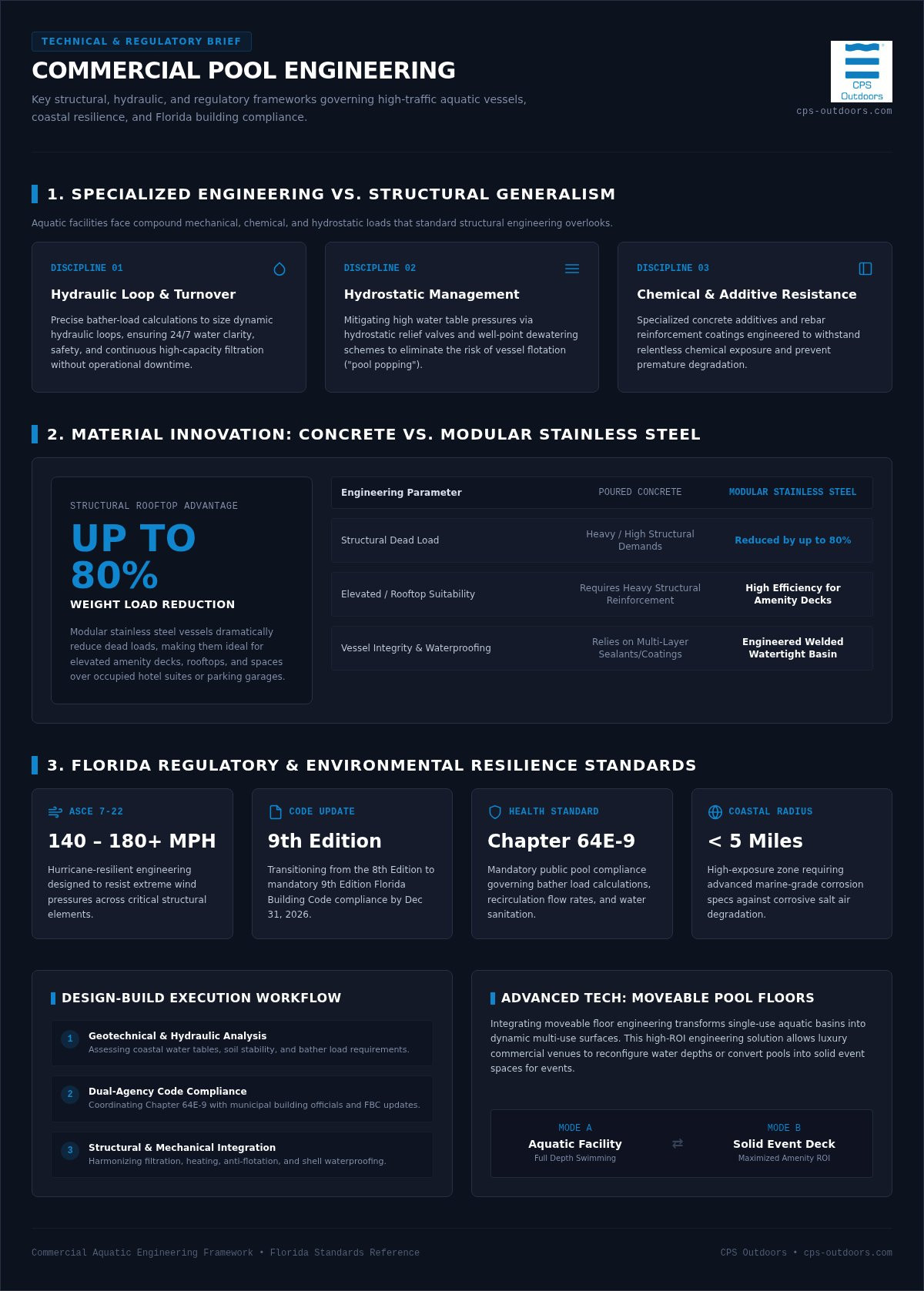
Aquatic engineering is a multi-disciplinary field that bridges the gap between architectural ambition and technical reality. It requires a precise coordination of structural integrity, mechanical systems, and complex hydraulics. Commercial pool engineering is the integration of safety, durability, and architectural vision. While a general structural engineer understands load-bearing walls, they often lack the specialized knowledge required to combat the corrosive nature of pool chemicals or the intense hydrostatic pressure of Florida’s high water tables.
Utilizing specialized commercial pool engineering services protects the facility’s lifecycle by anticipating these unique stressors. Generalists often overlook the specific concrete additives or reinforcement coatings necessary to withstand constant chemical exposure. This oversight leads to premature degradation, which can cause insurance premiums to skyrocket and result in astronomical repair costs. By investing in specialized expertise, developers ensure their aquatic features remain prestigious assets rather than financial liabilities.
Beyond the Shell: Integrated Aquatic Systems
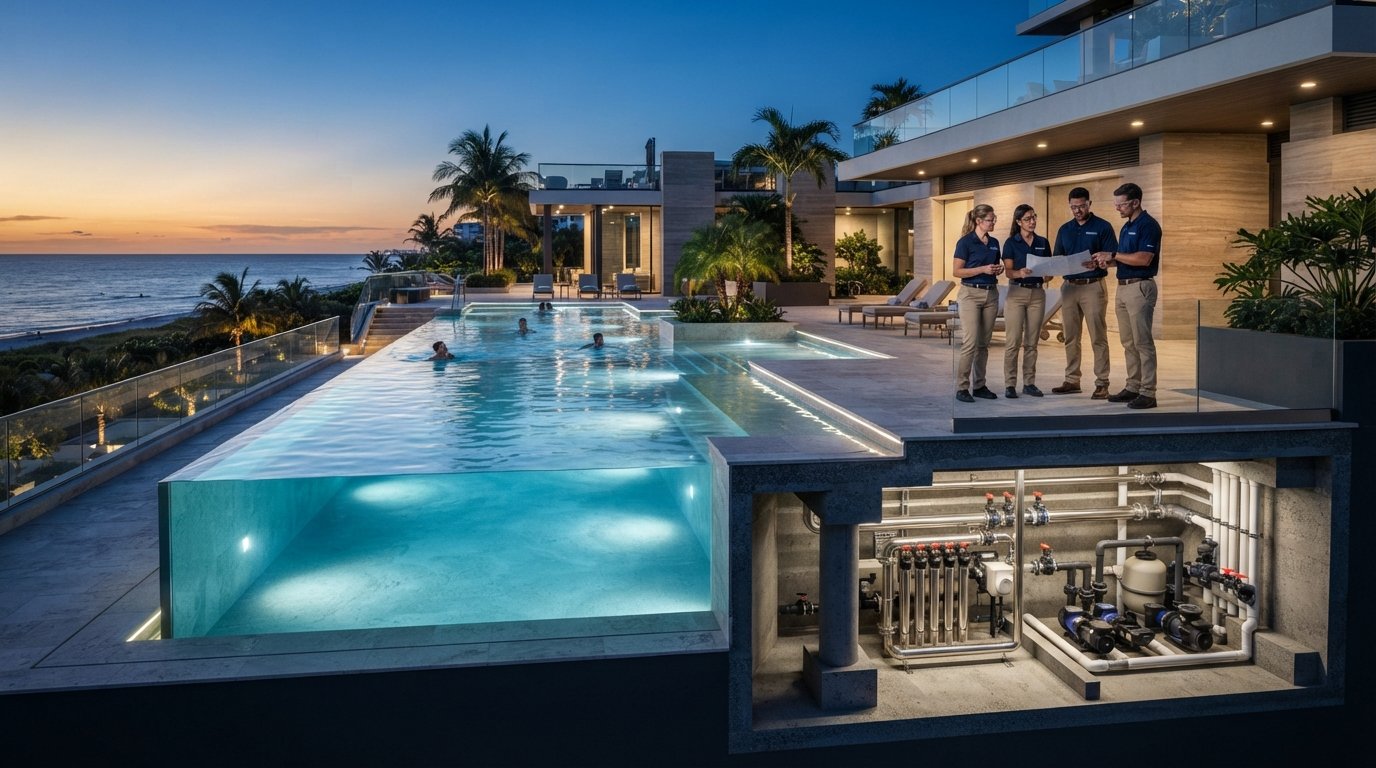
Designing a commercial pool requires more than just a waterproof container. It demands a holistic understanding of how swimming pool sanitation and filtration systems interact with the physical shell. Proper engineering ensures that heating, filtration, and structural support work in perfect synergy. For instance, engineers must specify hydrostatic relief valves and well-point dewatering schemes to prevent “pool popping,” which is a disastrous scenario where a vessel literally floats out of the ground during emergency drain-downs or high-water events. In elevated or rooftop designs, this coordination becomes even more critical. Meticulous waterproofing and structural weight calculations are vital to protect the occupied hotel rooms or parking garages situated below the amenity deck.
Engineering for High-Traffic Durability
High-traffic environments, such as luxury resorts or urban hotel decks, demand a different level of structural and mechanical rigor. Engineers must accurately calculate bather loads to determine the necessary hydraulic turnover rates for water clarity and safety. This process isn’t just about pump size; it’s about the entire hydraulic loop. Structural reinforcement for large-scale basins must account for thousands of gallons of shifting weight while maintaining 24/7 operational reliability. A well-engineered system allows for seamless performance during peak guest hours, ensuring the facility’s aesthetic appeal and safety standards never waver under pressure. Investing in professional commercial pool engineering services at the start of a project prevents the operational downtime that can devastate a property’s reputation.
Navigating Florida Building Codes and Environmental Challenges
Florida presents a demanding environment for aquatic construction. The regulatory landscape is defined by dual oversight, requiring meticulous synchronization between local municipal building officials and the state. Compliance with the Florida Department of Health public swimming pool standards under Chapter 64E-9 is non-negotiable for any commercial facility. These rules govern everything from bather load formulas to mandatory recirculation flow rates. As the industry prepares for the mandatory 9th Edition Florida Building Code update on December 31, 2026, professional commercial pool engineering services become even more vital for ensuring projects remain compliant throughout the permitting and construction phases.
Environmental resilience is equally critical. In Florida, engineering for hurricane force winds is a primary structural requirement. Facilities must be designed to resist wind pressures of 140 to 180+ mph according to ASCE 7-22 standards. Beyond the wind, the state’s shallow coastal water tables create significant hydrostatic pressure issues. Without a robust geotechnical report and the subsequent engineering of hydrostatic relief systems, even the heaviest concrete vessels are at risk of structural flotation. A disciplined approach to these environmental stressors prevents catastrophic failure and protects the property’s long-term ROI.
Coastal Engineering: Managing Salt Air and Corrosion
Proximity to the ocean introduces corrosive salt air that can degrade standard building materials in months. For facilities within five miles of the coast, engineering specifications must prioritize 316L marine-grade stainless steel and non-conductive fiberglass rebar (GFRP). These materials combat saltwater intrusion and high humidity, extending the life of the structure. For indoor natatoriums, the challenge shifts to advanced HVAC engineering. Precise air handling is necessary to maintain bather comfort and prevent “indoor rain,” a phenomenon where condensation causes chemical-laden water to drip from the ceiling, leading to rapid structural corrosion.
Compliance and Accessibility Standards
True luxury is inclusive. Integrating ADA requirements into a high-end architectural vision requires a sophisticated engineering touch. It’s about moving beyond basic ramps to create seamless, aesthetic entries that feel like an intentional part of the design. Safety features also play a vital role. Modern engineering allows for the integration of automatic pool covers that provide security and energy efficiency without disrupting the visual horizon. Navigating the complex permit process requires a partner who understands how to balance these safety mandates with the project’s aesthetic goals. Developers who consult with commercial aquatic specialists early in the process avoid the costly delays associated with mismatched state and local approvals.
Material Innovation: Concrete vs. Stainless Steel Engineering
Modern aquatic design is witnessing a decisive shift toward high-performance materials. For decades, shotcrete was the industry standard, but the demands of 2026 commercial projects have prioritized precision and longevity. Specialized commercial pool engineering services now frequently specify stainless steel pools for their superior structural attributes. This material choice isn’t just about aesthetics; it’s a strategic engineering decision that addresses the weight constraints of urban rooftop developments and the rigorous hygiene requirements of Model Aquatic Health Code standards.
Weight load is a primary concern for elevated amenity decks. Traditional concrete structures exert a deadload of 150 to 250 lbs/sq ft, whereas fully welded stainless steel vessels average only 30 to 40 lbs/sq ft. This represents an 80% reduction in structural weight. For rooftop luxury, this disparity allows architects to reduce support requirements or allocate that weight capacity to other amenities. A stainless steel vessel provides a 50-year lifecycle with negligible structural degradation, while traditional concrete requires significant resurfacing and tile repair every decade.
The Engineering of Stainless Steel Basins
Stainless steel engineering relies on modular construction and precision welding. This approach allows for rapid on-site assembly and eliminates the common failure points of traditional builds. There is no risk of concrete micro-cracking or tile delamination, which are frequent issues in high-traffic commercial environments. For a detailed technical material benchmark, developers should consult our Berndorf Baderbau vs. Stainless Steel Pools guide. These vessels arrive as pre-engineered components, ensuring the final product matches the architectural vision with millimeter accuracy.
Traditional Concrete: When and How to Engineer It Right
Concrete remains a viable choice for ground-level basins where bespoke, organic shapes are required. Engineering these structures correctly involves advanced shotcrete techniques and the integration of high-performance waterproofing membranes. Engineers must also account for the inevitable settling of massive concrete structures, especially in Florida’s varied soil conditions. Precise reinforcement and expansion joint placement prevent structural stress from turning into visible leaks. When executed with rigor, a concrete shell provides a solid foundation, though it demands more frequent aesthetic maintenance than its steel counterparts.
The Commercial Pool Design-Build Workflow
A successful aquatic project relies on a methodical progression from conceptual vision to technical execution. Unlike fragmented approaches where design and engineering are treated as separate silos, elite commercial pool engineering services integrate these disciplines from the project’s inception. This collaborative model ensures that the architectural intent is never compromised by structural limitations. It follows a disciplined five-phase process:
- Phase 1: Conceptual Engineering and Feasibility Studies: Initial assessments to align the vision with site realities and utility capacities.
- Phase 2: Detailed Hydraulic and Structural Design Documentation: Creation of precise schematics and stamped structural drawings for permitting.
- Phase 3: Coordination with MEP Teams: Seamless integration with mechanical, electrical, and plumbing professionals to support complex filtration.
- Phase 4: Construction Administration and Site Inspections: Rigorous quality control and compliance checks during the build phase.
- Phase 5: Final Certification and Operational Hand-off: Comprehensive testing and training for the facility’s management team.
Feasibility and Site Analysis
The foundation of any high-end facility is a thorough assessment of the environment. This phase involves analyzing existing utility capacities to ensure they can support commercial-grade heating and advanced filtration systems. For properties requiring a luxury infinity pool, precise topographical mapping is essential to engineer the vanishing edge and catch basin correctly. Identifying structural constraints through professional commercial pool engineering services early in the design phase prevents the design creep that often leads to budget overruns or compromised aesthetics.
Constructability and Value Engineering
Value engineering is not about cutting costs; it’s about optimizing the relationship between design and durability. We streamline hydraulic layouts and structural reinforcements to reduce material waste while maintaining the highest quality standards. This coordination extends to the surrounding environment, specifically in luxury pool hardscape design. By aligning aquatic engineering with landscape architecture, we ensure that every stone, deck level, and drainage point works in harmony. This level of detail ensures that field crews can execute the project efficiently, maintaining the timeline and the precision required for a premium result. If you’re ready to begin your project with a disciplined design-build partner, contact our team for expert commercial aquatic consulting.
Maximizing ROI with Advanced Aquatic Technology
Modern developers no longer view aquatic features as static amenities. In 2026, the focus has shifted toward creating dynamic, multi-purpose environments that generate revenue around the clock. High-end commercial pool engineering services play a pivotal role in this transformation by integrating technology that maximizes square footage and operational efficiency. Whether it’s through the visual branding of high-performance water features or the silent precision of automated dosing systems, advanced engineering ensures that your facility remains a high-yield asset.
Automation is a primary driver of long-term ROI. By integrating Building Management Systems (BMS) with cloud telemetry, resort managers can monitor flow rates and chemical levels in real time. This doesn’t just improve safety; it significantly reduces the labor costs associated with manual data logging and chemical adjustments. When your mechanical systems operate with this level of autonomy, your staff can focus on the guest experience rather than the pump room.
Moveable Floors: Engineering Square Footage
One of the most significant innovations in commercial aquatics is the moveable pool floor. These systems allow a facility to transition from a five-foot swimming depth to a dry, load-bearing terrace in minutes. This engineering feat effectively doubles the utility of the space, allowing a daytime pool deck to become a nighttime event venue or cocktail lounge. The mechanics involve a sophisticated buoyancy and drive system that maintains strict safety protocols while supporting heavy bather or event loads. For urban commercial properties where every square foot is at a premium, this vanishing technology represents a profound shift in how aquatic square footage is valued.
Sustainable Engineering for 2026
Sustainability is now a core requirement for achieving LEED certification in new developments. Advanced commercial pool engineering services utilize Variable Frequency Drives (VFDs) and variable-speed pumps to achieve 50% to 75% reductions in electrical energy consumption. Similarly, the adoption of Regenerative Media Filtration (RMF) can reduce backwash wastewater by up to 90% compared to traditional sand filtration. These systems don’t just protect the environment; they lower utility costs and minimize chemical waste. Smart water management ensures that your facility meets the highest environmental standards while maintaining the crystal-clear water quality that discerning guests expect. By prioritizing these high-efficiency systems during the design phase, developers secure a durable, low-maintenance facility that stands the test of time.
Engineering Your Aquatic Legacy for 2026 and Beyond
The standard for excellence in commercial aquatics is shifting toward a model defined by precision and longevity. As we move toward the mandatory 9th Edition Florida Building Code, relying on specialized commercial pool engineering services is a fundamental requirement for project success. You’ve seen how the integration of stainless steel vessels and moveable floor systems can transform a static amenity into a high-ROI asset. These innovations provide the structural integrity and operational flexibility required for premium hospitality brands to thrive in demanding coastal environments.
Our disciplined design-build approach ensures that your architectural vision remains uncompromised by technical constraints. With a deep understanding of Florida’s unique coastal building codes and a commitment to bespoke execution, we stand ready to bring your vision to life. Partner with CPS Outdoors for your next commercial aquatic masterpiece and ensure your facility remains a prestigious landmark for decades to come. Your property deserves the meticulous expertise that only seasoned professionals can provide.
Frequently Asked Questions
What is the difference between a pool builder and a commercial pool engineer?
A pool builder focuses on the physical execution and assembly of the facility, whereas a commercial pool engineer provides the technical design, structural calculations, and hydraulic schematics. Engaging professional commercial pool engineering services ensures that the project complies with specialized safety standards and environmental regulations before construction begins. This distinction is critical for high-stakes projects where general structural knowledge is insufficient to handle the complexities of aquatic environments.
How long does the engineering phase of a commercial pool project typically take?
The duration of the engineering phase typically ranges from eight to twelve weeks, depending on the complexity of the aquatic features and the speed of municipal reviews. This period includes conceptual feasibility studies, detailed structural documentation, and the synchronization of mechanical systems with local building codes. Projects involving advanced technology like moveable floors or rooftop installations may require additional time for precise load-bearing calculations and coordination with the broader architectural team.
Why are stainless steel pools becoming the standard for Florida rooftop developments?
Stainless steel is the preferred choice for Florida rooftop developments because it offers an approximate 80% weight reduction compared to traditional concrete. Modular stainless steel vessels exert a deadload of only 30 to 40 lbs/sq ft, significantly lowering the structural reinforcement requirements for high-rise podium decks. Additionally, 316L marine-grade stainless steel provides exceptional resistance to Florida’s corrosive salt air, ensuring a leak-proof lifespan that far exceeds traditional shotcrete or tile finishes.
How much does commercial pool engineering cost in Florida?
The cost of engineering for a commercial aquatic facility in Florida varies based on the total bather capacity and the technical complexity of the hydraulic systems. Fees are typically calculated as a percentage of the total construction budget or as a fixed fee for stamped permit drawings and hydraulic turnover calculations. Property owners should consult with a specialized firm to receive a bespoke proposal that accounts for specific site constraints and required state health department approvals.
Do commercial pools in Florida require a specific type of structural inspection?
Commercial pools in Florida are subject to dual regulatory oversight, requiring inspections from both the local municipal building official and the Florida Department of Health. Under Chapter 64E-9, the facility must pass a final inspection to receive its operating permit, which confirms the hydraulic systems meet mandatory safety and sanitation standards. Additionally, coastal projects often require specialized inspections to verify compliance with High-Velocity Hurricane Zone wind load and structural anchoring requirements.
Can a moveable pool floor be installed in an existing commercial pool?
It’s possible to integrate a moveable pool floor into an existing commercial pool during a comprehensive renovation, though it requires significant structural engineering. The process involves assessing the existing shell’s integrity and depth to accommodate the buoyancy and drive mechanisms of the new floor. Our team specializes in these complex retrofits, allowing facility managers to transform traditional single-use basins into versatile, multi-purpose event spaces that maximize the property’s revenue potential.
What are the most common structural failures in commercial aquatic facilities?
The most frequent structural failures in commercial environments include pool popping caused by hydrostatic pressure and premature shell degradation due to chemical corrosion. Without precise commercial pool engineering services, high water tables can cause an empty pool to float out of the ground, leading to catastrophic structural loss. Other common issues involve waterproofing failures in elevated designs and the delamination of tile or plaster finishes in high-traffic facilities that lack advanced material specifications.
How does commercial pool engineering impact long-term maintenance budgets?
Professional engineering directly reduces long-term maintenance costs by prioritizing durable materials and energy-efficient mechanical systems. For instance, specifying Variable Frequency Drives and regenerative media filtration can lower electrical consumption by up to 75% and reduce water waste by 90%. By investing in high-spec materials like stainless steel during the design phase, property managers avoid the recurring expenses of replastering and tile repair, ensuring a more predictable and lower operational budget.