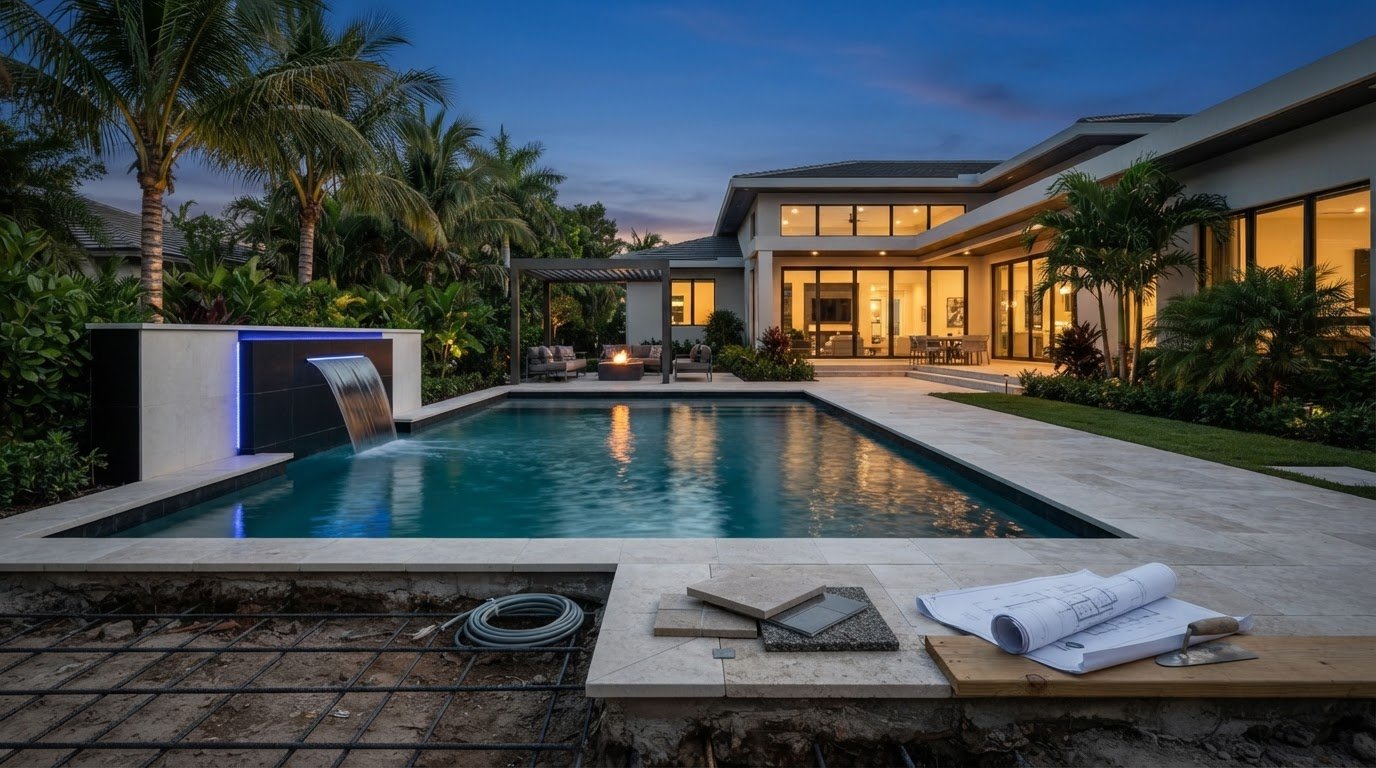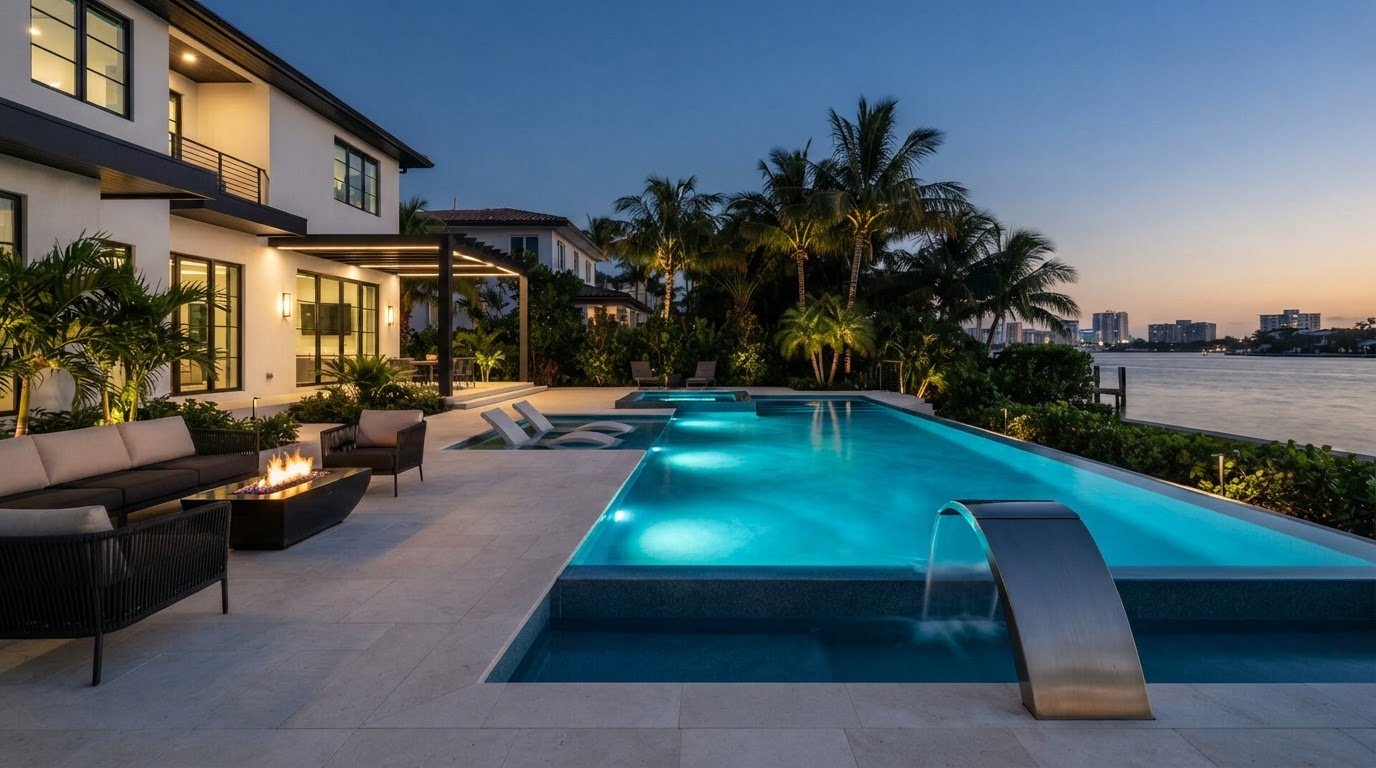
A knife edge pool is a high-stakes engineering feat where a single millimeter of error can shatter the entire visual illusion. You’ve likely seen these breathtaking perimeter overflows in luxury resorts and wondered if such a perfect mirror surface is achievable in Florida’s shifting coastal sands. It’s natural to feel concerned about hydraulic failures or the long-term integrity of a system that appears so delicate. You want the aesthetic of a seamless transition into your outdoor living space without the nightmare of a leaking masterpiece.
This guide clarifies the technical demands and architectural precision behind these sophisticated builds. By understanding the specialized requirements of knife edge pool builders Florida experts utilize, you’ll ensure your investment remains structurally sound and visually flawless. We will examine the critical role of surge tank engineering, the 2026 Florida Building Code standards for safety barriers, and why Florida’s unique limestone subgrades demand a meticulous, design-build approach to aquatic construction. Discover how precision-machined tolerances and advanced hydraulic balance turn a complex engineering challenge into a serene, permanent fixture of your home.
Key Takeaways
- Understand why precise hydraulic balance and surge tank engineering are critical for maintaining a perfectly level mirror surface.
- Identify the technical expertise required from knife edge pool builders Florida experts to ensure long-term structural integrity in coastal environments.
- Compare the architectural precision of stainless steel versus traditional concrete to determine which material suits your bespoke structural goals.
- Distinguish between infinity and knife edge designs to select the configuration that best complements your property’s unique topography.
- Learn how a comprehensive design-build approach integrates advanced features like moveable pool floors for a cohesive, luxury outdoor environment.
The Sophistication of Knife Edge Pools: More Than a Visual Statement
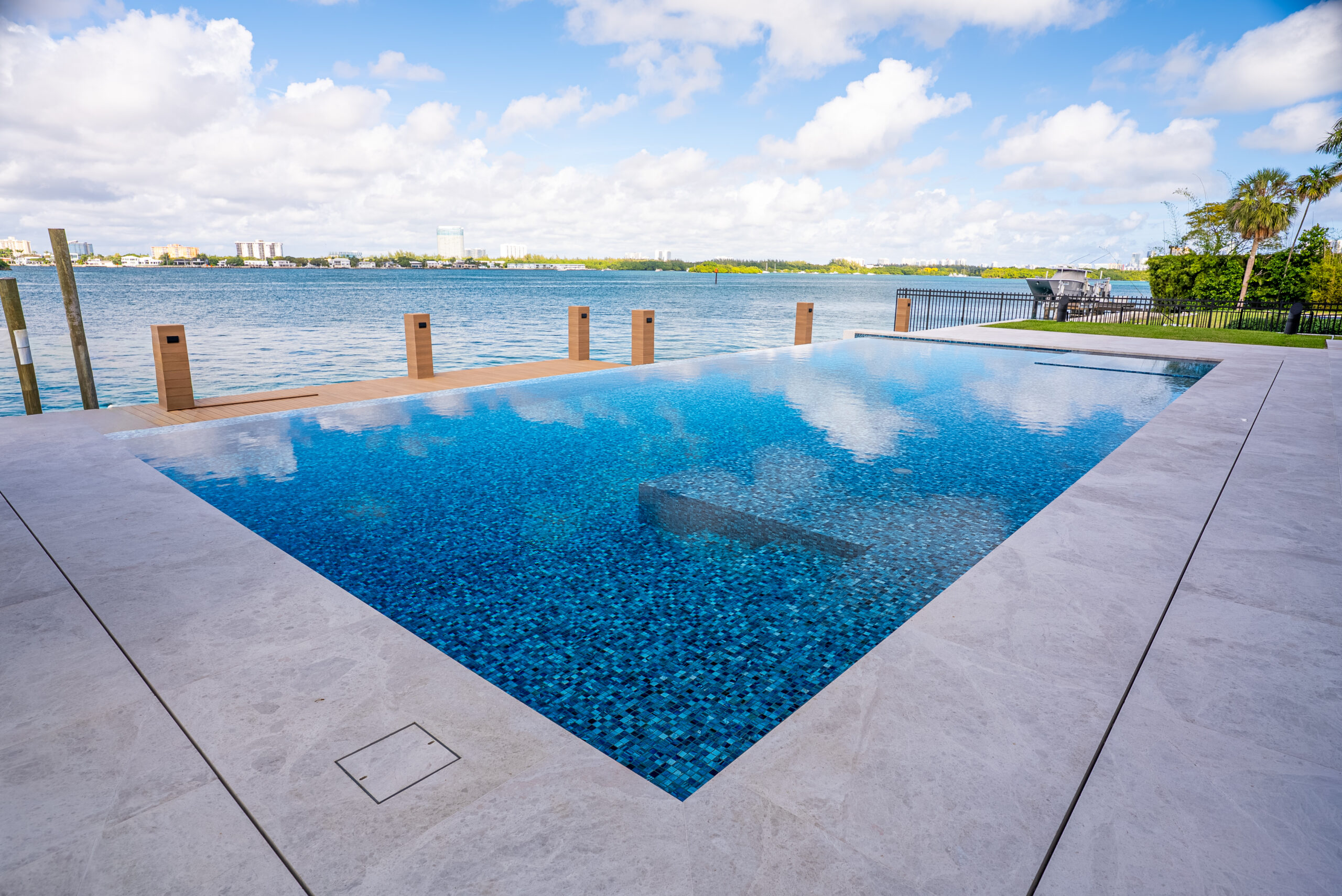
A knife edge pool represents the absolute pinnacle of custom aquatic engineering. While traditional designs rely on a visible perimeter to contain the water, a knife edge system allows the water level to sit perfectly flush with the surrounding deck. This creates a visual effect of water with no boundary, where the pool surface appears as a solid, unmoving sheet of glass. For homeowners seeking the expertise of knife edge pool builders Florida offers, this design is more than a luxury; it’s a commitment to architectural precision. It requires a 360-degree perimeter overflow system where water spills into a hidden slot, collected and recirculated through a sophisticated, invisible gutter.
This design is particularly favored for modern Florida estates where the flat topography allows for long, uninterrupted sightlines. Integrating these systems with high-end hardscaping allows the pool to function as a central piece of a curated outdoor environment. It’s vital to distinguish the knife edge from general perimeter overflows. While all knife edges are perimeter overflows, not all overflows achieve the specific mirror look where the collection slot is virtually invisible at deck level. Achieving this level of detail is why many luxury homeowners prioritize specialized knife edge pool builders Florida firms when planning their bespoke renovations or new builds.
The Aesthetic Impact of Perimeter Overflows
The primary draw of a perimeter overflow is the mirror surface effect. When the water remains still, it reflects the surrounding landscape and architecture with startling clarity. This transforms the pool into a structural element rather than a separate utility. It anchors the outdoor living space, creating a sense of calm and permanence. Beyond the visuals, the auditory experience is equally refined. Instead of the splashing associated with traditional skimmers, a properly engineered knife edge pool produces a subtle, rhythmic trickle within the hidden gutter system. This enhances the serenity of the environment, making it ideal for minimalist designs that prioritize sensory harmony.
Knife Edge vs. Standard Coping
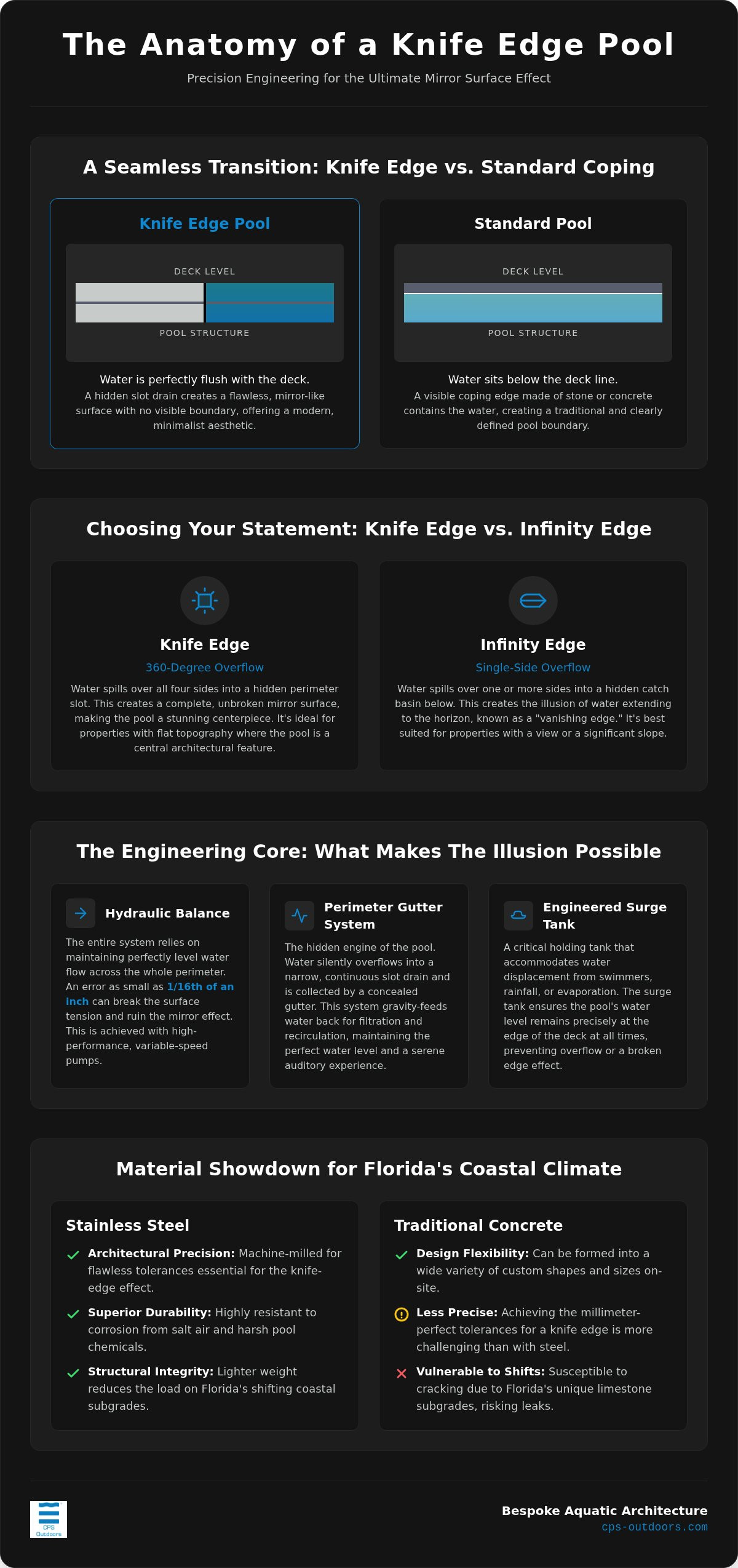
Traditional pool construction uses coping, which is a visible lip of stone or concrete that separates the water from the deck. This creates a clear, functional boundary. In contrast, the knife edge eliminates this visual break. By utilizing a precision-machined slot drain, the water disappears into a narrow gap between the pool and the hardscape. This creates the striking illusion of a floating pool deck. For discerning clients, this lack of visible hardware is the hallmark of a truly custom build. It requires a level of craftsmanship that standard contractors rarely possess. The tolerance for error is measured in mere millimeters to maintain the hydraulic balance across all four sides of the perimeter.
Precision Engineering: The Hydraulics of the Florida Knife Edge
Achieving a flawless mirror surface requires more than a steady hand. It demands rigorous mathematical modeling. The water must flow at a consistent rate over the entire perimeter to maintain the surface tension that defines the knife edge look. If one corner is 1/16th of an inch lower than the rest, the water will favor that exit point. This breaks the tension and ruins the visual effect. Leading knife edge pool builders Florida firms utilize high-performance variable speed pumps to ensure this flow remains constant regardless of bather load or wind conditions.
Engineering these systems in a coastal environment adds layers of complexity. The proximity to salt air necessitates the use of premium materials that can withstand aggressive conditions. For instance, the corrosion resistance of stainless steel makes it an ideal choice for the intricate plumbing and gutter interfaces found in high-spec Florida builds. This material ensures that the mechanical components of the pool remain as durable as the aesthetic design is beautiful.
The Perimeter Gutter and Slot Drain System
The perimeter gutter is the hidden engine of the overflow pool. It sits beneath the deck level, capturing water as it spills through the narrow slot drain. This water is then gravity-fed into a filtration loop. Designers offer several options for the visible portion of this system:
- Stone-Covered Slots: The deck material extends over the gutter, leaving only a 1/4 inch gap for water.
- Open-Grate Systems: Often used in commercial aquatics, these provide a modern, industrial aesthetic.
- Recessed Drains: These allow for a completely flush transition between the water and the hardscape.
Maintenance is a critical consideration. Precision builds include discreet access points that allow for the cleaning of debris without disrupting the architectural lines of the deck.
Surge Tank Engineering for Large-Scale Displacement
A surge tank acts as a buffer for the pool’s volume. When people enter the water, the displaced liquid must go somewhere. The surge tank stores this overflow until the bathers exit, at which point the system pumps the water back into the main vessel. Calculating the required volume is a precise science. A tank that is too small will overflow during heavy use, while one that is too large creates unnecessary construction costs. Florida’s high evaporation rates also necessitate automated water leveling systems. These sensors detect even minor drops in volume and replenish the tank to keep the knife edge functioning perfectly. For those seeking a technical partner capable of managing these variables, CPS Outdoors provides the engineering oversight required for these high-spec aquatic systems.
Knife Edge vs. Infinity Edge: Choosing Your Statement
Distinguishing between an infinity edge and a knife edge is essential for any high-end aquatic project. While both utilize overflow mechanics, their architectural applications and engineering requirements differ fundamentally. An infinity edge, often called a vanishing edge, requires a structural drop-off to create the illusion of water merging with the horizon. It’s a localized overflow, typically occurring on one or two sides. In contrast, a knife edge pool is designed for flat terrain. It allows the water to sit flush with the deck on all sides, creating the mirror effect. Discerning homeowners often seek specialized knife edge pool builders Florida firms because the engineering required for a flush perimeter is significantly more complex than a single-sided vanishing edge.
This complexity translates directly into engineering hours. A knife edge requires 360 degrees of perfectly level transitions, whereas an infinity edge only requires precision along the weir wall. The cost of a knife edge reflects this meticulous labor and the advanced hydraulic balance needed to keep the water surface tension consistent across the entire perimeter.
Site Suitability and Lot Topography
Topography dictates the design. Infinity edges are the premier choice for Florida coastal or intracoastal properties with significant elevation changes. They allow the eye to travel from the pool directly to the open water beyond. However, for modern estates on flat lots or internal courtyards, the knife edge is the superior architectural choice. It integrates the pool as a flat, structural plane within the hardscape. For the ultimate statement, some projects utilize a hybrid “Infinity-Knife” design. This combines a vanishing edge on the side facing a view with a knife edge on the sides adjacent to the home, offering both a horizon line and a mirror finish.
Maintenance and Operational Realities
Operational realities also diverge between these two systems. Infinity pools utilize a large catch basin, which is relatively easy to access and clean. Knife edge pools rely on narrow slot drains that can trap Florida debris like sand and oak leaves. Managing this requires a more robust filtration strategy and strategically placed access points within the gutter system. Additionally, the constant movement of water over the perimeter increases CO2 outgassing. This causes pH levels to rise more rapidly than in traditional pools. Maintaining chemical balance in these high-surface-area systems requires professional-grade automation and high-capacity filtration units to ensure the water remains as clear as the design is precise.
Material Selection: Stainless Steel vs. Concrete in Florida
Selecting the structural substrate is as critical as the hydraulic engineering itself. While most knife edge pool builders Florida residents consult focus on traditional gunite, the technical superiority of stainless steel is becoming the new standard for high-spec projects. Stainless steel allows for razor-thin edges that concrete cannot replicate. A concrete weir requires a minimum thickness to maintain structural integrity, but steel can be machined to a fine point. This ensures a cleaner water break and a more convincing mirror effect across the entire perimeter.
Florida’s geography presents distinct challenges for traditional masonry. The combination of salt-laden air and shifting sandy soils creates an environment where concrete is prone to settling and micro-cracking. Stainless steel remains unaffected by these conditions. It provides a level of durability that is essential for maintaining the millimeter-perfect leveling required for an overflow system. Additionally, steel is significantly lighter than concrete. For elevated or rooftop installations in coastal high-rises, this weight reduction is often the deciding factor in project feasibility.
Why Experts Choose Stainless Steel for Knife Edges
One of the most frequent failures in perimeter overflow pools is tile delamination at the spillover point. Constant water movement and chemical exposure eventually weaken the bond between the tile and the concrete shell. Stainless steel eliminates this vulnerability entirely. The vessel is pre-engineered and often fabricated in a controlled environment, which results in faster onsite installation and superior quality control. For those prioritizing long-term structural integrity and precision, investing in stainless steel pools through a specialized design-build firm ensures these technical advantages are fully realized.
Concrete and Stone: The Traditional Luxury Path
Concrete remains a prevalent choice due to its aesthetic versatility. Achieving a knife edge in concrete requires custom-cut, mitered stone finishes that wrap over the edge and into the hidden gutter. This method relies heavily on the artisan skill of the mason. It also necessitates the use of high-performance waterproofing membranes to protect the shell from constant saturation. Without meticulous grout selection and specialized membranes, the “constant-wet” environment of a perimeter overflow can lead to efflorescence or structural degradation over time. While concrete offers a traditional look, it requires a much more rigorous maintenance schedule to preserve the delicate interface between the stone and the water.
Bespoke Aquatic Architecture: The CPS Outdoors Difference
A knife edge pool is more than a standalone feature; it’s the centerpiece of a curated environment. Most knife edge pool builders Florida homeowners encounter treat the pool as an isolated utility. At CPS Outdoors, we operate as a design-build firm. This means hydraulic modeling and architectural aesthetics are integrated from the initial sketch. Our team manages the unique challenges of Florida’s subgrades, where shifting limestone and sandy soils require specialized engineering to support heavy, high-tolerance aquatic structures. We ensure the structural integrity of your build while simultaneously designing the surrounding Elemento Living hardscape to create a cohesive outdoor masterpiece.
Integrating Moveable Floors and Automatic Covers
Maintaining a seamless perimeter overflow becomes significantly more complex when adding secondary luxury features. A moveable pool floor system allows for a dual-purpose space, transforming your aquatic vessel into a solid event deck. Engineering this requires the floor to move without disrupting the millimeter-perfect water level of the knife edge. Similarly, we integrate automatic pool covers by concealing the tracks within the perimeter gutter system. This approach maximizes the usable square footage of high-end Florida estates, providing safety and flexibility without compromising the mirror-like visual plane of the water.
The CPS Outdoors Design-Build Process
Our methodology is structured to ensure technical excellence and aesthetic precision. We follow a steady, logical progression from vision to execution:
- Phase 1: Conceptual Architecture and Modeling. We develop the broad vision, focusing on how the mirror surface interacts with the home’s architecture. Hydraulic modeling ensures the flow remains perfectly balanced across all edges.
- Phase 2: Precision Engineering. We adapt the design to meet the 2026 Florida Building Code standards and address specific site conditions, including surge tank placement and subgrade stabilization.
- Phase 3: Construction and Meticulous Finishing. Our artisans execute the build with disciplined process management, ensuring every finish meets the highest industry specifications.
Realizing a project of this magnitude requires a partner that balances bold innovation with rigorous technical discipline. If you are ready to define your outdoor space with a world-class aquatic installation, Schedule a consultation for your Florida aquatic project to begin the design-build journey.
Defining the Future of Your Outdoor Living Space
Realizing a flawless perimeter overflow requires a rare combination of hydraulic mastery and structural discipline. Every technical choice, from surge tank volume calculations to the selection of high-grade stainless steel, directly impacts the final visual effect. Florida’s coastal environment and specific subgrade conditions demand a level of meticulous oversight that standard contractors cannot provide. A successful build depends on maintaining millimeter-perfect tolerances across the entire aquatic vessel.
Partnering with experienced knife edge pool builders Florida experts ensures your project remains both a technical and aesthetic success. CPS Outdoors operates as a comprehensive design-build firm, specializing in complex aquatic engineering and the integration of advanced features like moveable pool floors. We prioritize the structural integrity and architectural precision required for Florida’s most sophisticated estates, ensuring your investment is as durable as it is beautiful.
Consult with our Florida aquatic engineers for your bespoke knife edge pool to begin the realization of your architectural vision. We look forward to helping you curate a high-end environment that reflects your commitment to excellence and precision.
Frequently Asked Questions
What is the main difference between a knife edge and an infinity pool?
A knife edge pool features a 360-degree perimeter overflow where the water sits perfectly flush with the deck. This creates a mirror-like surface. In contrast, an infinity pool requires a structural drop-off to create a vanishing horizon, typically on just one side. While infinity pools suit sloped lots with views, knife edge designs are preferred for modern, flat estates where seamless integration with the hardscape is the primary architectural goal.
Are knife edge pools harder to maintain than standard pools?
Maintenance for these systems is more demanding than traditional pools. The constant movement of water over the perimeter increases evaporation and chemical outgassing, which requires more frequent monitoring of pH levels. Debris like sand or leaves can collect in the narrow slot drains, necessitating specialized cleaning of the hidden gutter system. Professional-grade automation and high-capacity filtration are essential components that leading knife edge pool builders Florida firms integrate to manage these operational realities.
How much does a knife edge pool cost to build in Florida?
Building a knife edge pool represents a significant investment due to the precision engineering and additional infrastructure required. These projects involve complex hydraulic systems, including surge tanks and specialized perimeter gutters, which aren’t found in standard builds. The cost is influenced by material choice, such as stainless steel versus concrete, and the integration of features like moveable floors. Discerning homeowners should expect a premium budget that reflects the meticulous labor and millimeter-perfect tolerances involved.
Can a knife edge pool be built on a flat lot?
Yes, a knife edge pool is the superior choice for flat lots. Unlike infinity pools that rely on a slope to achieve their visual effect, a knife edge creates its mirror surface through a flush-deck perimeter. This allows the water to meet the hardscape on a single, level plane. It’s a perfect solution for luxury Florida courtyards or modern residences where a traditional drop-off isn’t feasible or desired for the landscape.
Do knife edge pools lose more water to evaporation?
These pools do experience higher evaporation rates compared to standard designs. The continuous flow of water over the edge increases the total surface area exposed to the air. Florida’s high temperatures and humidity levels can accelerate this process. To combat this, sophisticated builds include automated water leveling systems. These sensors monitor the surge tank volume and replenish the system automatically to maintain the precise water level necessary for the perimeter overflow to function.
Are perimeter overflow pools safe for families with children?
Perimeter overflow pools are safe when designed with modern safety technology. Florida law requires specific barriers for residential pools, and these high-end builds often integrate automatic pool covers to meet those standards. At CPS Outdoors, we engineer cover tracks directly into the perimeter gutter system. This preserves the clean architectural lines while providing a robust safety barrier. Combining a knife edge with a moveable pool floor further enhances safety by allowing the water to be completely covered.
Can I use stainless steel for a knife edge pool in a coastal environment?
Stainless steel is an ideal material for coastal Florida environments. It offers exceptional resistance to salt-laden air and chlorinated water, outperforming traditional concrete in longevity and structural integrity. Its ability to be machined to extremely fine tolerances allows for the sharp, precise edges that define a world-class knife edge design. For elevated installations or areas with shifting sandy soils, the lighter weight and durability of a stainless steel vessel provide a significant engineering advantage.
How long does the construction of a custom knife edge pool take?
The construction timeline for a bespoke knife edge pool is typically longer than a conventional build. Meticulous hydraulic testing and precision leveling of the perimeter weir are time-intensive phases that cannot be rushed. Each millimeter of deviation must be corrected to ensure a perfectly balanced overflow. While timelines vary based on the project’s complexity and the integration of Elemento Living features, the focus remains on delivering a structurally sound and visually flawless architectural masterpiece.