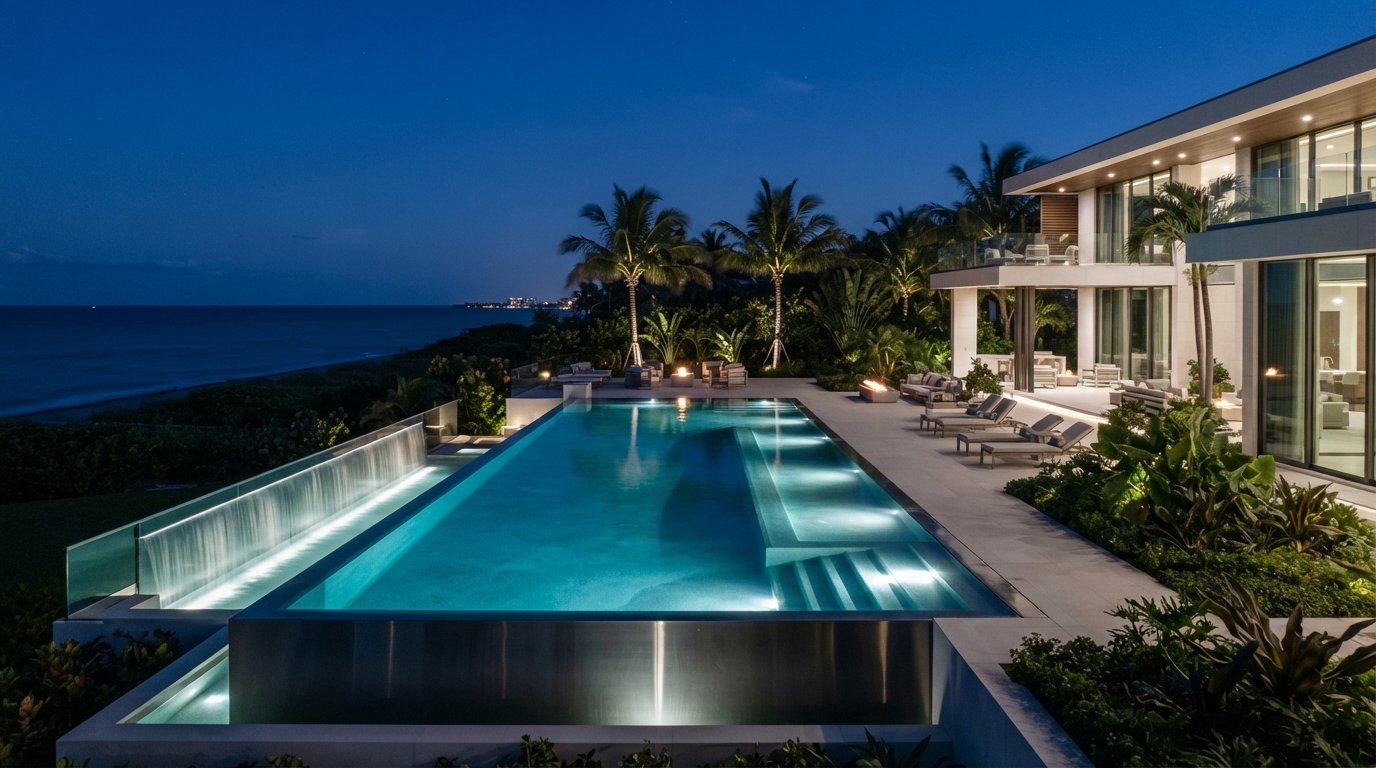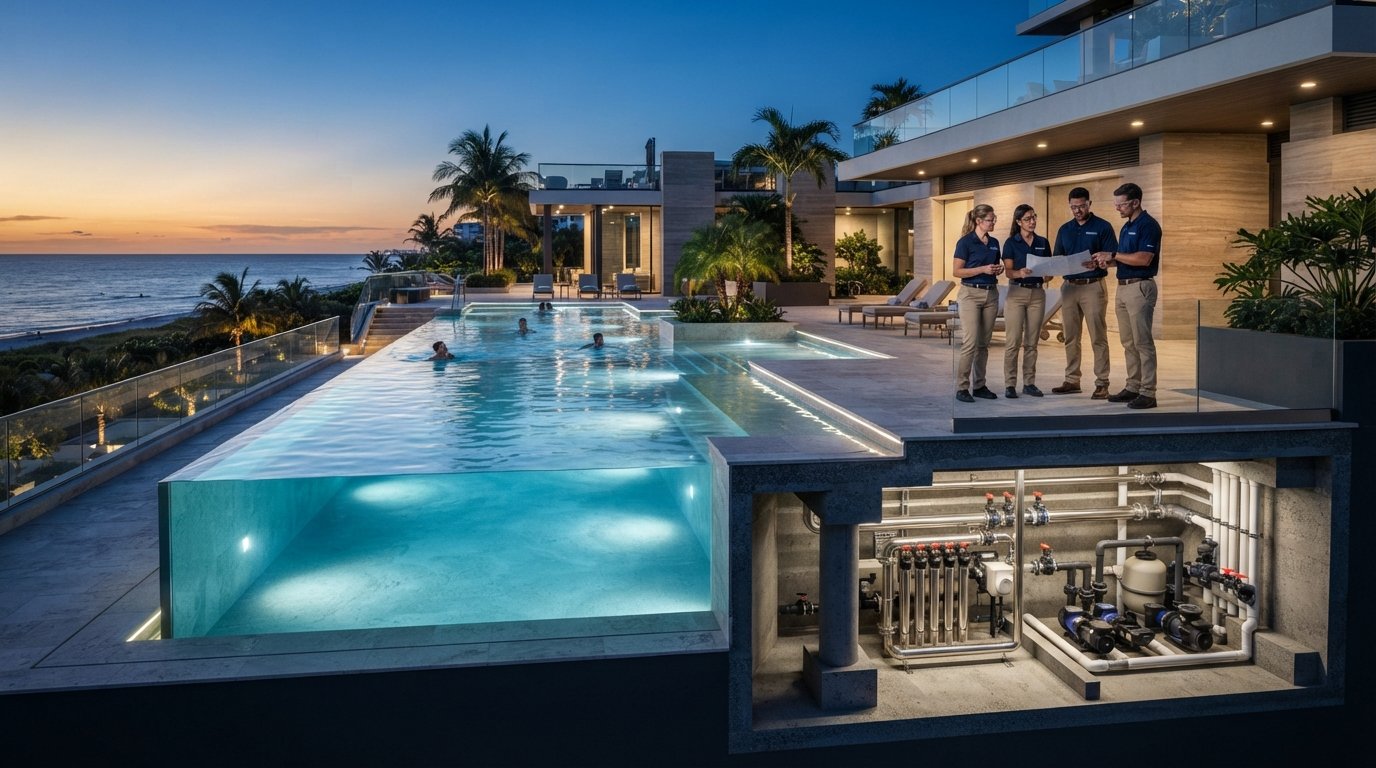
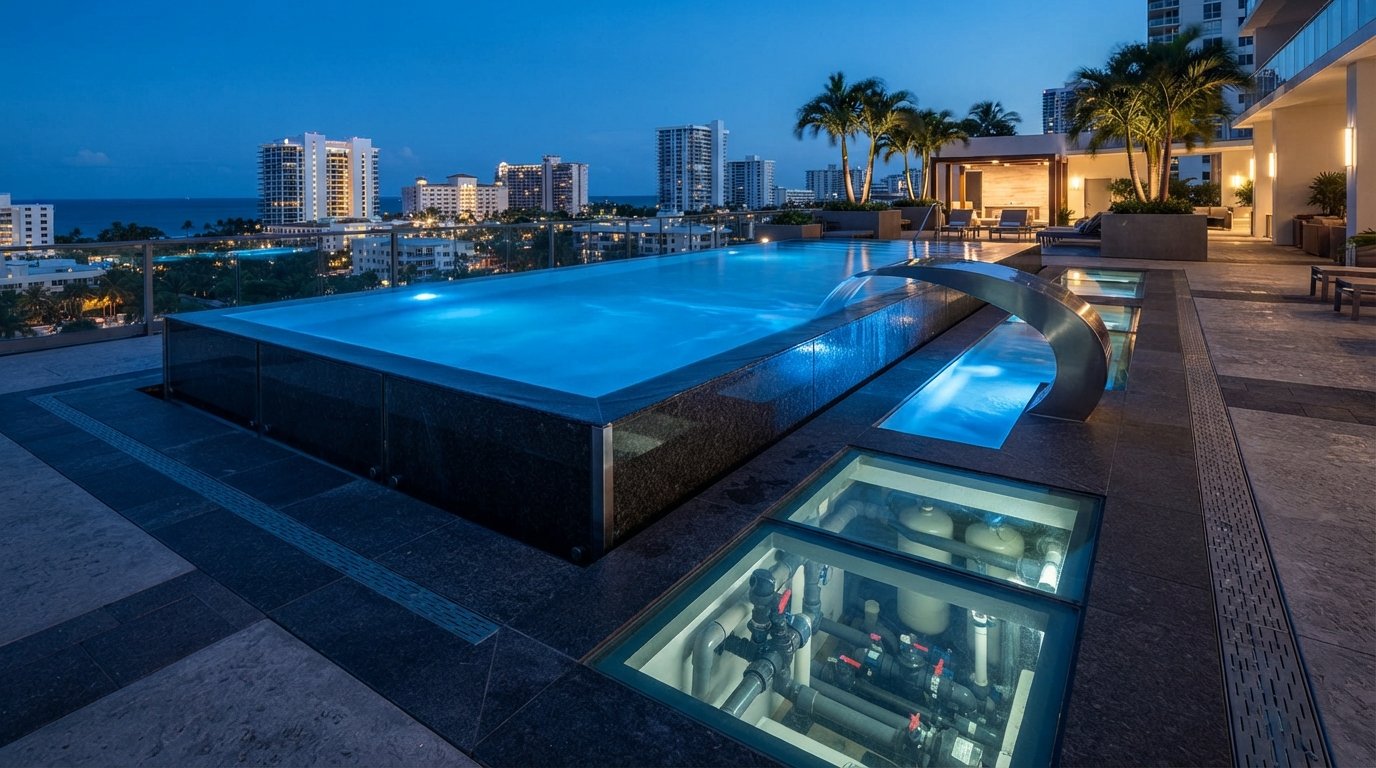
The true measure of an architectural water feature isn’t found in its visual drama, but in the structural calculations concealed beneath the surface. In high-stakes environments, commercial aquatic engineering serves as the invisible bridge between bold aesthetic ambition and permanent structural reliability. When developers and designers ask what the core engineering requirements are for a sustainable, high-end commercial installation, the answer extends far beyond decorative finishes.
Elevated amenity decks, rooftop hospitality basins, and stringent coastal wind-load requirements under ASCE 7-22 leave zero margin for structural leaks or compounding operational expenses. You need hydraulic systems engineered to endure relentless environmental pressure without burdening facility operations. This guide explores the technical precision and MEP disciplines required to protect your architectural investment while deliberately engineering out future maintenance headaches. You’ll gain a definitive understanding of advanced hydraulic planning, the distinct structural advantages of pre-engineered 316L stainless steel vessels, and the automated building controls that safeguard water quality and mechanical performance.
Key Takeaways
- Explore how commercial aquatic engineering harmonizes architectural vision with mechanical, electrical, and plumbing infrastructure to prevent costly long-term failures.
- Discover why pre-engineered marine-grade 316L stainless steel provides critical dead-load reductions and leak-proof security for elevated amenity decks and rooftop installations.
- Learn the operational requirements of advanced hydraulic modeling, high-efficiency filtration, and automated building management systems that stabilize water quality.
- Understand critical regulatory considerations under Florida Building Code Section 454.1 and ASCE 7-22 coastal wind-load requirements to ensure complete project compliance.
- Examine the single-source design-build methodology that transforms complex aquatic concepts into enduring, low-maintenance commercial installations.
The Role of Precision Engineering in Commercial Aquatic Design
Commercial water features demand far more than basic artistic expression. At its core, commercial aquatic engineering represents the technical synthesis of fluid dynamics, structural engineering, mechanical systems, and material science. When architectural ambition meets moving water, aesthetics cannot exist in isolation from structural physics.
In high-density commercial developments, high-end hospitality venues, and civic plazas, water serves clear psychological and economic purposes. Thoughtfully engineered water features attract foot traffic, extend patron dwell times, and establish memorable visual anchors that elevate property value. Off-the-shelf fountain kits inevitably fail in these demanding spaces. Mass-market systems lack the durability to handle continuous public operation, rigorous hydraulic loads, and aggressive environmental wear. Translating an architect’s conceptual sketch into detailed, stamped construction documents requires meticulous calculation of flow rates, basin containment, and equipment tolerances before site preparation begins.
Beyond Aesthetics: The Functional Purpose of Water Engineering
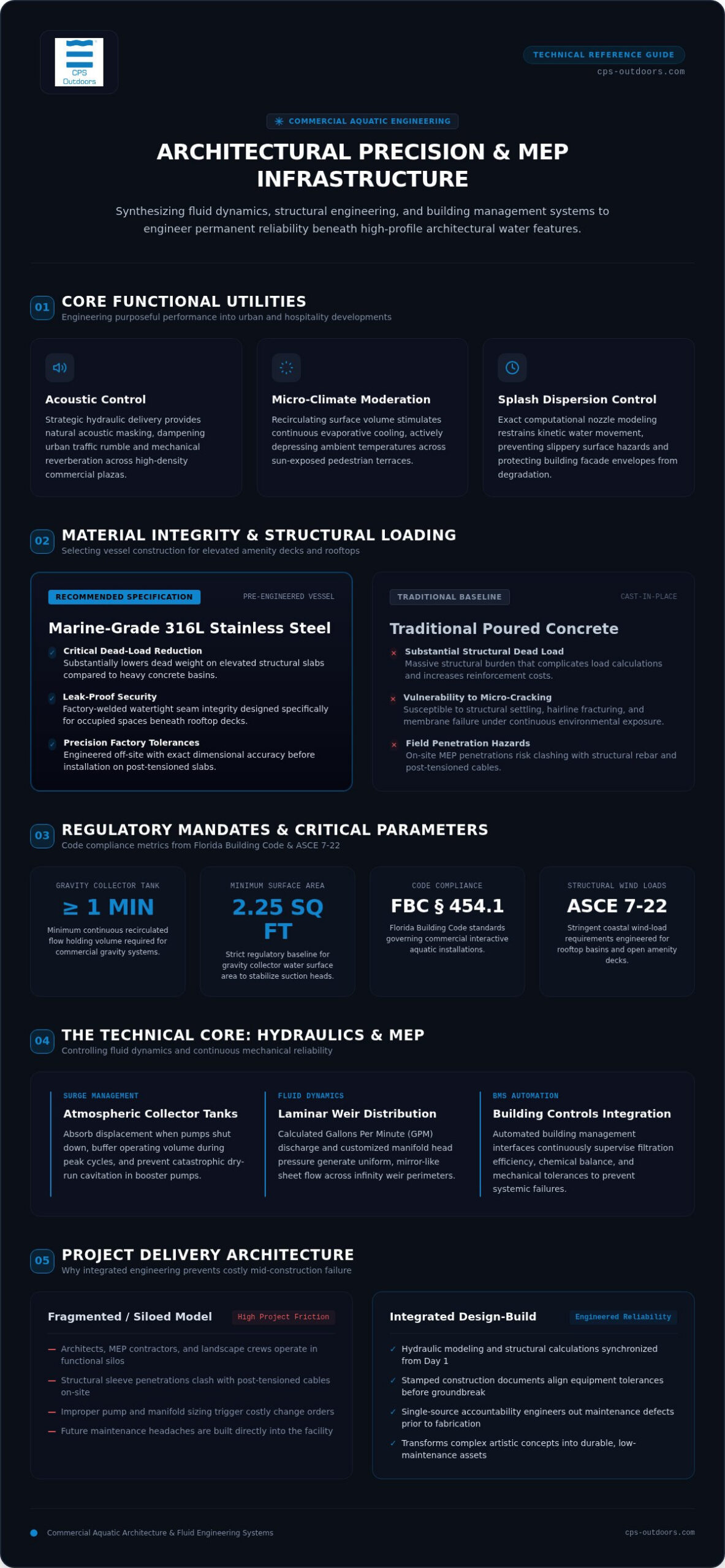
Aquatic architecture is the precise fusion of structural engineering and fluid dynamics designed to animate physical environments. Beyond visual appeal, precision-engineered architectural water features provide critical functional utilities in urban and coastal developments:
- Acoustic control: Strategic water presentation delivers natural sound masking, dampening urban traffic noise and mechanical reverberation within busy commercial courtyards.
- Micro-climate moderation: Recirculating surface water induces evaporative cooling, lowering ambient air temperatures across outdoor terraces and open-air hospitality plazas.
- Controlled splash dispersion: Exact computational nozzle modeling ensures hydraulic movement remains contained, preventing slippery hardscapes and premature facade degradation.
The Design-Build Advantage for Complex Features
Fragmented delivery models often jeopardize complex aquatic installations. When architects, MEP contractors, and landscape teams work in silos, coordination failures occur. Pumps arrive improperly sized, structural penetrations clash with post-tensioned slabs, and costly mid-construction change orders derail build schedules.
Adopting an integrated design-build methodology resolves this friction early. By synchronizing hydraulic engineering with structural design from day one, design-build firms engineer out future maintenance challenges before pouring concrete or fabricating metal. This unified workflow eliminates technical ambiguity, transforming ambitious visions into high-performance commercial assets. To understand how this unified approach shapes luxury environments, explore the art of bespoke aquatic architecture.
The Technical Core: Hydraulics, MEP, and Filtration Systems
Behind every effortless architectural cascade lies an intricate network of mechanical, electrical, and plumbing engineering. Fluid behavior is inherently dynamic; water seeks the path of least resistance, accelerates over weir edges, and generates turbulence that easily disrupts intended visual textures. In high-caliber commercial aquatic engineering, achieving architectural fluidity requires computational precision across flow rates, pressure heads, and water replenishment.
Surge tank design serves as the operational anchor for these installations. Atmospheric collector tanks stabilize operating levels during high-flow cycles, absorb displacement when water effects shut down, and prevent dry-run cavitation in booster pumps. For commercial interactive systems in Florida, building codes mandate that gravity collector tanks hold at least one minute of continuous recirculated flow with a minimum water surface area of 2.25 square feet. Sizing these tanks precisely ensures seamless hydraulic transitions without overflowing perimeter collection trenches.
Hydraulic Flow Dynamics and Pump Selection
Creating specific water profiles requires calculated Gallons Per Minute (GPM) discharge rates and customized manifold pressure. A mirror-like, “glassy” sheet flow over an infinity weir demands uniform laminar distribution, often requiring low-velocity weir troughs engineered to minimize surface disruption. Conversely, aerated cascades require turbulent boundary conditions and higher nozzle head pressures.
- Variable frequency drives (VFDs): Calibrating pump RPM to real-time demands cuts electrical consumption, prolongs mechanical service life, and pairs with anemometers to throttle spray heights automatically during gusty conditions.
- Acoustic isolation: Luxury hospitality environments demand near-silent mechanical operation. Specifying low-vibration base plates, flexible neoprene pipe couplings, and sound-attenuated pump assemblies keeps structural vibration from telegraphing into occupied guest suites.
Commercial Filtration and Sanitation Engineering
Public water features require rigorous biological and chemical treatment to maintain visual clarity and bather health. While decorative systems avoid heavy organic loads, aerosol-generating features can harbor pathogens like Legionella pneumophila if left unmanaged. Engineering specifications should align with federal Model Aquatic Health Code standards to guarantee absolute water safety.
Achieving regulatory clarity thresholds of 0.5 NTU or less requires high-rate sand filtration with automated backwash cycles or micro-filtration systems paired with automated chemical controllers. Incorporating medium-pressure ultraviolet (UV) reactors delivering validated dosages of 40 mJ/cm² neutralizes chlorine-resistant pathogens before water ever returns to the feature basin. Concealing these substantial components within an acoustically isolated, elevated mechanical room preserves pristine site lines without sacrificing technician accessibility. When planning your property’s mechanical footprint, consulting with specialists in commercial aquatics and pool design and engineering ensures your infrastructure matches the architectural intent.
Material Selection: Stainless Steel vs. Traditional Concrete
Selecting the structural medium dictates an aquatic feature’s operational lifespan, service profile, and vulnerability to catastrophic failure. For decades, cast-in-place concrete dominated large-scale civil and architectural installations. However, advancing commercial aquatic engineering standards have exposed concrete’s inherent liabilities, particularly in high-exposure or weight-critical environments. Traditional concrete demands meticulous crack-control engineering under ACI 350, requiring heavy reinforcement, specialized low-permeability admixtures, and ongoing surface resurfacing to combat chemical degradation.
Pre-engineered marine-grade metals have revolutionized this landscape. Modern architects increasingly replace poured shotcrete with fully welded Type 316L or 2205 duplex stainless steel vessels. This shift provides millimetric precision, crisp linear geometries, and a non-porous structure that completely eliminates water migration. For comprehensive structural comparisons, review the ultimate guide to stainless steel pools.
Engineering for Weight-Sensitive Environments
Positioning substantial water volumes over occupied interior spaces demands stringent structural load calculations. Water weighs approximately 8.34 pounds per gallon, transforming rooftop fountains and podium installations into intense dead-load challenges for structural columns and transfer slabs.
- Substantial dead-load reduction: Prefabricated 316L stainless steel vessels deliver a 70% to 80% weight reduction compared to conventional cast-in-place reinforced concrete basins, dramatically minimizing dead loads on the supporting building framework.
- Foundation optimization: Shedding this structural mass reduces required transfer beam depths and column footings throughout lower levels.
- Accelerated erection schedules: Off-site vessel fabrication allows rapid placement via crane, avoiding weeks of formwork erection and curing on active amenity decks.
To examine how these load-bearing principles apply to elevated developments, see our technical breakdown of luxury rooftop pool construction.
Corrosion Resistance in Commercial Settings
Florida’s coastal atmosphere actively attacks reinforced concrete. Airborne chlorides penetrate porous cementitious matrixes, oxidating internal steel rebar, causing expansive spalling, and generating microscopic pathways for structural water leaks. These continuous structural threats demand continuous monitoring to satisfy Florida Department of Health public swimming pool regulations and local structural inspection mandates.
Stainless steel resolves these chronic deterioration cycles. Containing 2% to 3% molybdenum, marine-grade Type 316L stainless steel provides an impenetrable barrier against pitting, chemical etching, and aggressive saltwater spray. Because fully welded metallic shells offer zero-permeability containment, they prevent water from migrating through hairline fissures into occupied sub-levels. Stainless steel is the premier choice for elevated aquatic engineering because its superior strength-to-weight ratio and impermeable, corrosion-resistant metallurgy guarantee leak-proof structural security over occupied building footprints.
Navigating Florida Building Codes and Environmental Resilience
Deploying outdoor water features across Florida demands rigorous alignment between architectural intent and environmental reality. Between hyper-saline coastal air, tropical storm systems, and strict oversight from the Florida Department of Health (FDOH), commercial installations face extraordinary operating hurdles. Specialized commercial aquatic engineering bridges the gap between regulatory compliance and structural endurance.
Permitting across Florida follows a strict dual-track protocol. Local building departments review structural engineering, foundation design, electrical safety under NEC Article 680, and wind loading under the 8th Edition (2023) Florida Building Code. Concurrently, the FDOH Bureau of Environmental Health enforces Chapter 514 and Florida Administrative Code (F.A.C.) Rule 64E-9. Features accessible to pedestrian interaction must meet public pool sanitation standards, including rapid 30-minute turnover rates, automated chemical controllers, and ADA-compliant safety clearances. Navigating both regulatory tracks early prevents catastrophic stop-work orders and redesigns during final inspections.
Hurricane-Ready Water Feature Engineering
High-Velocity Hurricane Zones (HVHZ), including Miami-Dade and Broward counties, require structural engineering governed by ASCE 7-22 design standards. Exterior water walls, cantilevered spillways, and open basins must withstand ultimate design wind speeds ranging from 160 to 180+ mph.
- Dynamic wind loading: Vertical water walls act as solid shear surfaces during severe gale conditions, requiring reinforced footing moments, chemical anchor embedments, and heavy-gauge structural sub-frames.
- Automated storm drainage: Integrating motorized actuated valves tied to building management systems enables automated water drawdown ahead of tropical depressions, eliminating basin overflow and structural pooling.
- Salt air mechanical isolation: Coastal atmospheres corrode unrated components within months. Engineering mechanical layouts with NEMA 4X enclosures, 316L hardware, and elevating pump skids above coastal flood zones shields capital equipment from high water tables.
Sustainability and Water Conservation Standards
Subtropical heat and constant sun exposure accelerate evaporation across open water surfaces. Sustainable commercial design integrates subsurface ultrasonic leak detection alongside digital water-makeup systems to continuously track consumption anomalies. Multi-stage filtration paired with intelligent micro-climate wind sensors curtails wind drift over adjacent walkways, slashing unnecessary water replenishment. Incorporating variable-frequency hydraulic controls directly reduces kilowatt consumption, qualifying facilities for valuable commercial LEED points and local water efficiency credits. To verify your project meets every wind-load and health department mandate from day one, partner with CPS Outdoors for expert commercial aquatic engineering.
The Design-Build Process for Commercial Water Features
Transforming complex liquid architecture into an operational landmark requires a disciplined project delivery system. When structural modeling, mechanical planning, and construction exist under separate contracts, communication gaps inevitably compromise the finished installation. Single-source commercial aquatic engineering streamlines this progression through four clearly defined, accountable project milestones:
- Phase 1: Conceptual Engineering and Hydraulic Feasibility: Evaluating sightlines, acoustic goals, boundary conditions, and preliminary flow calculations to validate architectural viability.
- Phase 2: Detailed MEP and Structural Documentation: Producing stamped engineering schematics, hydraulic line sizing, power loads, surge basin configurations, and dual-track permitting submittals.
- Phase 3: Off-Site Fabrication and Site Preparation: Pre-engineering stainless steel vessels within climate-controlled facilities while roughing in structural slab penetrations and primary plumbing runs on site.
- Phase 4: Assembly, System Commissioning, and Staff Orientation: Setting assemblies, landing mechanical skids, performing rigorous pressure validations, and calibrating digital automation systems for facility operators.
From Concept to Reality: Engineering the Vision
Bridging the gap between an artistic rendering and physical mechanics begins with digital fluidity modeling. Advanced 3D computational fluid dynamics simulate weir break points, splash trajectories, and surface tension behaviors long before site mobilization. Precision prototyping of bespoke discharge manifolds and CNC-milled edge details ensures the physical water effect matches design intent with absolute accuracy. To explore this structured design-build pathway, discover our disciplined approach to custom pool design and engineering.
Commissioning and Long-Term Reliability
The transition from structural completion to daily commercial operation centers on a rigorous commissioning protocol. Often called the “First Splash” phase, this verification process stresses every mechanical system under live hydraulic pressure. Technicians validate fail-safe mechanisms, calibrate automatic chemical feed rates, verify emergency shutoffs under simulated utility failures, and fine-tune variable-speed pumps for optimal acoustic levels.
Engineering for low-maintenance operation isn’t about cutting corners during construction; it’s the ultimate commercial luxury. High-specification components, automated filtration cycles, self-balancing water chemistry, and resilient marine alloys liberate facility teams from daily firefighting. By designing out recurring operational vulnerabilities during early engineering phases, commercial owners protect their capital outlay and guarantee flawless performance for decades to come. When you’re ready to bring technical precision and unyielding structural integrity to your hospitality or mixed-use development, partner with CPS Outdoors for your next commercial aquatic masterpiece.
Architectural Fluidity Engineered for Structural Permanence
A successful commercial water feature balances visionary aesthetics with uncompromising technical precision. By prioritizing calculated hydraulic flow, impermeable marine-grade stainless steel, and strict compliance with coastal wind-load mandates, developers protect both patron experience and structural integrity. Engineering out recurring maintenance headaches during initial planning isn’t just smart design; it’s essential asset protection.
Executing these complex installations requires an integrated partner who understands every hydraulic, structural, and regulatory nuance. With PE-certified engineering oversight, specialized expertise in high-stakes Florida coastal construction, and a disciplined design-build workflow, CPS Outdoors sets the standard for high-performance commercial aquatic engineering. Your vision deserves structural permanence without compromise. Consult with our Commercial Aquatic Engineers to begin turning bold architectural concepts into enduring reality.
Frequently Asked Questions
What is the primary difference between residential and commercial water feature engineering?
Commercial installations operate under continuous public exposure, severe regulatory scrutiny, and industrial-grade hydraulic loads. While residential systems rely on standard intermittent domestic pumps, commercial aquatic engineering mandates automated NSF-50 water quality management, high-capacity surge vessels, strict bather-load turnover rates, and equipotential bonding under NEC Article 680. Commercial designs prioritize durability, public health compliance, and continuous duty cycles over occupied building footprints.
How do Florida wind-load codes affect the design of vertical water walls?
Florida Building Code enforces ASCE 7-22 criteria requiring vertical water walls to endure ultimate design wind speeds between 160 and 180+ mph in coastal regions. Structural engineers treat vertical surfaces as solid wind sails during tropical storm events. Engineering requires deeply embedded structural anchors, moment-resisting sub-frames, and automated storm-response valves that draw down water basins before high-velocity gusts displace hydraulic volumes across pedestrian decks.
Why is stainless steel preferred for rooftop commercial water features?
Marine-grade 316L stainless steel provides a 70% to 80% dead-load weight reduction compared to cast-in-place concrete basins, substantially lessening stress on structural building columns. Unlike porous concrete, which risks cracking and liquid seepage over occupied tenant spaces, fully welded stainless steel vessels guarantee zero-permeability containment. The material resists corrosive salt air without requiring ongoing membrane reapplications or structural crack injections.
What are the filtration requirements for public-access water features in Florida?
Public-access water features governed under Florida Administrative Code Rule 64E-9 and FBC Section 454.1 require rapid 30-minute water turnover periods. Systems must maintain water clarity at 0.5 NTU or less using automated chemistry controllers operating without stabilized cyanuric acid. Engineers incorporate medium-pressure UV secondary disinfection producing at least 40 mJ/cm² to neutralize chlorine-resistant pathogens before water recirculates through interactive spray assemblies.
How much does a custom commercial water feature cost to engineer and build?
Total investment scales directly with hydraulic complexity, structural siting, vessel materials, and automation sophistication. Rooftop installations demanding marine-grade 316L stainless steel, vibration isolation, or extensive structural slab reinforcement require different engineering resources than ground-level architectural basins. A custom feasibility study and preliminary MEP schematic provide the site-specific clarity needed to establish an accurate capital budget for your commercial development.
Can an existing commercial pool be renovated to include engineered water features?
Structural renovations can integrate modern engineered water elements into existing commercial aquatic vessels. Engineers evaluate existing plumbing line velocities, structural load limits, and surge capacity before tying in new features. Upgrades often include dedicated booster pumps, variable-speed hydraulic controls, and specialized return manifolding to run perimeter weirs, sheer descents, or automated interactive sprays without degrading the pool’s baseline primary filtration turnover rate.
How does automation reduce the operational burden of commercial fountains?
Advanced automation eliminates manual balancing by continuously monitoring chemical ORP levels, regulating water pH, and scheduling automated filter backwashing. Smart anemometers measure local wind gusts in real time, automatically adjusting variable frequency drives to throttle spray heights and prevent perimeter flooding. Digital diagnostic sensors notify facility teams of abnormal water drawdowns instantly, minimizing maintenance intervention while preventing pump cavitation or equipment dry-firing.
What is the typical timeline for the engineering phase of a commercial aquatic project?
The comprehensive engineering phase generally spans several weeks to a few months, depending on project scale and municipal coordination. Initial hydraulic modeling and conceptual feasibility take roughly two to four weeks. Developing stamped structural MEP construction documents and navigating dual-track reviews through local building departments and the Florida Department of Health requires additional scheduled milestones before off-site vessel fabrication and site work commence.