A splashpad can become both an engaging play space and a defining feature of a public or private development. Commercial interactive water features in Florida must also be planned around state requirements: the 2023 Building Code requires recirculation systems to treat the water volume in the tank and piping on a 30-minute turnover, and collector tanks must hold at least 3 minutes of combined feature-pump and filter-pump flow unless the design engineer hydraulically justifies a smaller tank.
For Florida developers and public agencies, commercial interactive water features can make a space memorable while meeting practical design and coordination needs. Some respond to movement or touch, while play tables and cascading displays help define the character of the setting.
This guide explores custom splashpad concepts, Florida building-code coordination, and the project factors that shape feature selection and design. Use, layout, water treatment, and circulation all contribute to a cohesive aquatic environment.
Key Takeaways
- Match splashpad features to the space, intended users, and overall design so water play feels purposeful rather than added on.
- Plan code coordination alongside layout and engineering to account for circulation, treatment, access, and safety requirements.
- Adapt feature selection to the needs of municipalities, resorts, hotels, schools, and mixed-use developments.
- Compare interactive options by how they engage visitors and contribute to the character of the surrounding environment.
Custom splashpads and water play equipment
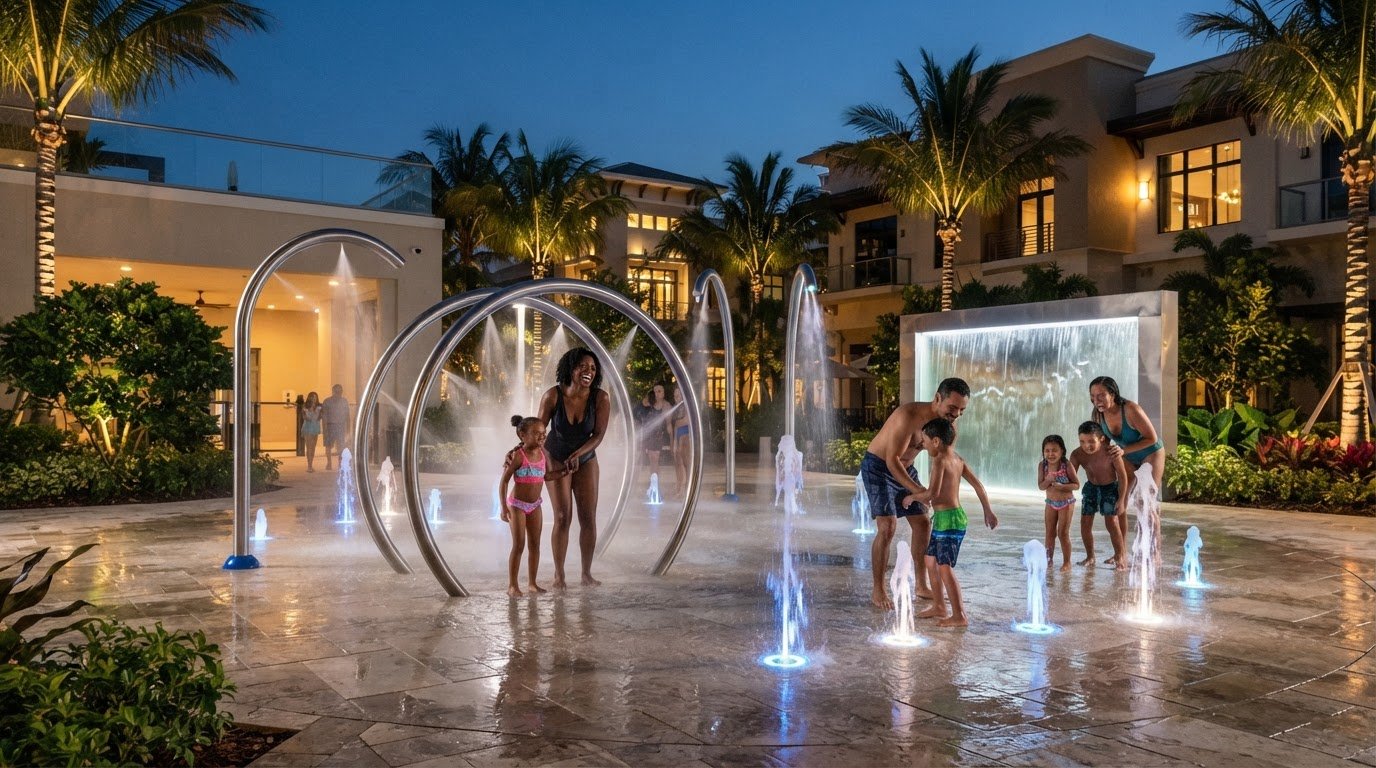
Begin with the visitor experience, then choose features that suit the site. A compact plaza might use ground-level jets and a low splash arch, while a resort play area could pair spray elements with a cascading wall. Interactive features may respond to movement, touch, or sound, encouraging visitors to explore. Group features by height and intensity to create distinct play zones without making every element compete for attention.
Equipment can support different kinds of participation. The U.S. Access Board identifies play tables designed for water play as an interactive feature. A table can offer hands-on activity alongside sprays, while open deck space lets visitors move between elements. When planning a custom splashpad, consider who will use each feature, where water will drain, and how the layout supports movement through the area.
In Florida, recirculating splashpads collect and treat water for reuse, while flow-through systems use incoming water and send used water to drainage. Recirculation involves pumps, filtration, and disinfection; flow-through operation depends on the water supply and discharge design. Florida’s 2023 Building Code includes requirements for interactive water feature recirculation systems, so that system choice belongs in early design coordination.
Operating, maintenance, and water costs vary with system design, pump runtime, treatment needs, water use, and schedule. Recirculating systems require attention to filtration and disinfection equipment, while flow-through systems make water consumption and drainage central considerations. Feature count and flow settings also affect pump and treatment demands. A clear operating plan should connect these choices with routine inspection and cleaning.
For commercial interactive water features in Florida, coordinate the equipment layout with the site plan and intended use. Define the audience and desired play experience first. Then map feature locations, circulation paths, and drainage, and align the water system and equipment with the operating plan. This sequence helps developers compare custom splashpad concepts by function, site fit, and ongoing resource demands, not appearance alone.
Florida building-code requirements for interactive water features
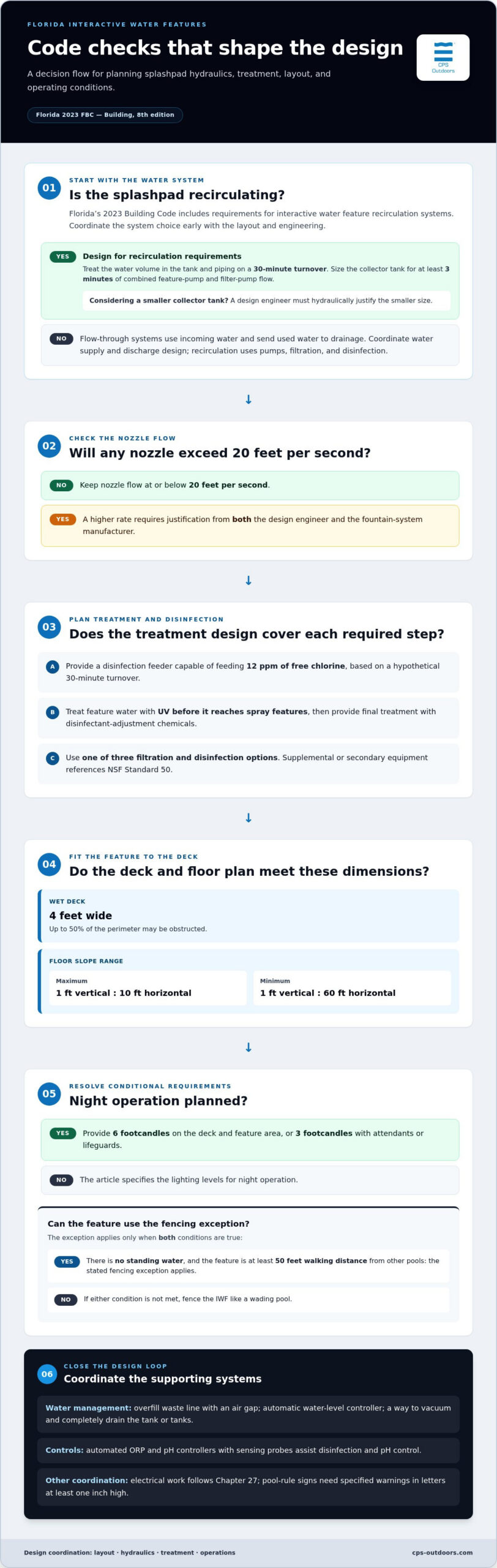
Florida’s 2023 FBC – Building, 8th edition sets design requirements for interactive water features (IWFs). Build compliance into the layout, hydraulics, treatment, electrical plan, and operating procedures before construction documents are finalized.
- Size the collector tank for at least 3 minutes of combined feature-pump and filter-pump flow. A design engineer may hydraulically justify a smaller tank. Recirculation must treat the contained water volume in the tank and piping on a 30-minute turnover.
- Provide a disinfection feeder capable of feeding 12 ppm of free chlorine, based on a hypothetical 30-minute turnover. Treat feature water with UV before it reaches spray features, then provide final treatment with disinfectant-adjustment chemicals. IWFs must use one of three filtration and disinfection options; supplemental or secondary equipment references NSF Standard 50.
- Limit nozzle flow to 20 feet per second unless the design engineer and fountain-system manufacturer justify a higher rate. Provide a 4-foot-wide wet deck around the feature; up to 50 percent of its perimeter may be obstructed. Floor slopes must range from a maximum of 1 foot vertically per 10 feet horizontally to a minimum of 1 foot vertically per 60 feet horizontally.
- Include an overfill waste line with an air gap, an automatic water-level controller, and a way to vacuum and completely drain the tank or tanks. Automated ORP and pH controllers with sensing probes assist disinfection and pH control.
Night operation requires 6 footcandles on the deck and feature area, or 3 footcandles with attendants or lifeguards. Fence IWFs like wading pools, except where there’s no standing water and the feature is at least 50 feet walking distance from other pools. Electrical work follows Chapter 27. Pool-rule signs need specified warnings in letters at least one inch high. Water theme parks also need showers near attraction queue entrances; small-child pools require fencing within 50 feet of pools at least 3 feet deep.
Design, permitting, and construction timelines depend on feature complexity, permit review, site readiness, and construction sequencing. Early coordination helps identify dependencies before installation.
Florida heat, rainfall, and storms can bring debris, changing water levels, clogged nozzles, and added filter cleaning. Routine inspection of drains, treatment equipment, and controls helps operators identify maintenance needs. For a coordinated approach to feature planning, explore project-specific water-feature design.
Interactive water features for Florida municipalities, resorts, hotels, schools, and developers
Public and private projects face a shared design challenge: matching water play to users, setting, and operating needs. Florida projects offer useful reference points.
Florida Design and Installation Providers
Commercial splashpad projects call for aquatic design and construction teams that coordinate feature layout, engineering, and installation. When assessing a team, consider how clearly its approach connects the visitor experience to practical site requirements. A municipal park, for example, may need open, visible play areas, while a hotel may prioritize a feature that complements its landscape and guest circulation.
Compare proposals by scope, not equipment names alone. Review how each concept addresses water movement, drainage, circulation, access, and the relationship between play zones. Consider how design decisions align with the operating plan and applicable Florida requirements. This helps distinguish a visually appealing concept from a coordinated installation approach.
Municipalities, resorts, hotels, and schools have different users and schedules. A school project may focus on supervised group activity, while a resort may aim to create an immersive guest experience. Define these priorities in the project brief before selecting features and coordinating design, permitting, and construction.
Notable Local Installations
Lake Buena Vista offers a prominent Florida example: EPCOT’s Journey of Water, Inspired by Moana. The exploration trail is based on Disney’s 2016 animated film, and its interactive elements show how water can become part of a themed visitor experience. Visitors encounter water effects that respond to touch and movement, connecting participation with the setting.
One effect plays music when visitors touch its water strings; an interactive water curtain parts as visitors walk through. These examples show two approaches: direct interaction with water and movement through a responsive feature. For project teams, the distinction helps clarify whether the site should invite hands-on play, create a passage, or combine both.
For municipalities and developers, the practical lesson is to consider how an installation relates to its destination, audience, and circulation. A resort, school, or civic park can have a distinct design concept while grounding decisions in site function and the intended visitor experience.
What types of commercial interactive water features are available in Florida?
Commercial options range from hands-on play elements to architectural water displays. Interactive features respond to movement, touch, or sound, inviting participation or creating a visual focal point. A splash area, for example, could include play tables for direct water interaction, while a hotel courtyard might center on a cascading wall. The right format depends on the site’s purpose, audience, and available space.
Kinetic water sculptures add movement beyond conventional spray features. Some respond to wind, proximity, or sound, creating changing patterns in a plaza or resort landscape. Their appeal lies in the visible relationship between visitors, the environment, and water. Decide whether the intended experience is active play, a contemplative display, or a transition between spaces. This helps determine where the feature belongs and how visitors encounter it.
Cascading walls and illuminated pools can serve as customizable displays in commercial settings. A wall can create a strong backdrop, while an illuminated pool can add visual interest after daylight fades. Unlike play-focused equipment, these features may shape the atmosphere of an entrance, courtyard, or gathering area. Choose them for their role in the broader landscape, rather than treating every water feature as a splashpad.
For a more participatory concept, combine distinct interactions without crowding the layout. A play table can offer a tactile activity, while a nearby responsive sculpture introduces motion or sound. EPCOT’s Journey of Water illustrates how touch and movement can engage visitors with water. For a commercial project, use a clear design theme to connect the features and guide visitor flow.
Compare each option by audience, setting, desired interaction, and visual role. A school or civic space may prioritize hands-on play; a resort entrance may favor a sculptural focal point. These choices also shape layout and engineering needs. To develop a coordinated concept for a commercial aquatic environment, discuss your commercial aquatics project.
CPS Outdoors: Residential Pool Construction
CPS Outdoors brings commercial aquatic projects together with pool design and engineering, helping developers shape designs around the site and its intended use. Its Commercial Aquatics service supports municipalities, resorts, hotels, schools, and developments planning an aquatic environment that requires design and construction expertise. Early coordination can help align the project vision with site conditions and Florida code requirements.
For residential projects, CPS Outdoors also provides residential pool construction and renovations. These services suit a different setting from a public splashpad, while sharing a focus on aquatic spaces planned for their intended use.
Bring your project goals and site priorities into the conversation to define a suitable next step. Contact CPS Outdoors to discuss your aquatic project.
Shape the Next Step for Your Project
A successful aquatic environment starts with a clear brief. Define the experience visitors should have, the feature’s role in the development, and the priorities that will guide design decisions. For commercial interactive water features in Florida, setting these goals early gives the project team a stronger foundation for design coordination.
Consider how the feature should complement its setting, serve its users, and contribute to the larger development. A focused conversation can turn those priorities into a clear project direction. CPS Outdoors works with clients on aquatic projects, from early design considerations through construction planning.
Take the next step at a pace that suits your project. Contact CPS Outdoors about your project to discuss your goals and explore a considered path forward. With a clear vision and the right project priorities, your development can make water an intentional part of the experience.
Frequently Asked Questions
What are the main benefits for developers and city officials?
Interactive water features can give developments a purposeful public amenity and a distinctive design element. A city might use a splash area to support community recreation, while a hotel can make water part of the guest experience. Responsive elements encourage visitors to participate rather than simply pass through. Planning around the audience and setting clarifies the feature’s role in the larger project.
What is an interactive water feature?
An interactive water feature responds to human movement, touch, or sound. Examples include a water curtain that parts as visitors walk through or water strings that play music when touched. Some kinetic sculptures respond to wind or proximity. Unlike purely decorative fountains, these features change their water effects in response to visitor actions or environmental conditions.
What Florida and local regulations apply to commercial splash pads and interactive fountains?
Florida’s 2023 Building Code includes requirements for interactive water features, including water treatment, recirculation, lighting, electrical work, and deck layout. For example, electrical work must comply with Chapter 27 of the Florida Building Code, Building. Water theme parks also have provisions for sanitary facilities within 200 feet walking distance of any water-attraction exit. Project teams should coordinate code provisions with local project approvals.
What health and safety standards apply to public interactive water features in Florida?
Florida’s 2023 Building Code requires IWF water treatment before water reaches spray features, followed by final treatment using disinfectant-adjustment chemicals. Automated ORP and pH controllers with sensing probes assist with disinfection and pH levels. The code also requires pool-rule signs with specified warnings in letters at least one inch high. These provisions make treatment equipment, monitoring, and clear user instructions integral design considerations.
Do Florida commercial splash pads require permits, inspections, or water-treatment systems?
Florida’s 2023 Building Code requires water-treatment and recirculation systems for interactive water features, including UV treatment before spray features and final disinfection adjustment. A project’s permitting and inspection pathway depends on its scope and local approval process, so coordinate those steps with the design and construction schedule. Include electrical, plumbing, site, and aquatic-system work in the project documentation to support coordinated review.
What design and accessibility requirements apply to public splash pads in Florida?
Florida’s 2023 Building Code requires a wet-deck area at least 4 feet wide around an interactive water feature, with up to 50 percent of the perimeter allowed to be obstructed. Feature layout should also consider how visitors approach and move between play elements. The U.S. Access Board identifies play tables designed for water play as an example of interactive equipment to include in design considerations.