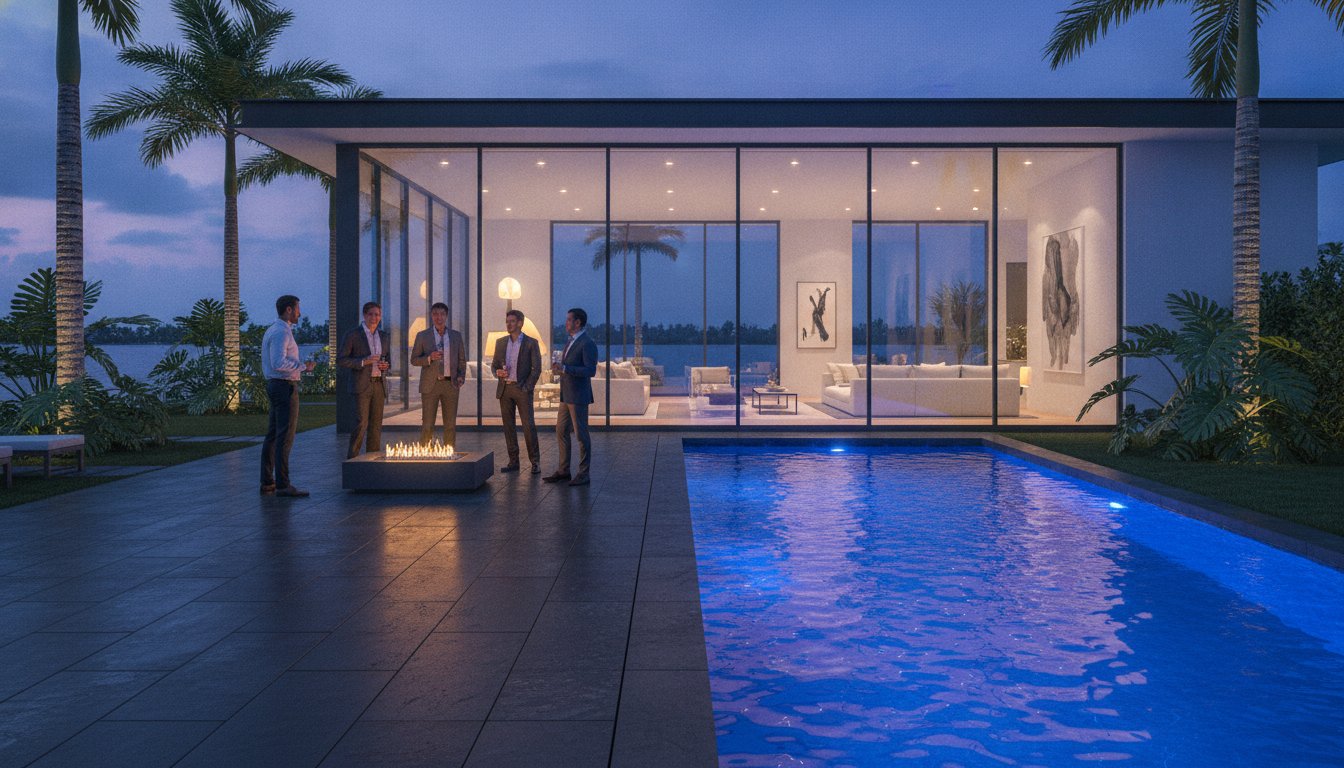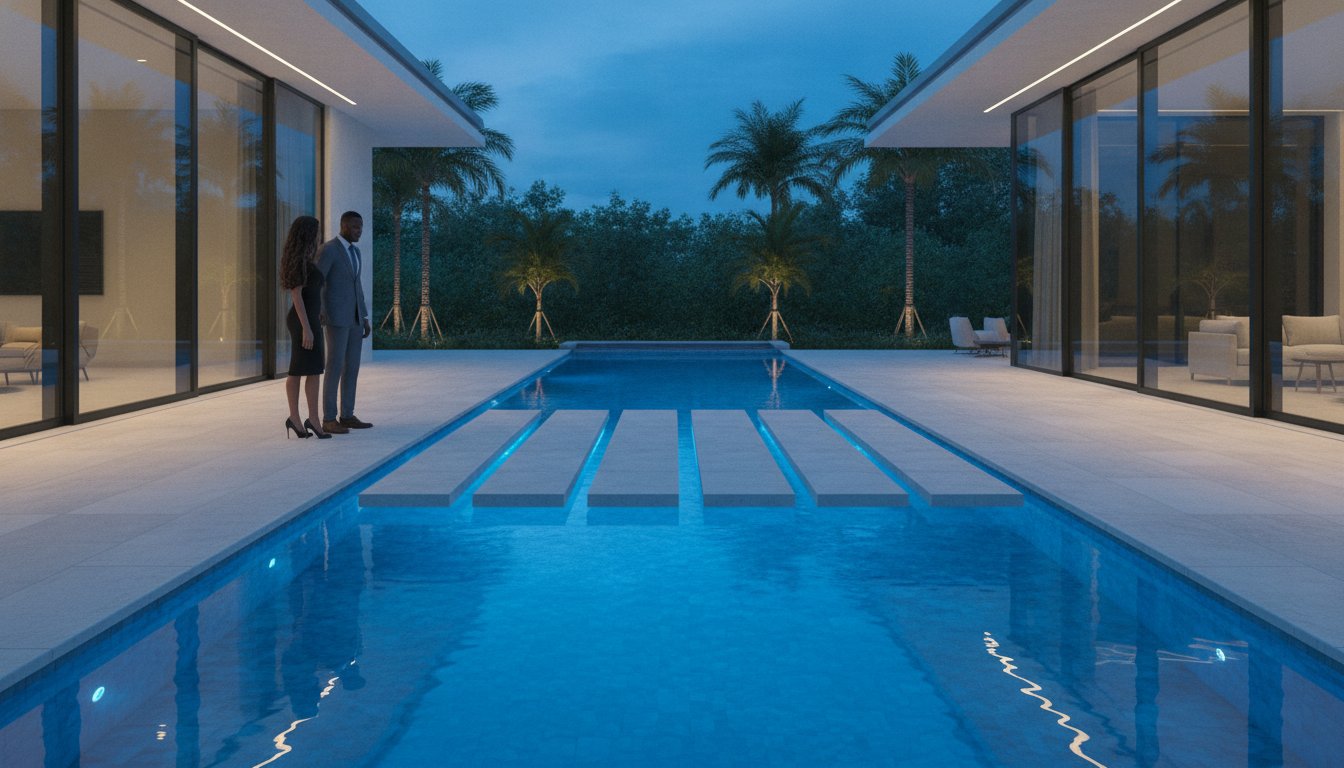
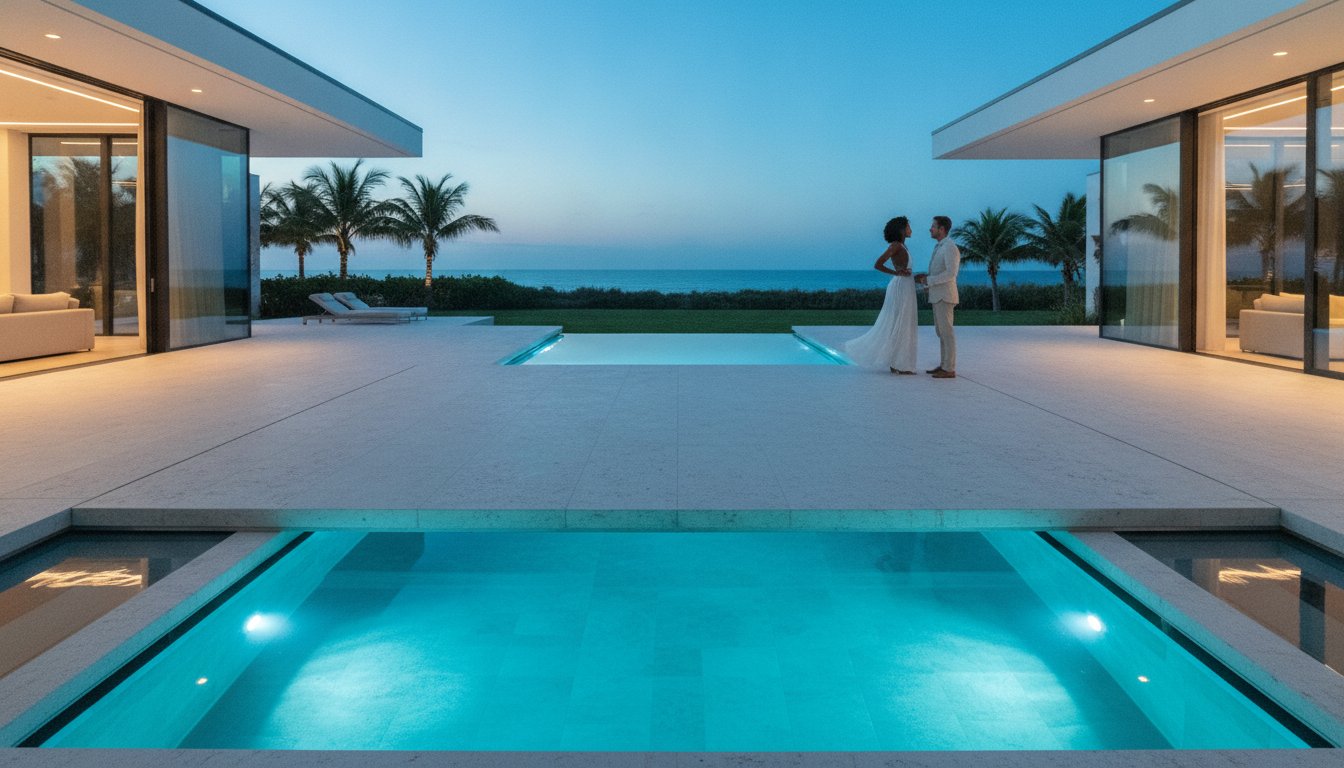
What if your outdoor terrace could vanish in ninety seconds, revealing a deep-water swimming pool beneath the stone? In high-value Florida real estate, every square foot of land is a premium asset, yet traditional layouts often force a compromise between an expansive entertaining patio and a luxury aquatic feature. You understand that maximizing usable space requires more than just a standard build; it demands a sophisticated marriage of architecture and mechanical precision.
This technical evaluation of twinscape vs custom pool floors explores the critical differences between standardized luxury systems and bespoke engineered solutions. You’ll discover how to navigate the complexities of 2026 load capacities, movement speeds, and the rigorous demands of coastal engineering. We’ll examine the structural requirements for seamless integration, ensuring your multi-functional environment offers both aesthetic excellence and long-term mechanical peace of mind. By the end of this comparison, you’ll have the technical clarity needed to select a system that transforms your property into a versatile, high-performance masterpiece.
Key Takeaways
- Understand how vanishing pool floors reclaim high-value square footage in Florida estates; this allows a single area to function as both a deep-water pool and a structural terrace.
- Analyze the technical trade-offs of twinscape vs custom pool floors to determine whether a standardized branded system or a bespoke engineered platform suits your project requirements.
- Evaluate the mechanical reliability of different drive systems, including hydraulic, electric, and spiral lift technologies, to ensure long-term performance under heavy dynamic loads.
- Discover the architectural freedom provided by custom engineering; these solutions adapt the mechanical hardware to your pool’s unique geometry rather than forcing design compromises.
- Learn why early integration with a specialized design-build firm is essential for navigating Florida-specific site conditions and complex municipal building codes.
The Evolution of Aquatic Space: Understanding Moveable Pool Floors
The concept of a vanishing pool floor represents the pinnacle of modern aquatic design. It is a sophisticated mechanical platform capable of adjusting water depth with absolute precision. What was once a niche application for commercial hydrotherapy has evolved into a centerpiece for high-end residential architecture. These systems allow a single footprint to serve multiple purposes, shifting from a deep-water swimming pool to a shallow wading area or a completely dry, structural floor. This adaptability is no longer a luxury of convenience; it’s a requirement for the modern, high-performance home.
In Florida’s most exclusive enclaves, such as Palm Beach or Miami, land is the ultimate luxury asset. Homeowners are increasingly unwilling to sacrifice a significant portion of their property to a static body of water that remains unused for large portions of the day. The decision-making process regarding twinscape vs custom pool floors often hinges on how effectively a system can reclaim that high-value square footage while maintaining the home’s aesthetic integrity. When evaluating the engineering behind twinscape vs custom pool floors, the choice often dictates the level of architectural customization available for the pool’s finish materials and the overall integration with the home’s terrace.
How Vanishing Pool Floor Technology Works
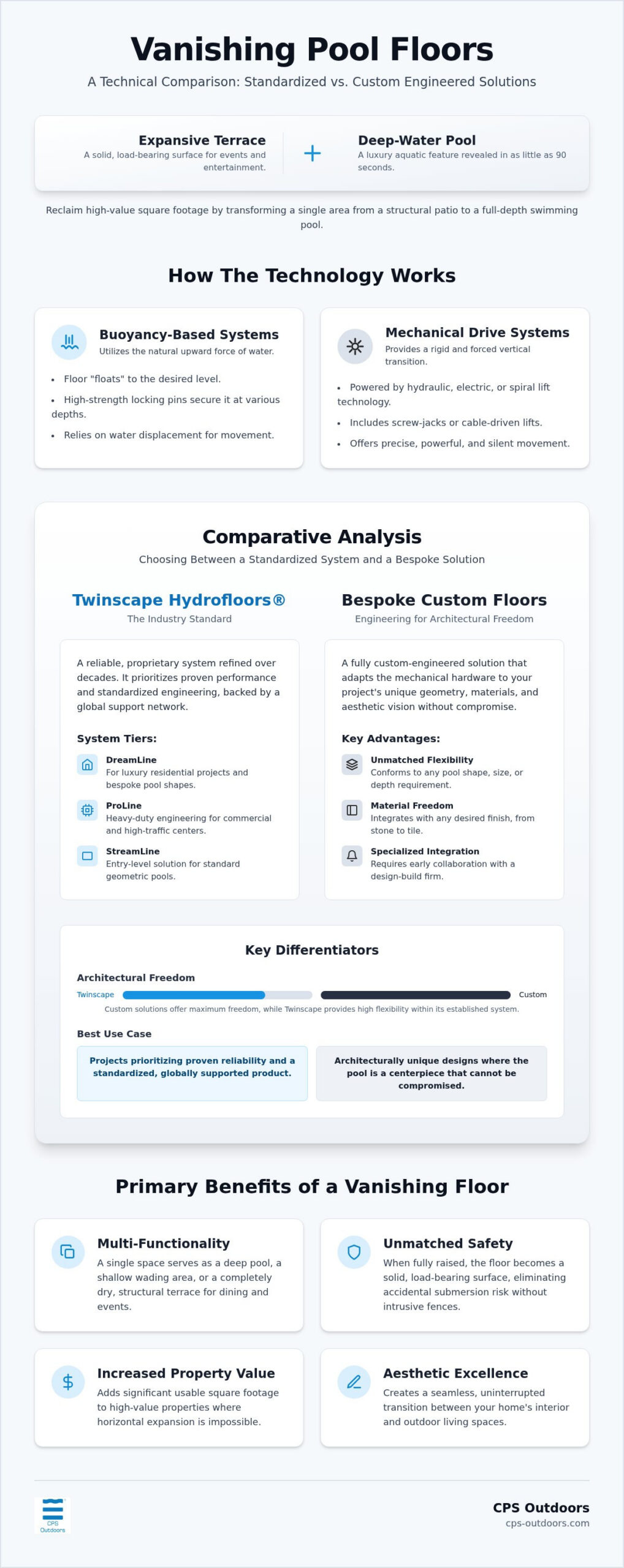
Modern moveable floors operate through two primary mechanical philosophies. Buoyancy-based systems utilize the natural upward force of water, essentially floating the floor and using high-strength locking pins to secure it at the desired depth. In contrast, mechanical drive systems, such as screw-jacks or cable-driven lifts, provide a more rigid and forced vertical transition. These systems rely on fundamental Architectural Engineering Principles to manage massive water displacement and ensure silent movement. Precision drainage and specialized filtration paths are required to allow water to flow around and beneath the platform without creating turbulence or mechanical strain. Power requirements are typically optimized for residential grids, ensuring the transition from a six-foot pool to a flush patio occurs smoothly and efficiently.
The Value of Multi-Use Square Footage in Luxury Real Estate
The primary appeal of this technology lies in its versatility. Within minutes, a deep swimming area becomes a stone-clad dining terrace or a structural event space. This multi-functional capability significantly boosts property valuation on compact, high-end lots where horizontal expansion is impossible. It is an investment in usable square footage that does not require a larger land parcel. Beyond the lifestyle benefits, these floors offer a level of safety that traditional covers cannot match. When fully raised, the floor becomes a solid, load-bearing surface. It effectively eliminates the risk of accidental submersion, providing total peace of mind for families without the need for intrusive safety fences. This seamless transition between an aquatic feature and a functional living space is the hallmark of bespoke estate design.
Twinscape Hydrofloors®: Analyzing the Industry Standard
Twinscape remains the global benchmark for branded moveable pool floors. Their Hydrofloors® technology is widely recognized as the industry standard, providing a reliable, proprietary chassis that has been refined over decades of high-end installations. For many architects and developers, the appeal of a Twinscape system lies in its mechanical maturity and the security of an established global support network. It’s a choice that prioritizes proven performance and standardized engineering protocols over purely experimental designs.
The DreamLine and ProLine Systems
Twinscape categorizes its offerings into three distinct tiers to address different project scales. The DreamLine system is the most popular choice for luxury residential projects. It supports bespoke pool shapes and complex features like vanishing edges, offering a high degree of aesthetic flexibility. For large-scale hospitality or public aquatic centers, the ProLine series provides the heavy-duty engineering required for high-traffic environments and increased load capacities. Finally, the StreamLine system serves as an entry-level solution designed specifically for standard geometric pools. This tiered approach allows for a more predictable specification process during the early design phases.
Strengths of Standardized Luxury
Choosing a branded system offers a level of predictability that is highly valued in complex construction. Architects benefit from ready-to-use CAD blocks and established structural requirements, which simplifies the integration of disappearing pool technology into the overall site plan. When evaluating twinscape vs custom pool floors, the primary advantage of the former is its proven mechanical history and rigorous warranty protocols. Because these are proprietary units, replacement parts are standardized and accessible through a global network of certified partners.
However, this standardization requires a specific approach to logistics. Lead times for Twinscape systems are often substantial, reflecting the precision manufacturing required at their factory facilities. Installation must be performed by factory-certified technicians to maintain warranty validity. This ensures the mechanical components are calibrated to the exact tolerances required for silent, reliable operation. If you are beginning the planning phase for a high-specification aquatic project, consulting with an experienced engineering partner can help determine if a branded system aligns with your project’s timeline and architectural goals.
Bespoke Custom Pool Floors: Engineering for Architectural Freedom
Bespoke engineering prioritizes the architectural vision above mechanical convenience. While branded systems offer a reliable chassis, a custom-engineered floor is designed from the ground up to fit the pool’s specific geometry. This approach is essential for projects that deviate from standard rectangular or simple organic shapes. In the comparison of twinscape vs custom pool floors, the bespoke route provides the flexibility to select mechanical drive systems tailored to site-specific constraints, such as limited pit depth or strict acoustic requirements. Integrating these platforms with stainless steel pool construction provides a level of dimensional stability that concrete cannot match, ensuring the tight tolerances required for a flawless finish.
Custom solutions are often the only viable path when a design involves complex architectural curves, extreme depths, or cantilevered structures. These projects demand a meticulous level of coordination between the structural engineer and the aquatic designer. By engineering the lift mechanism around the pool’s unique footprint, designers can maintain the purity of their vision without being restricted by the fixed dimensions of a proprietary kit. It’s a process of creating a mechanical masterpiece that serves the architecture, rather than forcing the architecture to serve the machine.
Material Selection Beyond the Standard
A significant advantage of custom engineering is the ability to support extreme material weights. Standard systems often have lift capacities calibrated for thin porcelain or lightweight composites. A bespoke floor can be engineered to lift rare stone slabs, intricate tile-work, or heavy specialized decking that matches the surrounding terrace perfectly. This ensures total architectural continuity between the pool surface and the luxury pool hardscape design. Achieving a truly invisible transition requires the mechanical power to move these high-density materials with silent, effortless precision.
Integration with Complex Aquatic Architecture
For projects managed by luxury infinity pool builders miami, custom floors allow for the seamless integration of vanishing edges and perimeter overflows. These features require specialized water management systems that can adapt as the floor changes depth. In the context of luxury rooftop pool construction, custom mechanical pits are often necessary to navigate the structural beams and plumbing of the building’s envelope. Whether it’s a glass-walled pool or a multi-level aquatic feature, custom engineering provides the technical solutions required for the most ambitious residential designs.
Twinscape vs. Custom: A Comparative Engineering Analysis
Deciding between a branded system and a bespoke build requires a deep dive into the mechanical philosophy of each. Twinscape operates as a proprietary “black box” solution; it is a refined, closed-loop product where every component is designed to work within a specific factory ecosystem. In contrast, custom-engineered floors represent an open-architecture approach. This allows engineers to select the most robust industrial components for a specific site’s demands. When analyzing twinscape vs custom pool floors, the primary distinction lies in whether you prefer the security of a global brand or the flexibility of a system designed specifically for your property’s unique environmental and structural profile.
Mechanical Reliability and Load Capacities
Load-bearing capacity is a critical metric for any floor that doubles as an entertaining space. While most systems meet the ASTM F1346 standard of supporting at least 415 pounds, high-end social gatherings often demand much higher static PSI ratings. Custom-engineered floors can be reinforced to handle the weight of heavy furniture or large crowds without risking mechanical deflection. Drive systems also vary significantly; while Twinscape often utilizes high-performance buoyancy and cable systems, custom builds might employ spiral lift technology or heavy-duty electric actuators. Fail-safe mechanisms are equally vital. In the event of a power outage, these systems must utilize mechanical brakes or hydraulic locks to prevent unintended movement. In Florida, the engineering must also account for extreme salt air. Using 316L stainless steel and corrosion-resistant composites is mandatory to ensure the drive train doesn’t seize in the humid coastal climate.
Maintenance and Long-Term Serviceability
Long-term ownership reveals the true cost of a “Proprietary Trap.” If a proprietary motor or sensor fails ten years from now, you are entirely dependent on that specific manufacturer’s supply chain and pricing. Custom pool floors often utilize industrial-standard hydraulic and electrical components. These parts are readily available from multiple high-end vendors, ensuring that your system remains serviceable for decades without being tied to a single brand’s existence. Routine maintenance involves more than just software updates; the pit beneath the floor requires periodic cleaning to remove debris and ensure the drainage paths remain clear. CPS Outdoors approaches long-term support by designing systems with accessible service points and utilizing non-proprietary hardware where possible. This provides our clients with total mechanical independence and peace of mind. If you are ready to evaluate the best mechanical fit for your estate, contact our engineering team to discuss a tailored solution.
The CPS Outdoors Approach: Designing Your Vanishing Floor System
CPS Outdoors serves as the specialized bridge between architectural vision and mechanical reality. We guide our clients through the nuanced selection process of twinscape vs custom pool floors by analyzing the project’s structural constraints and lifestyle requirements. Engaging with custom residential pool builders Florida experts during the initial design phase ensures that the pool shell and mechanical pit are engineered as a single, cohesive unit. Our process moves methodically from the first engineering concept through to precise commissioning and comprehensive client training. We don’t just install equipment; we curate high-performance environments.
The Florida Engineering Perspective
Operating in South Florida introduces unique environmental challenges that standardized kits may not fully address. High groundwater levels and the porous nature of limestone substrates require sophisticated hydrostatic relief systems to protect the mechanical pit from uplift. In coastal areas like Miami Beach, the saline environment demands ultra-high-grade 316L stainless steel for all submerged components to prevent rapid oxidation. We navigate the stringent Florida building codes regarding moving structures and hurricane-resistant anchoring. This local expertise is especially critical for rooftop installations. In these cases, the dynamic load of a moving floor must be perfectly balanced with the building’s structural capacity to ensure long-term stability.
The Investment: Value Beyond the Initial Cost
A moveable pool floor is a strategic investment in a property’s functional square footage. In premium markets where lot sizes are limited, the ability to reclaim hundreds of square feet for entertaining significantly impacts the home’s market value. When evaluating the luxury swimming pool cost miami, it’s essential to view the moveable floor not just as a pool feature, but as a structural addition to the home’s living space. The comparison of twinscape vs custom pool floors ultimately comes down to which system provides the most enduring value for your specific site. Our firm provides the technical oversight required to ensure your investment delivers both architectural beauty and mechanical longevity. Scheduling an engineering consultation is the first step toward realizing a truly multi-functional estate.
Mastering the Art of Aquatic Versatility
The decision-making process for twinscape vs custom pool floors ultimately centers on the specific demands of your property and the complexity of your architectural vision. Whether you prioritize the established mechanical history of a branded system or the total freedom of a bespoke engineering solution, the goal remains the same: a multi-functional environment that maximizes every square foot of your estate. In Florida’s unique coastal climate, success depends on meticulous technical oversight and a deep understanding of local structural requirements.
As specialists in stainless steel and mechanical pool systems, CPS Outdoors ensures that your vanishing floor operates with silent, reliable precision. It’s a journey that requires a seamless integration of design and engineering to achieve a truly invisible transition. By partnering with experts who understand the nuances of Florida-based bespoke aquatic architecture, you secure both aesthetic excellence and long-term mechanical peace of mind. Consult with our aquatic engineers on your moveable floor project to begin transforming your high-value living space. We look forward to helping you realize a more versatile outdoor environment.
Frequently Asked Questions
How much weight can a moveable pool floor actually support?
A moveable pool floor typically supports a minimum of 415 pounds to meet ASTM F1346 safety standards. Branded systems like Twinscape are engineered for standard residential loads, while custom solutions can be reinforced for significantly higher weight limits. This is a primary consideration when comparing twinscape vs custom pool floors for entertaining. Bespoke engineering allows for the placement of heavy outdoor furniture or large social gatherings directly on the raised platform without structural deflection.
Can I install a moveable floor in an existing pool during a renovation?
Installation during a renovation is possible but requires a rigorous structural evaluation of the existing shell. Most systems necessitate a sub-floor pit to house the mechanical components when the floor is at full depth. We often integrate stainless steel liners during these projects to ensure the perfectly plumb walls required for vertical movement. It’s an intensive engineering task that transforms a traditional basin into a high-performance, multi-functional asset.
How long does it take to transition the floor from full depth to solid ground?
Movement speed is regulated for safety, typically averaging 1.5 feet per minute according to the 2024 Model Aquatic Health Code. For a standard five-foot pool, the transition from a deep swimming environment to a flush entertaining terrace takes approximately three to four minutes. This deliberate pace ensures that water displacement occurs smoothly and prevents mechanical strain. The operation is designed to be silent and steady, reflecting the precision of the underlying drive system.
Is a moveable pool floor considered a legal safety cover in Florida?
In many Florida jurisdictions, a fully raised and locked moveable floor serves as a legal safety barrier. It must meet ASTM F1346 standards to be classified as a safety cover. While this can potentially negate the need for secondary pool fencing, compliance is always determined by local municipal building codes. We work closely with Florida officials to ensure every installation adheres to the specific safety requirements of your local area.
Do custom pool floors require more maintenance than standard pools?
Moveable floors require more specialized attention than traditional pools. Maintenance includes periodic cleaning of the sub-floor pit to remove debris and routine inspections of the hydraulic or electric drive components. While standard pools focus on water chemistry, these systems demand mechanical calibration to ensure long-term reliability. Choosing between twinscape vs custom pool floors often depends on your preference for proprietary service versus using industrial-standard parts that any qualified technician can source.
Can I tile a Twinscape floor to match my custom patio stone exactly?
You can tile a Twinscape floor to match your patio, though you must stay within the system’s specified weight tolerances for finishes. Branded systems like the DreamLine series are designed to accommodate porcelain or thin stone veneers. If your architectural vision requires thick, high-density stone slabs, a custom-engineered floor is often the superior choice. This allows for a perfectly seamless transition between the pool surface and the surrounding luxury hardscape.
What happens if the power goes out while the pool floor is halfway up?
Safety protocols are built into the mechanical design to handle power interruptions. Most systems utilize fail-safe mechanical brakes or hydraulic locking pins that engage automatically if power is lost. This prevents the floor from drifting or sinking unexpectedly. Manual overrides or battery backups are also common features, allowing you to complete the transition if necessary. These redundant systems provide the peace of mind required for high-stakes residential and commercial environments.
Are moveable pool floors compatible with salt water systems?
Moveable floors are fully compatible with salt water systems when constructed from the correct materials. We prioritize the use of 316L stainless steel and high-grade composites to resist the corrosive nature of saline environments. This is particularly important for Florida estates where salt air and water are constant factors. Proper material selection ensures the mechanical drive train and structural platform remain pristine and functional for decades of coastal use.