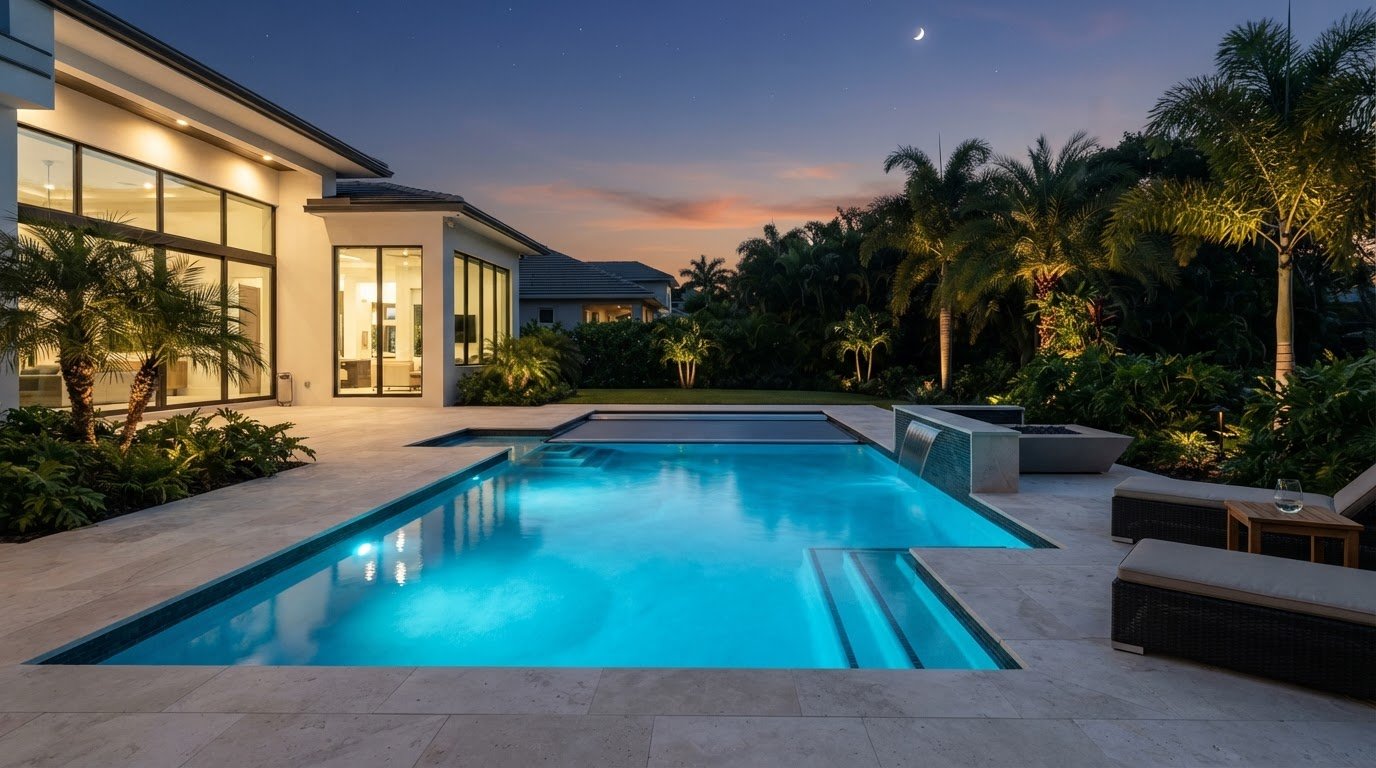
What if the best pool renovation starts by rethinking how the space works, not simply how it looks? A dated pool can feel out of step with the home, but deciding what to replace, retain, or re-engineer takes more than choosing a new finish. High-end residential pool renovations bring design, engineering, and household priorities into the same conversation.
It’s understandable to want distinctive features without sacrificing function or safety, especially when the condition of existing structures and systems is unclear. A considered renovation begins with an assessment of the pool and site, followed by design decisions based on how the household uses its outdoor space. Not every feature suits every property. Options such as a moveable pool floor or automatic pool cover need to be evaluated for their purpose and suitability.
This Florida case study focuses on the decisions that shape a renovation, from defining the project to evaluating technical feasibility. Rather than presenting an individual home’s before-and-after, it offers a practical framework for comparing priorities, scope, and features. CPS Outdoors’ design, engineering, and construction capabilities can support complex residential projects, with each proposed solution assessed for the property.
Key Takeaways
- High-end residential pool renovations can involve more than finishes. Match the scope to the pool’s condition and the changes you want to make.
- Compare targeted updates, coordinated renovations, and reconstruction by reviewing existing conditions, intended changes, and engineering needs.
- Use a clear planning sequence to connect household priorities, site assessment, design decisions, approvals, construction, and handover.
- Assess features such as moveable pool floors and automatic pool covers for suitability rather than assuming they belong in every renovation.
- When reviewing a case study or choosing a project partner, look for confirmed scope details and coordination across design, engineering, and construction.
High-End Residential Pool Renovations: When Is It Time to Rethink the Space?
A pool can look dated, feel awkward to use, or no longer suit the home without revealing what lies beneath the surface. Start by recording what is visibly out of date or difficult to use, then identify questions that need professional evaluation. A documented review of the pool and site can help distinguish a cosmetic refresh from changes involving the layout, surrounding areas, or systems.
Some projects focus on visible finishes. Others involve connected changes to the pool and its setting, calling for coordinated design and engineering. The distinction matters: a new surface can refresh appearance, but it won’t by itself address a layout that doesn’t support how the household swims, relaxes, or entertains. Pool construction and materials also inform the assessment; for background, see this overview of swimming pool construction.
Which signs suggest a pool needs more than a cosmetic refresh?
Separate what you can observe from what needs professional evaluation. Faded finishes or a visual mismatch with the residence are aesthetic concerns. Questions about structure, equipment, or circulation require qualified assessment. A visible symptom alone can’t establish its cause or the renovation scope.
- Visual: The finish, coping, or overall appearance feels inconsistent with the home.
- Functional: The layout no longer supports the household’s preferred activities or movement around the pool.
- Technical: There are concerns about the structure, equipment, or existing features that need professional review.
How should homeowners define a renovation brief?
Describe priorities before selecting features. Decide whether the pool is mainly for swimming, relaxation, entertaining, or a combination. Consider how people should move between the home, pool, and outdoor gathering areas. If several priorities compete, identify which ones matter most so the design team can use them to guide trade-offs.
Next, list what the project team needs to assess: the existing structure and systems, site constraints, surrounding features, and the relationship between the pool and residence. Specialized options such as a moveable pool floor or automatic pool cover should be considered in light of project goals and technical suitability. Homeowners looking for visual direction can explore luxury pool renovation trends in South Florida, then compare ideas with the realities of their property.
A focused brief gives design and engineering decisions a shared purpose. It also helps distinguish a surface refresh from a coordinated renovation without assuming in advance which scope is right.
How Design and Engineering Shape a High-End Pool Renovation
A successful renovation connects the homeowner’s brief to the existing pool and the realities of the site. Design establishes how the space should look and function. Engineering helps determine which changes are feasible and how they relate to existing conditions. That coordination distinguishes high-end residential pool renovations from a finish update considered in isolation.
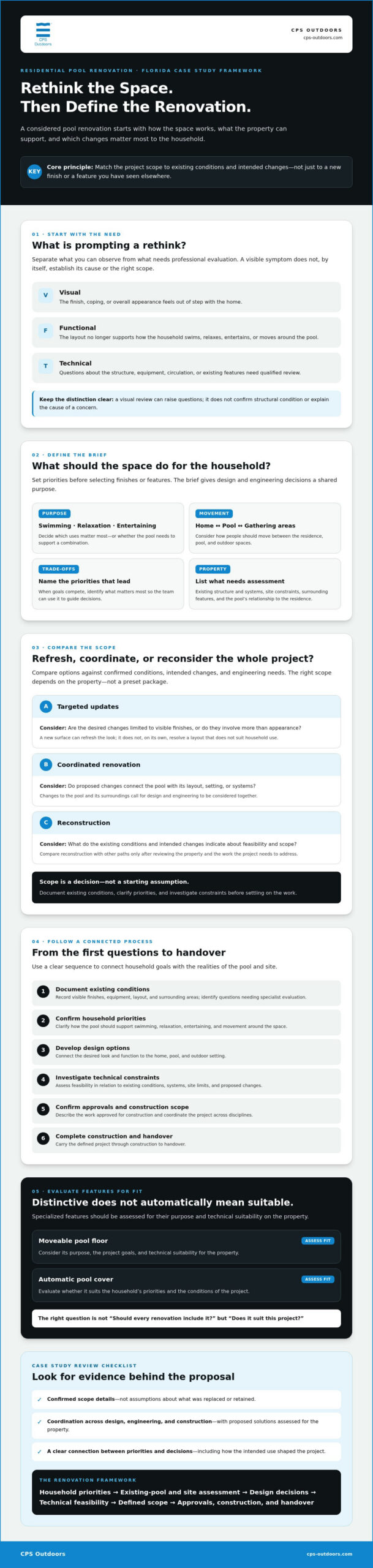
A useful project sequence is straightforward: document existing conditions, confirm household priorities, develop design options, investigate technical constraints, and describe the work that is approved for construction. Homeowners can use this sequence to ask whether a proposal addresses both the desired experience and the conditions of the property.
What does an existing-pool assessment need to establish?
An assessment should document the pool and its relationship to the property, including visible finishes, equipment, layout, and surrounding areas. It should distinguish observations from confirmed findings. A visual review can identify questions for further investigation, but it doesn’t prove structural condition or establish the cause of a symptom. Identify any concerns requiring specialist evaluation before design decisions depend on them.
The resulting information gives the project team a basis to compare the brief with the site. Circulation affects how people enter, exit, swim, and gather around the pool. Finish selection influences the visual relationship between the water, home, and adjacent spaces. Equipment and proposed changes also need to be considered together, rather than treated as unrelated selections.
How can specialized features fit a renovation?
Features should follow the project’s purpose, not lead it. A stainless steel pool may prompt questions about how the material fits the design and existing conditions. A moveable pool floor calls for project-specific evaluation of its structural and spatial requirements. An automatic pool cover also needs to be assessed for compatibility with the pool design and intended use. None should be assumed suitable without engineering and site review.
When material selection is relevant, a stainless steel pool engineering guide can offer background, but the project team still needs to assess the specific site and scope. For Florida projects, consult the Florida pool safety and sanitation standards as part of coordinating design decisions with applicable health guidance.
A disciplined design-and-engineering process turns inspiration into a brief that can be evaluated against existing conditions. Homeowners considering a complex renovation can review CPS Outdoors’ pool design and engineering capabilities when comparing project partners.
Renovation or Rebuild? Compare Scope, Feasibility, and Priorities
The right scope depends on what the existing pool can support and what the household wants to change. A finish update may suit a pool whose layout and relevant conditions meet the project brief. A coordinated renovation may address several connected elements. More extensive reconstruction may warrant consideration when the intended changes or assessment findings make a narrower scope unsuitable. None is automatically the better choice.
A premium feature isn’t automatically compatible with every existing pool. A moveable pool floor, for example, brings project-specific structural and spatial questions. Its appeal alone can’t establish feasibility. Resources such as the Pool & Hot Tub Alliance can inform the conversation, but suitability still depends on the specific pool, site, and design.
| Possible scope | Existing conditions and intended changes | Engineering review and implications |
|---|---|---|
| Targeted finish update | The brief focuses on appearance, while the existing layout and relevant components are considered suitable for the planned work. | Confirm the proposed finish work is compatible with the pool’s documented condition and scope. |
| Coordinated renovation | The household wants connected changes to the pool experience, such as adjusting how it relates to surrounding spaces or considering additional features. | Evaluate how each change affects the design, existing structure, equipment, and other project elements. |
| Broader reconstruction | The desired design or confirmed site conditions may not align with a narrower renovation scope. | Assess the feasibility of the proposed extent of change before settling on a direction. |
When might renovation preserve useful parts of an existing pool?
Retention should be based on assessment, condition, design goals, and qualified professional judgment. Ask the project team to document which components are suitable to keep, which require further investigation, and how each decision relates to the brief. Don’t assume that retaining a component guarantees savings, longer service life, or a particular performance outcome.
When might the project require a broader intervention?
Proposed changes that interact with the existing structure, equipment, or layout call for coordinated review. New features can introduce additional design and engineering considerations, so compare the intended result with what the site and existing pool can support. Broader custom aquatic architecture offers useful context, but it isn’t a substitute for project-specific assessment.
For high-end residential pool renovations, the strongest scope is the one justified by documented conditions and household priorities. A transparent comparison helps homeowners understand what can be retained, what needs investigation, and why a chosen direction fits the project.
Planning a Florida Pool Renovation: Decisions Before Construction
Good preparation turns a broad ambition into a project the team can assess, design, and coordinate. For high-end residential pool renovations, align household priorities with existing conditions before construction begins. In Florida, sun exposure, weather exposure, and drainage are among the site factors to evaluate. Their relevance depends on the specific property, so avoid treating them as assumptions about every pool.
What should homeowners settle before design development?
Gather the people, records, and priorities that will inform the brief. Identify who approves decisions, what matters most, and how the pool should connect to the outdoor setting. Available plans and past renovation records can provide context, but they don’t replace an assessment of current conditions.
- 1. Define goals: Set priorities for swimming, relaxation, entertaining, and the relationship between the pool, home, and outdoor areas.
- 2. Assemble information: Collect available plans, past renovation records, and relevant site information. Note questions about existing features or systems for the project team to assess.
- 3. Establish decision-making: Confirm who will make selections, who must approve the work, and how decisions will be communicated.
- 4. Assess the site: Review the existing pool and surrounding conditions. Consider whether sun, weather exposure, or drainage affects the intended design.
- 5. Develop and confirm the scope: Connect design choices to technical review, then check permit requirements with the relevant local authority. Requirements depend on location and project scope.
- 6. Coordinate construction and handover: Before work begins, clarify the approved scope, site access, anticipated sequencing, communication process, and what will be reviewed at handover.
How can construction coordination reduce uncertainty?
CPS Outdoors provides pool design, engineering, and construction, allowing these disciplines to be considered together. Homeowners should clarify how approved plans and scope will guide construction, how site access and sequencing will be handled, and who will communicate decisions or changes. Clear answers help keep design intent connected to the work being built.
Before committing to a direction, ask the project team to explain what is confirmed, what still needs investigation, and which approvals apply to the property. Homeowners considering a renovation can discuss project feasibility with CPS Outdoors.
CPS Outdoors Pool Renovation Case Study: From Verified Brief to Finished Space
A useful renovation case study shows how homeowner priorities, existing conditions, design choices, and engineering considerations shaped the finished project. This article takes a decision-focused approach rather than attributing a particular home, feature, or result to a completed renovation. That distinction is important: readers should be able to tell the difference between general planning guidance and verified project details.
CPS Outdoors designs, engineers, and builds residential pool renovations in Florida. When reviewing any project example, look for a clear account of the homeowner’s goals, the assessed conditions, the selected scope, and the completed work. Those details help readers understand how a renovation partner approaches complex decisions without implying that one project outcome applies to every property.
What project evidence makes the case study credible?
Organize a project account into a clear sequence so readers can follow the reasoning, not just view the finished space.
- Brief: Record the homeowners’ goals and reason for renovating, using details they have approved for publication.
- Existing conditions: Confirm the project location, pool and site conditions, and which findings were established through assessment.
- Design response: Verify the selected scope, materials, and features, and explain how they relate to the brief.
- Engineering decisions: Include only confirmed technical considerations and relevant approvals. Don’t treat visual observations as proof of structural condition.
- Completion: Describe the finished work and any measurable outcomes only when they’re documented, attributable to the project, and approved.
Before-and-after images should depict the same project accurately and have publication approval. Quotations and statements about performance also need an authorized source. If details can’t be verified, omit them rather than filling gaps with assumptions.
How can homeowners begin a comparable conversation?
Prepare a concise outline of what you want the renovated pool to support, along with available plans or renovation records. Note relevant site constraints and questions about existing features. This gives a project discussion useful context, but it doesn’t establish feasibility. That depends on review of the specific pool, site, and proposed scope.
For homeowners considering high-end residential pool renovations, CPS Outdoors’ design, engineering, and construction capabilities provide a starting point for discussing a project. Explore a residential pool renovation with CPS Outdoors.
Shape a Pool Around the Way You Live
A considered renovation begins with the existing pool, the site, and the household’s priorities. Comparing a focused update with a broader intervention helps clarify scope, while coordinated design and engineering connect the desired experience to what the property can support. For high-end residential pool renovations, distinctive features should be evaluated for project-specific suitability, not selected on appearance alone.
CPS Outdoors offers residential renovations alongside aquatic design, engineering, and construction. Depending on the project, specialized capabilities such as stainless steel pools, moveable pool floors, and automatic pool covers may be options to assess. A project conversation can help identify what information is needed to explore feasibility without assuming a particular feature or scope will suit every property.
Ready to discuss your goals, existing pool, and site considerations? Explore a residential pool renovation with CPS Outdoors. A clear brief is a thoughtful first step toward a more cohesive outdoor space.
Frequently Asked Questions
Is renovating an existing pool better than building a new one?
Neither option is automatically better. The right choice depends on the pool’s condition, the site, and the renovation goals. If the existing pool can support the desired changes, a targeted or coordinated renovation may be appropriate. If the intended design or assessment findings point beyond what the existing structure can accommodate, consider whether broader reconstruction is more suitable. Ask the project team to explain the technical basis for its recommendation.
Can you add high-end features to an existing residential pool?
Some features may be incorporated, but suitability depends on the specific pool, site, and engineering review. Stainless steel elements, a moveable pool floor, or an automatic pool cover shouldn’t be treated as standard additions. Each option can affect design decisions and technical requirements. For high-end residential pool renovations in Florida, discuss the feature’s purpose, compatibility with existing conditions, and any required design changes before including it in the project brief.
How much does a high-end residential pool renovation cost?
There’s no reliable project price without a defined scope and review of the property. Cost depends on the existing pool, the extent of proposed changes, material selections, features, and project-specific design and engineering requirements. Rather than relying on a broad online estimate, prepare your priorities and available pool information, then request a project-specific assessment and written scope. Confirm what is included and which items may require further investigation.
What happens if an inspection finds structural issues in the existing pool?
Structural concerns should be evaluated by qualified professionals before the renovation scope is finalized. Ask what was observed, what further investigation is recommended, and how confirmed findings affect the proposed design. A visible symptom alone doesn’t establish its cause or the appropriate response. Depending on the assessment, the team may need to revise the scope or evaluate broader interventions. Request documented findings and a clear explanation before authorizing related work.
Do pool renovations in Florida require permits?
Permit requirements depend on the project scope and the authority with jurisdiction over the property. Before construction, ask which approvals apply to the proposed work and who is responsible for confirming them. Verify current requirements directly with the relevant local building or permitting authority, rather than assuming a previous pool approval covers renovation work. Include approval responsibilities in project discussions so permitting questions are addressed before construction begins.
How long does a luxury pool renovation take?
Duration varies with the renovation scope, site conditions, design and engineering needs, approvals, and construction sequencing. A finish-focused update and a project involving structural or feature changes may require different schedules. Ask the project team for a schedule based on the approved scope, including key decision points and factors that could affect sequencing. Avoid relying on a general timeline before the property and proposed work have been assessed.
How do I choose a pool renovation contractor in Florida?
Look for a partner able to coordinate the disciplines your project needs, and verify relevant experience with comparable renovation scopes. Ask how existing conditions are assessed, how design choices are checked for technical feasibility, and how scope, approvals, construction coordination, and communication are handled. Review documented project examples, confirm references and credentials independently, and request clarity about inclusions and exclusions. CPS Outdoors offers residential renovations, pool design and engineering, and construction in Florida.