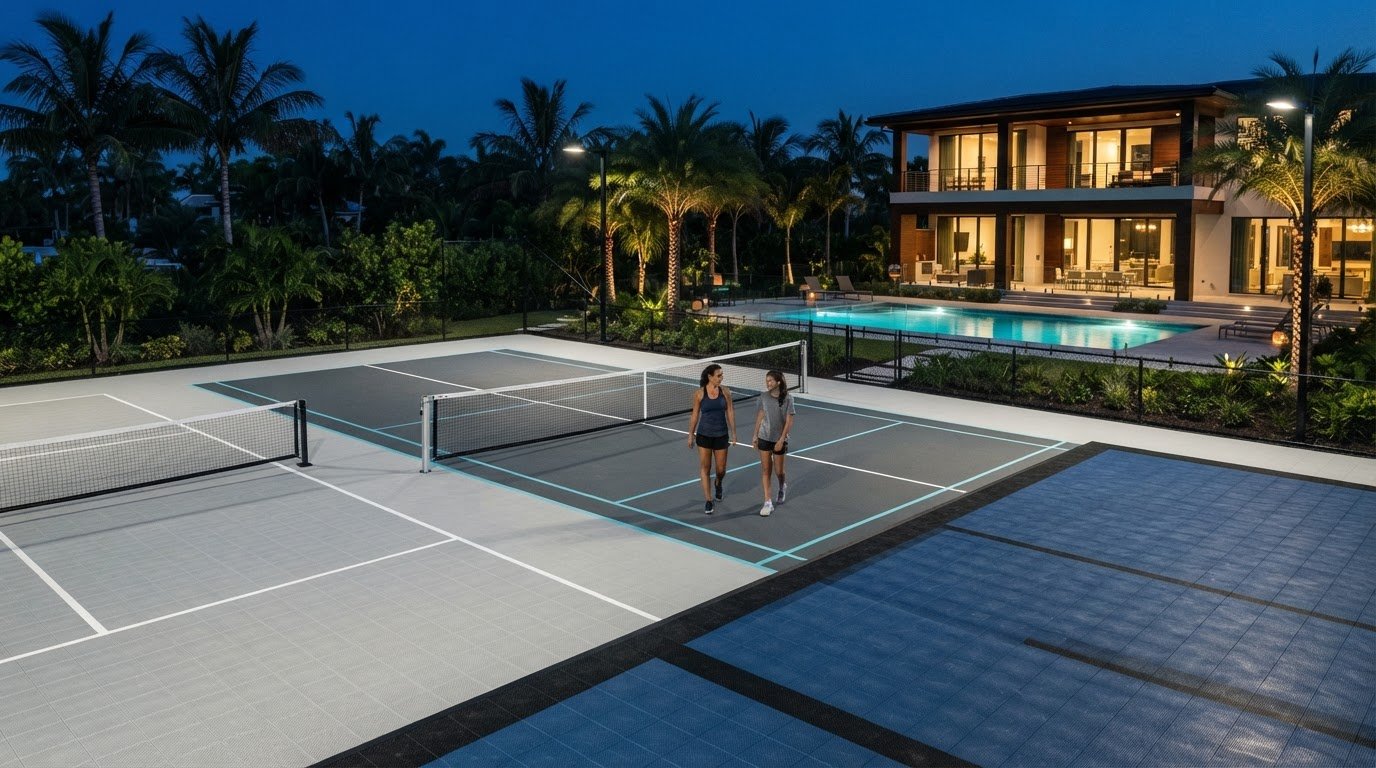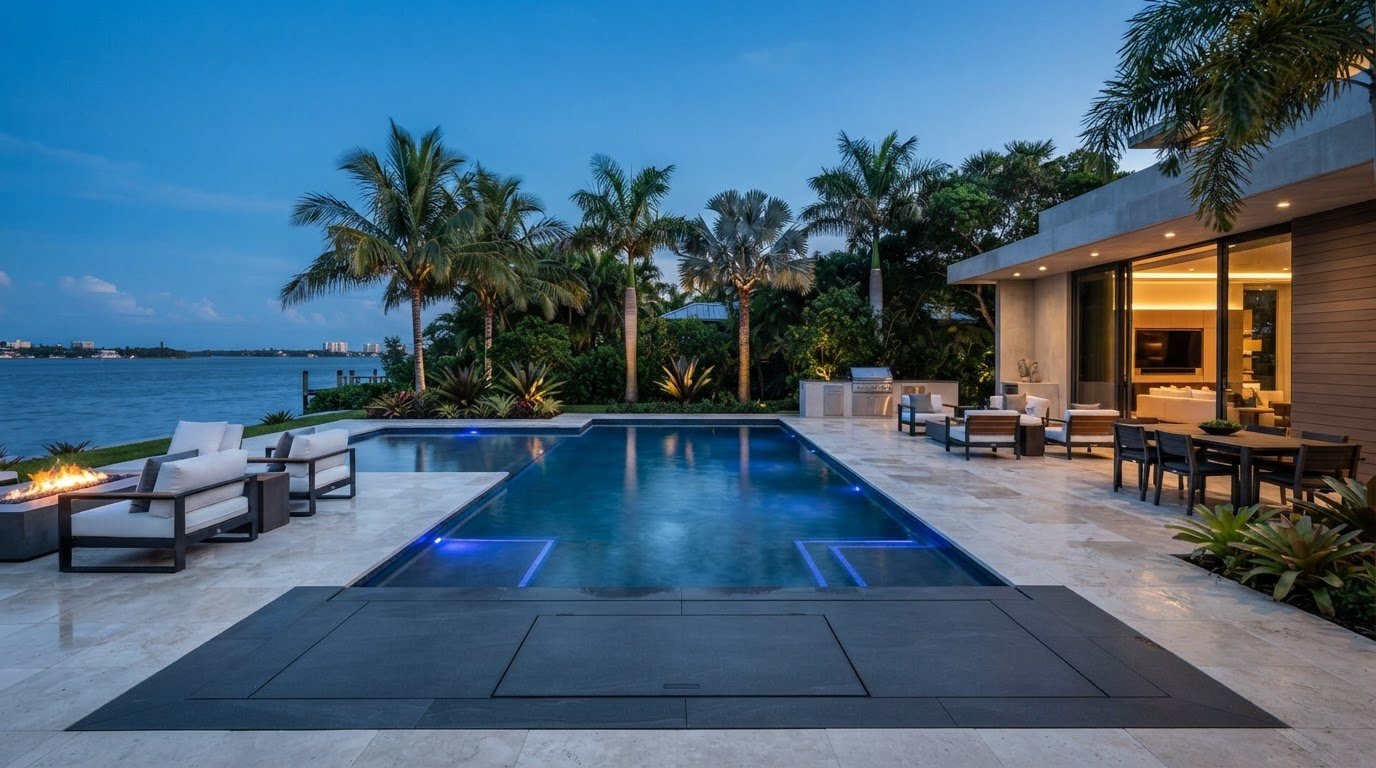
The court that fits your yard isn’t automatically the court that works for every game. With custom multi sport court installation, the order of decisions matters: prioritize the sports, check how their dimensions and markings can share the space, then assess the site before construction begins. Without that sequence, a court can end up with conflicting lines, awkward play areas, or surface concerns that planning could have identified.
You may be wondering which sports can share a court, or whether grading, drainage, and Florida weather exposure could affect the finished surface. A successful design connects intended use with the realities of the property. This guide walks through professional installation, from evaluating the site and selecting sports to confirming dimensions, markings, and equipment. You’ll also find Florida-specific site, local approval, and care questions to raise with a qualified contractor before work begins. With those decisions made in the right order, you can plan a court around your space and the way you intend to play.
Key Takeaways
- A clear usage brief helps determine which sports take priority and which court features can share the space.
- Assess drainage paths, utilities, access, and nearby structures before confirming dimensions or surface choices.
- For custom multi sport court installation, compare each sport’s layout and equipment needs before choosing shared markings.
- Ask how the proposed installation sequence accounts for verified site conditions and the selected flooring system.
- Confirm the project scope, communication process, and system-specific care guidance with a qualified installation partner.
How to Plan a Custom Multi-Sport Court Around the Games You Play
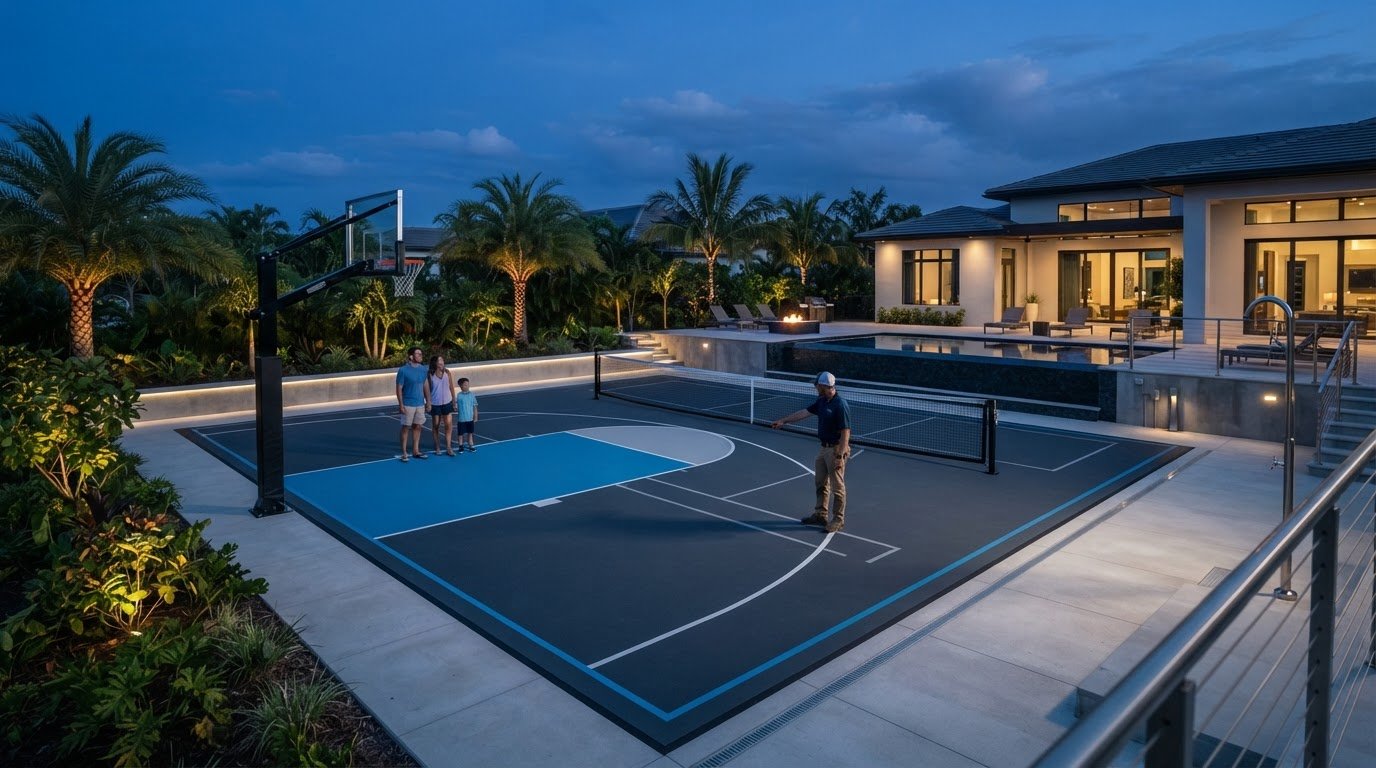
Start with the people and the sports, not the paint colors. A successful custom multi sport court installation begins by deciding who will use the court and how they’ll play. Those priorities guide choices about markings, finishes, and equipment. A basketball hoop with occasional pickleball, for example, may call for a different layout than two sports that need equal space and regular use.
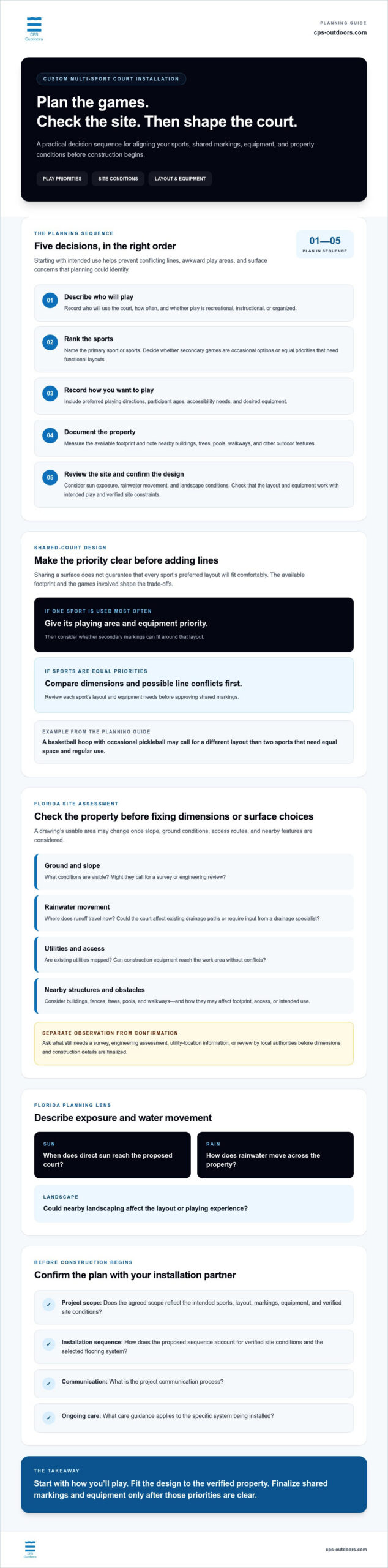
Use this sequence to turn early ideas into a design brief:
- Describe the users. Note who will play, how often, and whether play is recreational, instructional, or organized.
- Rank the sports. Identify primary sports and secondary activities. Decide whether secondary games are occasional options or equal priorities that need functional layouts.
- Record play preferences. Specify preferred playing directions, participant ages, accessibility needs, and desired equipment.
- Document the property. Measure the available footprint and note nearby buildings, trees, pools, walkways, and other outdoor features.
- Review the site and confirm the design. Consider sun exposure, rainwater movement, and landscape conditions. Then check that the layout and equipment suit both the intended play and verified site constraints.
A multi-use games area can support different activities, but sharing a surface does not mean every sport’s preferred layout will fit comfortably. If one sport will be used most often, give its playing area and equipment priority. Secondary markings can then be considered around that layout. If the sports are equal priorities, discuss their dimensions and potential line conflicts before approving a plan. The right design depends on the available footprint and the games involved, not simply on adding more lines.
Which sports should a custom court accommodate first?
Start by asking who will play, how often, and in what setting. A family might prioritize casual basketball and use another game only occasionally. A court for instruction may need to work for different participant ages or a more structured layout. Rank each sport as primary or secondary, then record preferred playing directions and accessibility needs. These details help the designer assess trade-offs before they become construction decisions.
What belongs in an early court design brief?
Include the available footprint, ranked sports, user groups, preferred directions, accessibility considerations, and desired equipment. Note nearby buildings, trees, pools, walkways, and other outdoor features that could affect the layout or playing experience. In Florida, describe when direct sun reaches the proposed court, how rainwater moves across the property, and whether nearby landscaping may affect use. A useful brief records playing priorities, equipment needs, and site constraints that have been verified.
How Florida Site Assessment Shapes Multi-Sport Court Installation
Review the site before settling on final dimensions, a surface, or a construction plan. The usable area on a drawing may change once slope, ground conditions, access routes, and nearby features are considered. For custom multi sport court installation, these findings help shape a design for the property instead of forcing a layout onto it.
Ask the project team to investigate:
- Ground and slope: What conditions are visible, and might they call for a survey or engineering review?
- Rainwater movement: Where does runoff travel now? Could the court affect existing drainage paths or require input from a drainage specialist?
- Utilities and access: Are existing utilities mapped, and can construction equipment reach the work area without conflicts?
- Nearby structures and obstacles: How do buildings, fences, trees, pools, and walkways affect the footprint, access, or intended use?
Some observations need confirmation beyond a visual review. Ask which items require a survey, engineering assessment, utility-location information, or review by local authorities before dimensions and construction details are finalized.
What should a contractor assess before construction?
Review the usable space alongside ground conditions, slope, equipment access, and nearby obstacles. Trace where rainwater flows and note areas where water collects or crosses the proposed footprint. These observations do not determine a solution on their own, but they can flag questions for specialist review. Ask the contractor to distinguish observed conditions from items that still need technical or local confirmation.
How do Florida weather and exposure affect planning?
Consider when and how the court will be used. Direct sun, shaded periods, rain exposure, and nearby landscaping can affect comfort and use throughout the day. Heavy rain also makes runoff patterns important to discuss. Assess local exposure and drainage before choosing a court system. Ask a qualified contractor to explain how the proposed drainage design and surface relate to verified site conditions, rather than assuming one recommendation suits every property.
Permits and applicable construction requirements can vary by city or county. Before work begins, confirm the rules for the property with the relevant local jurisdiction. Do not rely on assumptions based on another municipality. A clear site review also gives you a better basis for discussing how the court fits into the wider outdoor environment. A design-build conversation with CPS Outdoors’ multi-sport flooring team can help connect intended use with site constraints.
How to Balance Sports, Court Markings, and Equipment
A shared court is a design compromise, not a promise that every sport’s preferred layout will fit. In custom multi sport court installation, the priority sport should have the clearest playing area and most legible markings. Secondary sports can fit where their layouts do not make the primary game confusing or crowd movement around equipment.
Use the comparison below to guide the design conversation. These are planning prompts, not a universal layout. Exact geometry depends on the available footprint, intended level of play, and the other sports sharing the surface.
| Sport | Geometry to review | Markings to coordinate | Equipment considerations |
|---|---|---|---|
| Basketball | Playing area and hoop position | Basketball lines in relation to other court markings | Goal location, support, and any planned protection or storage |
| Pickleball | Playing area and net orientation | Boundary and service markings against overlapping lines | Net, posts or sleeves, and storage for removable equipment |
| Volleyball | Playing area and net position | Boundary lines and any intersecting markings | Posts, sleeves, net, and room for setup and removal |
| Tennis | Playing area and net orientation | Boundary and service markings relative to other sports | Net supports and clear circulation around the play area |
How should you prioritize overlapping court lines?
Identify which sport needs the clearest, most prominent markings for regular play. Before approving the design, ask the designer to review line colors, legibility, and every overlap on a single plan. A secondary layout that crosses key boundaries may be technically drawn but still difficult for players to read. If organized or formal play is intended, confirm the relevant dimensions and marking guidance with the sport’s governing organization. Recreational layouts do not automatically meet those requirements.
Which equipment and accessories need early coordination?
List goals, nets, sleeves, posts, storage, and removable equipment during design, rather than waiting until the playing surface is set. Equipment placement can affect circulation, adjacent play zones, and transitions between activities. For example, a net system needs a planned position that works for its sport without obstructing another game. Confirm proposed dimensions or equipment details against current relevant guidance, such as USA Pickleball or FIBA standards, if those standards apply to the intended play.
Before approving the plan, review one coordinated drawing that shows sport areas, markings, and fixed and removable equipment together. This makes conflicts easier to spot and gives the project team a chance to refine priorities. The final arrangement should reflect the actual sports, site, and use requirements, rather than a one-size-fits-all multi-sport template.
What Happens During Custom Multi Sport Court Installation?
After the design is approved, installation follows a coordinated sequence. Construction methods depend on the selected flooring system and verified site conditions. Ask the installer to document the project scope and explain how each phase connects to the next.
- Confirm the approved design. Review drawings, dimensions, drainage intent, utility information, equipment locations, and access routes before work begins. Confirm which local approvals or inspections apply and who is responsible for arranging them.
- Prepare the site. The installer prepares the work area according to the approved plan. Confirm how access will be managed and whether work could affect neighboring property, existing landscaping, or nearby outdoor features.
- Complete base work. Foundation and preparation requirements depend on the selected system and site. Ask the installer to document these requirements, including how the planned drainage approach will be addressed.
- Install the sports surface. The surface is installed according to the project specifications. Clarify what conditions must be met before this phase can proceed and how weather-related delays will be communicated.
- Apply markings and install equipment. Court lines and agreed equipment are coordinated with the approved layout. Confirm that goals, nets, posts, or sleeves match the plan.
- Complete the handover. Walk through the finished work, review care instructions, and confirm the appropriate contact for future questions.
What happens before the sports surface is installed?
Before surface work starts, check that the approved drawings match the agreed dimensions, equipment positions, and drainage intent. Confirm utility information and site access as well. The installer should document preparation and base requirements for the specific project. Ask how the team will communicate changes related to weather or unexpected ground conditions, including who approves adjustments and how they may affect the schedule.
Set expectations for coordination early. Confirm who manages access, communicates with nearby property owners if needed, tracks local approvals, and arranges required inspections. Requirements vary by jurisdiction, so verify them with the relevant local authority instead of assuming the construction sequence is the same everywhere.
What should the final walkthrough confirm?
Use the walkthrough to compare completed work with the agreed scope. Review the markings, equipment installation, visible surface condition, and any drainage observations the project team can confirm at that stage. Record questions or items that need follow-up, and request written care instructions for the installed system. Clarify who to contact with later questions. Do not assume inspection outcomes or warranty coverage without written confirmation.
A clear process depends on understanding responsibilities before work starts. Ask your contractor to confirm the schedule, decision points, inspection requirements, and weather contingencies in writing. For help coordinating a project around multi-sport flooring and site conditions, learn more about court installation with CPS Outdoors.
How to Prepare for Long-Term Use and Choose an Installation Partner
A well-planned court needs more than a considered layout. The installation partner should be able to explain how the design, site findings, construction scope, and handover fit together, then provide care guidance specific to the selected surface and equipment.
What should you ask a court installation contractor?
Ask how the team will turn your sport priorities and site observations into a documented design. Clarify who coordinates permits, site preparation, drainage planning, equipment, and the final walkthrough. Request relevant project examples, and confirm which Florida cities or counties the contractor currently serves before proceeding. Clear answers help distinguish what is included from what may require another professional or local authority.
Before choosing a partner for custom multi sport court installation, consider asking:
- Design coordination: How will the proposed layout account for my priority sports, site conditions, and surrounding outdoor features?
- Scope: Which preparation, surfacing, markings, and equipment tasks are included, and who handles work outside that scope?
- Communication: Who is my main contact, and how will schedule changes or unexpected site conditions be shared?
- Experience: Can you show relevant multi-sport flooring projects and explain their scope?
- Handover: What written care guidance and project documents will I receive?
How can you keep the court ready for regular play?
Follow the written care instructions for the installed surface and equipment. Appropriate care depends on the selected system and its manufacturer guidance, so generic maintenance advice may not apply. During routine checks, look for visible drainage changes, debris, surface changes, and loose equipment. If something appears different from the condition at handover, document it and ask the installer how to proceed.
At handover, discuss how Florida sun, rain exposure, and runoff may shape your regular observations. Ask which changes warrant follow-up. Consider how the court connects to surrounding outdoor surfaces and circulation areas, too. For a related perspective on the poolside environment, see this luxury pool hardscape design guide.
CPS Outdoors offers professional multi-sport flooring installation. The service can be part of a wider outdoor project, alongside the site and design considerations that shape how a court fits its setting.
Build a Court Around the Way You’ll Play
A successful custom multi sport court installation starts with clear priorities: identify who will play and which sports matter most, then coordinate layouts and equipment around those choices. A site assessment should inform dimensions and surface decisions, particularly in Florida, where sun exposure and rainwater movement deserve attention. From the approved design through installation and handover, confirm the scope, responsibilities, and system-specific care guidance with your project partner.
CPS Outdoors offers professional multi-sport flooring installation, pickleball court installation, and custom outdoor living projects. Discuss your custom multi-sport court project with CPS Outdoors to connect your plans with site conditions and the wider outdoor setting.
Frequently Asked Questions
What is included in custom multi-sport court installation?
Custom multi-sport court installation typically covers design coordination, site preparation, base work, surfacing, markings, equipment installation, and handover. The exact scope depends on the selected system, site conditions, and project agreement. Before work begins, confirm which tasks are included, who coordinates local approvals and required inspections, and what care instructions you’ll receive. A written scope helps clarify responsibilities as the project moves through each phase.
How do you plan a court for more than one sport?
Start by ranking the sports according to who will use the court and how often. Then review dimensions, line layouts, equipment, and the available footprint together. Decide whether secondary sports are occasional options or equal priorities. Ask the designer to flag overlaps and explain how markings will remain legible. If organized play is planned, verify dimensions and marking guidance with the relevant sport organizations before approving the design.
Can one court accommodate basketball and pickleball?
Yes, one court can be designed for basketball and pickleball, but the layout needs to suit the available footprint, intended use, and potential conflicts. Consider the positions of the basketball goal and pickleball net, whether court lines overlap, and how players will move between activities. Prioritize the sport used most often, then ask the designer to show how the secondary layout fits before approving markings or equipment locations.
How long does it take to install a custom multi-sport court?
There is no single installation timeline that applies to every court. The schedule can depend on site conditions, the selected flooring system, project scope, local approvals, and weather. Ask the contractor for a project-specific schedule covering preparation, base work, surfacing, markings, and handover. Clarify how unexpected ground conditions or weather delays will be communicated and handled, and who will let you know if the planned sequence changes.
What surface is best for an outdoor multi-sport court in Florida?
The best surface depends on the sports, site conditions, intended use, and selected system. There is no universal recommendation for every Florida property. Discuss sun exposure, rainwater movement, drainage, and playing characteristics with a qualified contractor. Ask for recommendations based on verified site conditions and written manufacturer guidance. Before choosing, confirm the surface’s care requirements and whether it suits the planned equipment and court layout.
Do I need a permit to install a sports court in Florida?
Permit requirements can vary by city or county, so verify the rules for your specific property with the relevant local jurisdiction before construction. Ask whether the project also needs review for drainage, setbacks, or other local requirements, and confirm who is responsible for applications and inspections. If the property is part of an association, check its rules separately. Do not assume a permit decision elsewhere applies to your location.
How do you prepare the site before installing a sports court?
Site preparation starts with confirming the usable footprint, ground conditions, slope, drainage paths, utilities, and access for construction equipment. The installer then documents preparation and base requirements for the selected system and verified site. Nearby structures, trees, pools, and walkways may also affect the work area. Ask which observations need a survey, engineering review, utility confirmation, or input from local authorities before construction begins.
How should an outdoor multi-sport court be maintained?
Follow the written care instructions for the installed surface and equipment, since maintenance needs vary by system. During routine checks, look for debris, visible drainage changes, surface changes, or loose equipment, and ask the installer how to address anything unusual. In Florida, include rainwater movement and sun exposure in your observations. Follow manufacturer and installer guidance rather than relying on generic cleaning or maintenance advice that may not suit the surface.