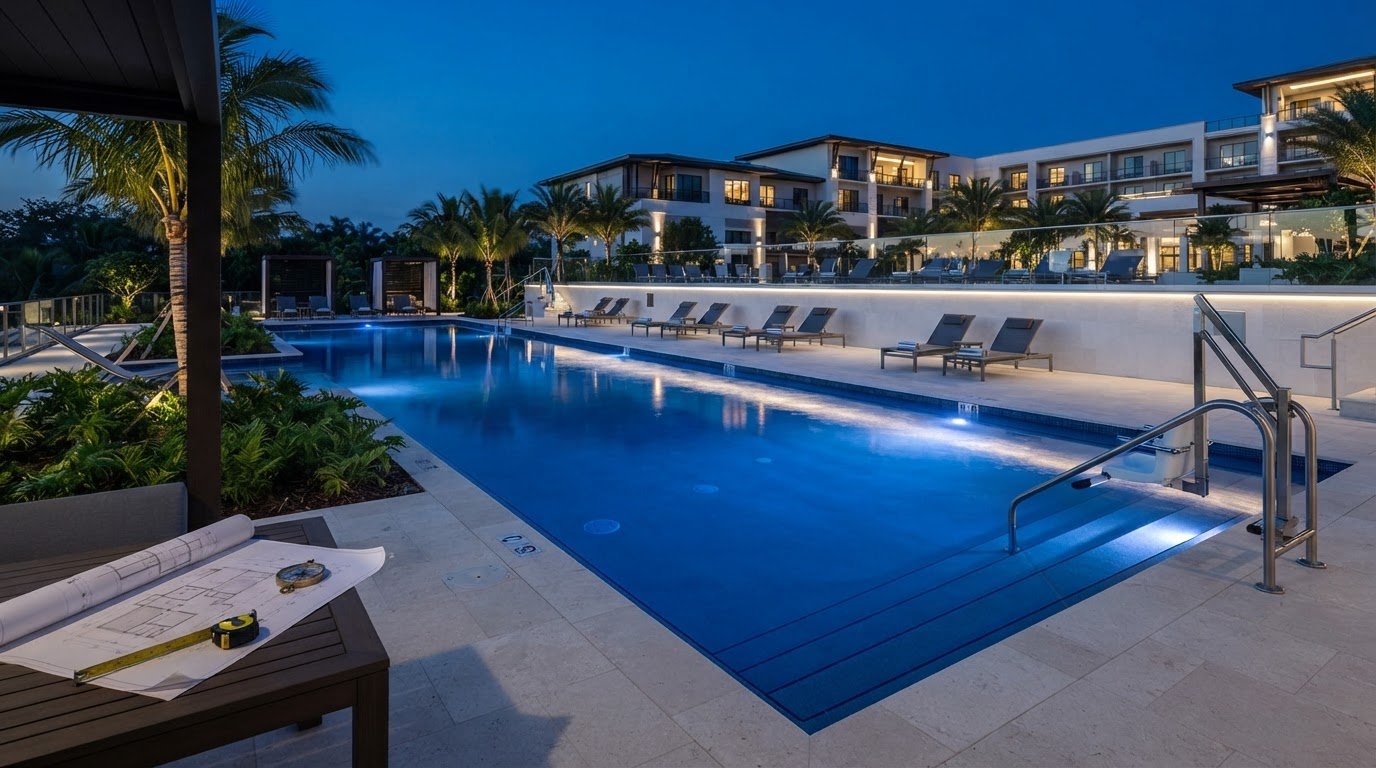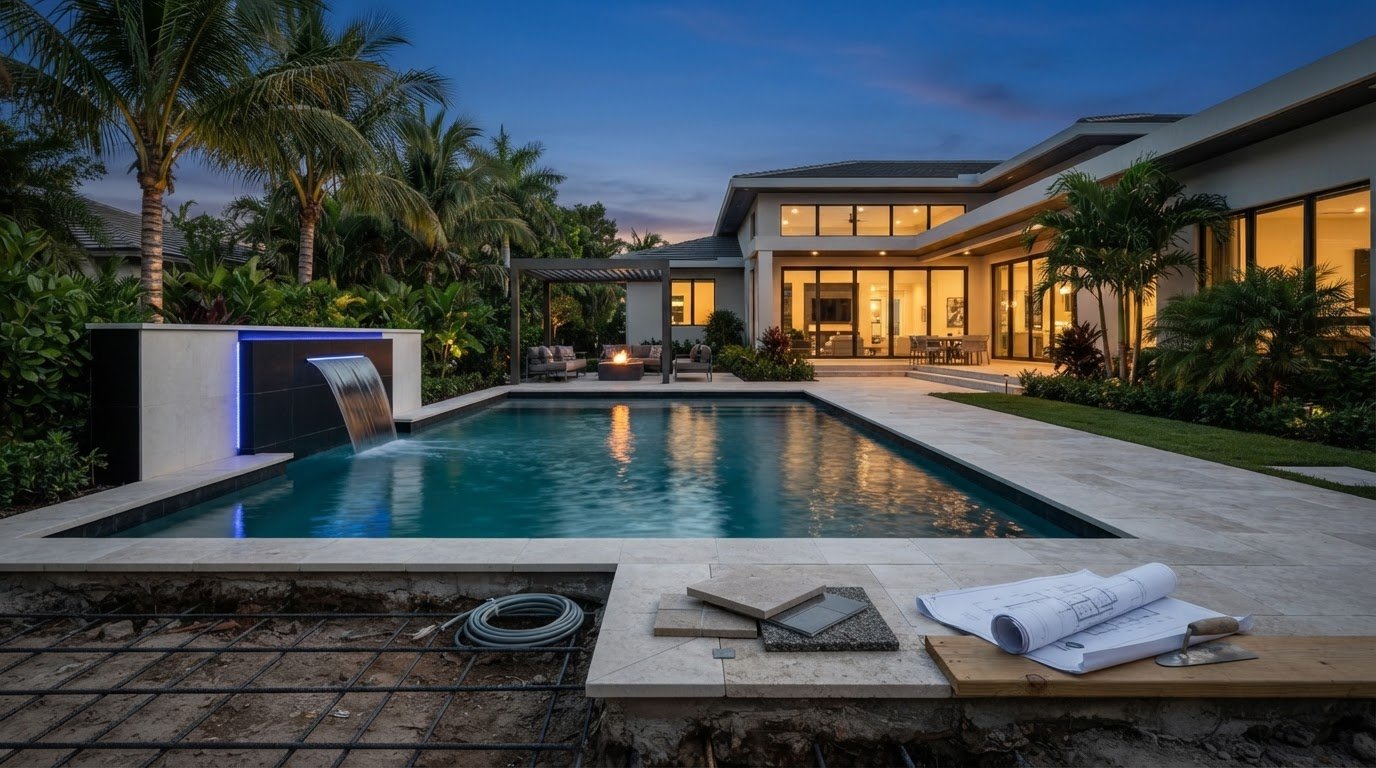
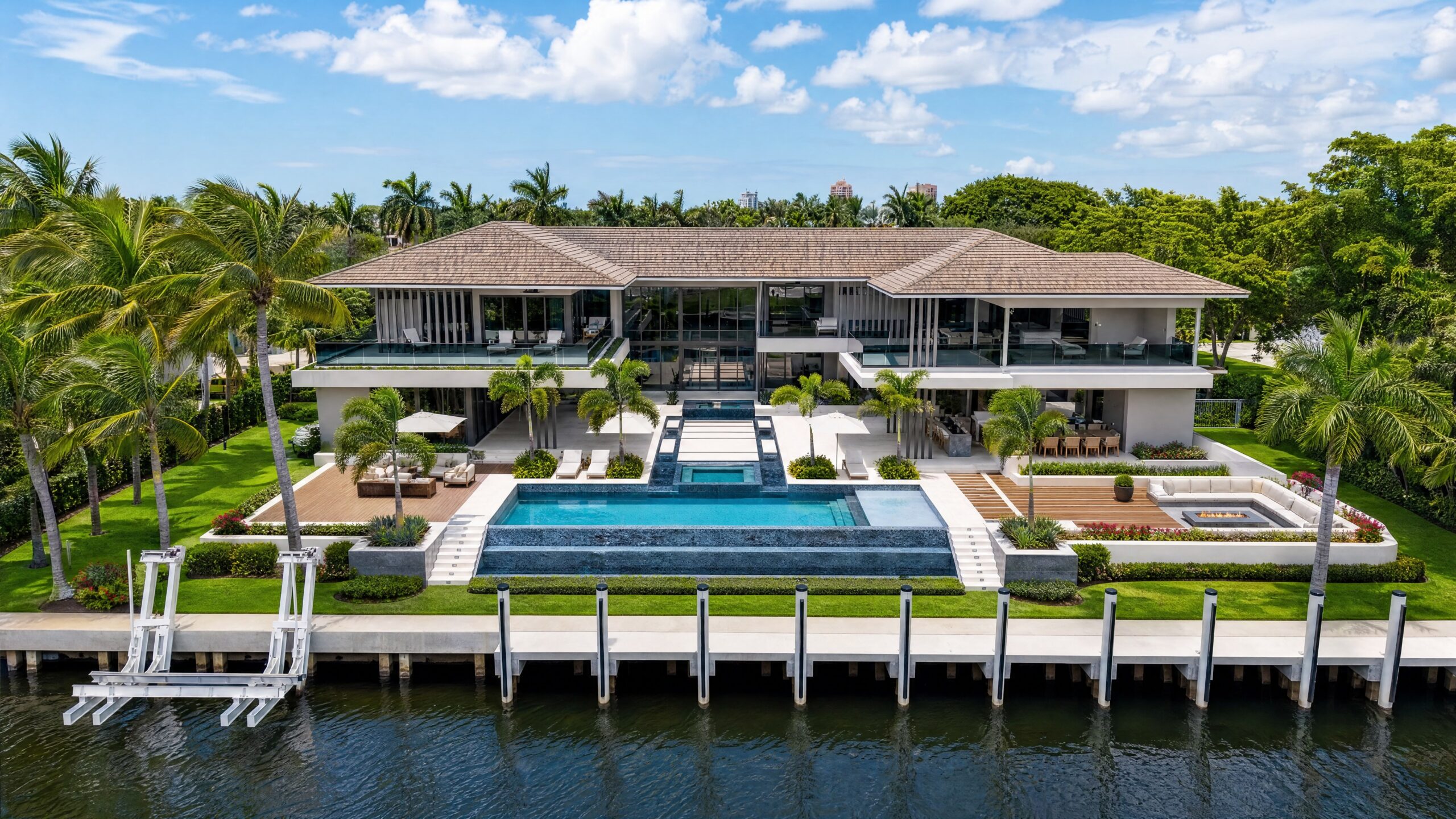
The most prestigious name in European aquatic engineering might not be the most resilient choice for a high-exposure Florida estate. When you demand a vessel designed to last fifty years, the decision between Berndorf Bäderbau vs. stainless steel pools crafted by specialized domestic firms becomes a question of localized engineering versus imported legacy. You likely recognize that stainless steel is the only material capable of delivering a true zero-entry, low-maintenance luxury experience that resists the relentless humidity and salt air of the coast. It’s a sophisticated choice for those who value architectural precision and long-term ROI over traditional concrete methods.
This guide clarifies the technical distinctions between proprietary European manufacturing and custom-engineered solutions tailored for the North American market. We’ll explore how these systems manage Florida’s unique environmental challenges, including specific corrosion risks and the critical need for water temperature regulation in metal vessels. You’ll gain a comprehensive understanding of how bespoke design-build processes allow for deeper integration with modern home aesthetics and advanced features like moveable floors. By the end of this comparison, you’ll have the technical clarity required to select a pool system that functions as a permanent, high-performance extension of your luxury outdoor living space.
Key Takeaways
- Contrast modular European systems with fully welded custom vessels to ensure your pool aligns with precise architectural constraints and complex site requirements.
- Analyze the performance of berndorf baderbau vs stainless steel pools in Florida’s corrosive salt air to protect your investment from long-term degradation.
- Gain insights into the 50-year lifecycle of stainless steel and how it provides a superior return on investment for modern residential estates.
- Evaluate the differences between patented vertical flow hydraulics and high-performance perimeter overflow designs for optimal water clarity and temperature management.
- Learn to distinguish when a legacy European brand is appropriate for commercial scale versus when local engineering offers superior site-specific resilience for private luxury homes.
Understanding the Stainless Steel Pool Landscape in 2026
Luxury aquatic architecture has undergone a fundamental transformation. By 2026, the shift from traditional gunite to stainless steel is no longer a trend; it’s a standard for high-performance estates. This transition is driven by a demand for materials that offer both structural permanence and surgical precision. While concrete is prone to cracking and requires frequent resurfacing, steel provides a watertight, monolithic structure that remains stable over decades. The conversation for many homeowners now focuses on the choice of berndorf baderbau vs stainless steel pools designed through bespoke domestic engineering.
Berndorf Bäderbau established the global foundation for this industry. Their European legacy is built on a modular panel system that revolutionized public and commercial swimming facilities. However, modern American architects are increasingly moving toward fully welded, custom-engineered vessels. This shift allows for a level of site-specific integration that modular systems often struggle to match. A custom approach ensures the pool is not just an added feature but a seamless extension of the home’s primary foundation.
The Material Science: 316L vs. Proprietary Alloys
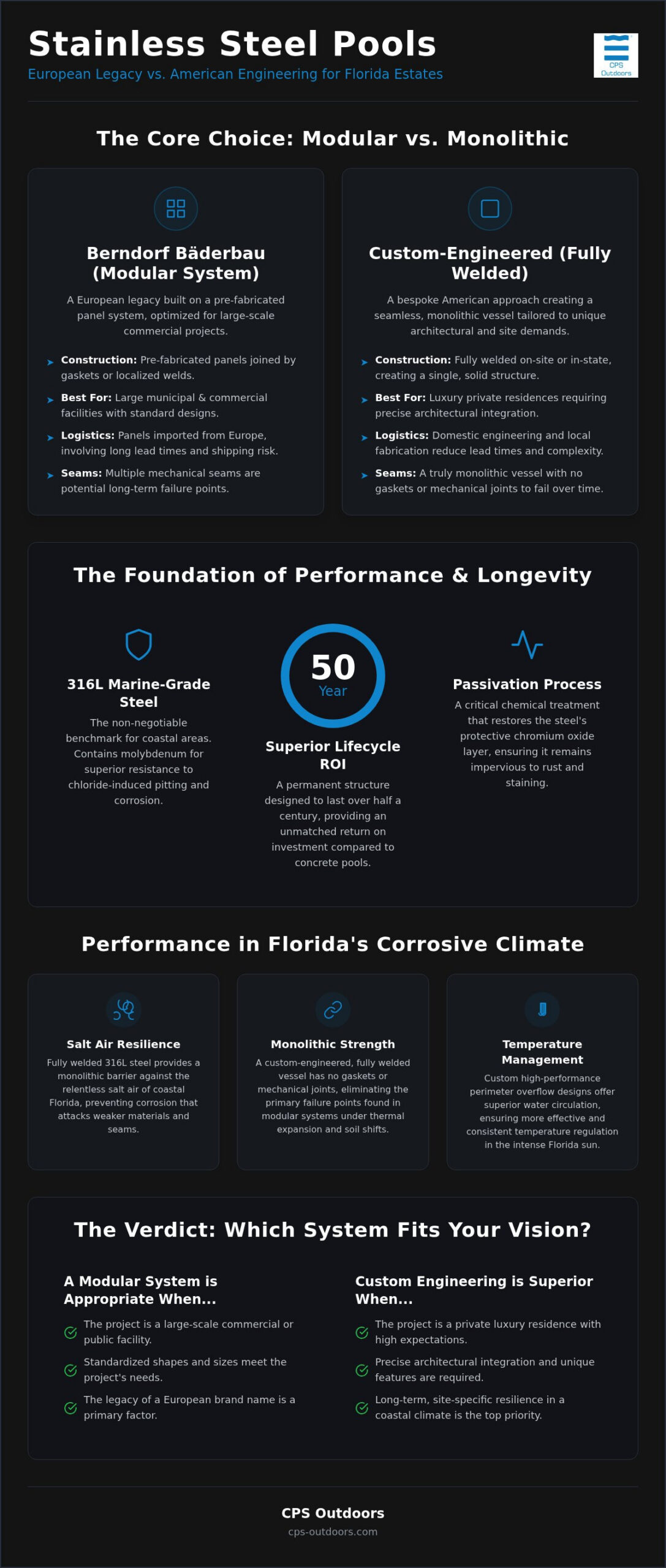
The integrity of a steel pool depends entirely on the specific grade of metal used. Marine-grade 316L stainless steel is the non-negotiable benchmark for coastal environments. This alloy contains molybdenum, a chemical element that significantly enhances resistance to chloride-induced pitting. Understanding these stainless steel properties is essential for any buyer concerned with longevity. Beyond the alloy itself, the passivation process is critical. This chemical treatment restores the protective chromium oxide layer on the steel surface. It ensures the vessel remains impervious to rust and staining, even when exposed to the harsh salt air common in Florida’s luxury corridors.
Aesthetic Versatility and Modern Design
Steel offers a level of crispness that masonry cannot replicate. It allows for tighter architectural tolerances and sharper lines, facilitating the minimalist designs favored in contemporary luxury builds. The visual impact is distinct. Polished or brushed steel surfaces create a unique “mirror effect,” where the water appears more vibrant and reflective than in a traditional plastered pool. This material also simplifies the integration of advanced features. Architects can easily incorporate large-scale acrylic windows or glass walls directly into the steel frame. These transparent elements create a weightless aesthetic, turning the pool into a focal point of the home’s structural design. In the comparison of berndorf baderbau vs stainless steel pools, custom fabrication often wins on these high-spec aesthetic details, as every weld and finish is tailored to the specific visual goals of the project.
Berndorf Bäderbau vs. Custom Engineering: The Technical Breakdown
The primary technical divergence in the berndorf baderbau vs stainless steel pools debate lies in the fundamental assembly method. Berndorf utilizes a modular panel system. This approach relies on pre-fabricated sections typically joined by gaskets or localized welds. While this is highly efficient for massive municipal projects, it introduces multiple potential failure points in a residential setting. For a private estate, the goal isn’t just speed; it’s the creation of a monolithic, impenetrable vessel.
The Modular Advantage and Limitations
Modular panels offer a distinct advantage in rapid assembly for large-scale commercial aquatics. They are the backbone of European public facilities for a reason. However, for a Florida estate, the logistics of importing these components often negate the speed advantage. Shipping large, precision-engineered panels across the Atlantic involves significant lead times and the inherent risk of transit damage. From a technical perspective, the application of requires a deep understanding of how metal behaves under structural stress. Modular systems, while engineered to high standards, still rely on mechanical seams that may not possess the same long-term monolithic strength as a fully welded vessel.
Bespoke Engineering for Unique Sites
Custom engineering takes the opposite approach by prioritizing structural continuity. Every plate is precision-cut and TIG-welded on-site to create a single, continuous shell. This is vital for rooftop installations where a single leak could cause catastrophic damage to the building’s interior. In Florida, soil conditions vary from shifting coastal sands to porous limestone. A fully welded vessel acts as a self-supporting bridge, resisting hydrostatic pressure and ground movement without the risk of seam separation. Custom welding is the ultimate method for achieving seamless aquatic finishes that remain watertight for fifty years or more.
Hydraulics also differ significantly between these two philosophies. Berndorf often promotes a patented vertical flow system, which is effective for high-occupancy public pools requiring rapid turnover. Conversely, bespoke residential engineering favors high-performance perimeter overflows. These systems provide superior surface tension and debris removal while maintaining the “mirror” aesthetic essential for modern luxury. Prefabricated components might seem faster on paper, but on-site fabrication offers a more integrated timeline. It allows for real-time adjustments to site constraints that modular systems simply cannot accommodate. If you’re planning a complex build, consulting with a firm that provides comprehensive pool design and engineering ensures the technical specifications match your site’s specific geology.
Performance in the Florida Climate: Salt, Sun, and Heat
Florida’s coastal environment presents a unique set of stressors that standard European specifications might not fully anticipate. The debate of berndorf baderbau vs stainless steel pools often centers on aesthetics, yet environmental resilience is the true differentiator for Miami estates. Unlike concrete, which is porous and prone to spalling as internal rebar oxidizes, a 316L stainless steel vessel is impervious to salt-laden air. This material creates a self-healing passive layer that prevents the structural degradation common in traditional masonry. During seismic events or hurricane-force storm surges, the inherent flexibility of steel allows the vessel to shift slightly without cracking. It’s a level of structural insurance that rigid concrete simply cannot provide.
UV stability is another critical factor for tropical climates. Traditional pool finishes like plaster, pebble, or vinyl liners inevitably fade and mottle under the intense Florida sun. Stainless steel maintains its architectural finish indefinitely. It doesn’t require the aggressive acid washing or resurfacing that masonry pools demand every decade. This permanence ensures that the visual integrity of your estate remains uncompromised by the elements.
Managing Water Temperature in 2026
A common misconception suggests that steel pools become excessively hot in the sun. The science of thermal mass tells a different story. While steel has high thermal conductivity, it has significantly lower thermal mass than concrete. This means it doesn’t “soak up” and hold heat throughout the night. Instead, steel responds rapidly to high-efficiency heat pumps and chillers. You can adjust your water temperature with far more precision and speed than is possible with a thick concrete shell. Integrating automatic pool covers into the design further enhances this thermal stability, reflecting solar radiation during the day and trapping desired temperatures at night.
Coastal Engineering and Building Codes
Navigating Florida building codes for elevated or rooftop installations requires a specialized engineering approach. Stainless steel is the preferred material for luxury infinity pool builders in Miami due to its lightweight nature and leak-proof security. A steel vessel weighs significantly less than a concrete equivalent, reducing the structural load on the home’s foundation or pilings. This is particularly vital for South Florida estates where drainage and overflow requirements are strictly regulated. Custom engineering allows for the precise integration of perimeter gutters and surge tanks that can handle tropical downpours without compromising the pool’s aesthetic edge. For those considering elevated installations, understanding the full scope of luxury rooftop pool construction is essential to navigating the weight calculations, waterproofing mandates, and structural reinforcement required by Florida’s building codes. Homeowners and developers who want to separate fact from fiction on this topic will also benefit from reviewing the latest guidance on stainless steel elevated pool construction, which addresses common misconceptions about weight, leakage risk, and code compliance in 2026.
ROI Analysis: Cost, Maintenance, and Longevity
Evaluating the return on investment for a high-end aquatic project requires a shift from immediate capital expenditure to long-term lifecycle value. While a traditional concrete pool involves a lower initial outlay, it’s burdened by a recurring cycle of structural repairs and aesthetic resurfacing. Stainless steel vessels operate on a fifty-year horizon. They eliminate the systemic degradation associated with porous masonry. In the context of berndorf baderbau vs stainless steel pools, the ROI is realized through the material’s near-indestructibility and its positive impact on future estate valuations. A pool that never cracks or leaks is a powerful asset in the Florida luxury real estate market.
Sustainability has also become a non-negotiable factor in modern luxury construction. Concrete production carries a significant carbon footprint and creates substantial waste at the end of its functional life. Conversely, stainless steel is 100% recyclable. It represents a circular investment that aligns with contemporary environmental standards. For waterfront properties, the structural integrity of a steel vessel prevents the leaching of chemicals or debris into the local ecosystem, preserving the natural beauty of the estate’s surroundings.
The Maintenance Advantage
The non-porous nature of a stainless steel surface provides a biological advantage. Unlike plaster or pebble finishes, which harbor microscopic algae in their pores, steel remains smooth and inhospitable to organic growth. This reduces the chemical demand required to maintain water clarity. The financial benefits of this material properties include:
- Elimination of expensive re-plastering or re-tiling every 10 to 15 years.
- High resistance to staining from minerals or organic debris.
- Simplified chemical balancing due to the inert nature of the vessel walls.
Maintenance for these systems is focused on preservation rather than intensive repair. Annual professional check-ups ensure the passivation layer remains intact and the hydraulic systems perform at peak efficiency.
Investment Comparison in the Miami Market
Analyzing the luxury swimming pool cost in Miami reveals that premium concrete builds often approach the price of steel when high-spec finishes and advanced engineering are included. However, the engineering costs for imported systems can escalate due to complex logistics and the need for specialized European technicians. Local custom builds offer a more direct investment path. They utilize domestic engineering that understands South Florida’s specific soil and storm requirements. Waterfront properties especially benefit from the rigid, leak-proof nature of a steel shell, which protects the home’s primary foundation from potential saltwater intrusion. If you’re ready to secure the long-term value of your property, you can consult with our aquatic engineering team to design a vessel tailored to your estate.
The Verdict: Which Solution Fits Your Vision?
The choice between Berndorf Bäderbau and a custom-engineered vessel depends entirely on the scale and intent of your project. Berndorf is the legacy brand for massive municipal facilities and public athletic centers. Their modular systems provide a proven, scalable solution for high-occupancy commercial environments. However, for a high-spec residential estate with unique architectural nuances, the comparison of berndorf baderbau vs stainless steel pools favors bespoke domestic engineering. Custom vessels allow for the surgical precision required to integrate the pool into a home’s specific structural footprint, especially on complex waterfront sites.
Maximizing Functionality with Moveable Floors
Stainless steel is the ideal substrate for high-tech integrations like hidden floors. Because steel doesn’t warp or shift like concrete, it provides a perfectly plumb environment for a moveable pool floor installation. These systems allow you to transform a swimming area into a solid event terrace or a shallow wading pool in seconds. Engineering a vanishing floor requires tolerances measured in millimeters. A custom-welded steel shell maintains these tolerances over decades, ensuring the mechanical floor operates without friction or misalignment. This level of synergy is difficult to achieve with modular panels that may exhibit slight variations at the seams over time.
Selecting a Partner for Your Florida Project
Navigating the technical complexities of a South Florida build requires an understanding of local geology and the rigorous permitting process for coastal properties. While European imports offer undeniable prestige, local design-build expertise ensures the vessel is engineered specifically for Florida’s hurricane codes and porous limestone soil. A custom builder manages the entire ecosystem, from the initial design and engineering to the final TIG-welded finish. CPS Outdoors bridges this gap by combining the high-register quality of European steel with the flexibility of American customization, providing a seamless experience for the discerning homeowner.
The final decision rests on the complexity of your vision. Choose Berndorf if your priority is a large-scale, standardized commercial facility where modularity is an asset. Select custom engineering if your project involves a bespoke residential estate, intricate site constraints, or the integration of advanced features like Elemento Living systems. This approach ensures your pool functions as a permanent, high-performance extension of your home’s architecture. The next step is a feasibility consultation with an aquatic engineer who can translate these technical advantages into a realized landscape.
Engineering Your Permanent Aquatic Legacy
Choosing between berndorf baderbau vs stainless steel pools is a decision that defines the structural and aesthetic future of your estate. While modular European systems serve commercial needs, custom-engineered vessels provide the site-specific resilience required for Florida’s coastal conditions. You now understand that a fully welded 316L shell offers superior protection against salt air corrosion and storm stress while allowing for the surgical integration of advanced technology. These vessels aren’t just pools; they are high-performance assets designed to endure for fifty years without the recurring maintenance cycles of traditional masonry.
As Florida coastal construction experts, we specialize in high-end aquatic engineering that bridges the gap between architectural vision and technical reality. Whether you require a vanishing edge that defies gravity or the precision of a moveable pool floor, our team delivers bespoke solutions tailored to the unique geology of your property. Consult with CPS Outdoors on your custom stainless steel pool project to begin engineering a modern outdoor environment that matches your standards for excellence.
Frequently Asked Questions
Are stainless steel pools better than concrete pools for Florida homes?
Stainless steel offers superior resilience in Florida because it accommodates the state’s shifting sandy soils without the structural cracking common in concrete. While concrete is porous and prone to osmotic blistering, a steel vessel is monolithic and watertight. This material choice is particularly effective for waterfront estates where salt air accelerates the oxidation of traditional rebar. Steel’s inherent flexibility allows it to withstand minor ground movements that would otherwise compromise a rigid masonry structure.
Does a stainless steel pool get too hot in the sun?
A stainless steel vessel doesn’t become excessively hot because it possesses low thermal mass. Unlike concrete, which absorbs solar energy all day and radiates it back into the water at night, steel reflects a significant portion of UV radiation. It also responds more efficiently to high-performance chillers. When paired with an automatic pool cover, a steel pool maintains a more stable and refreshing temperature than a traditional plaster finish in the intense South Florida sun.
How long does a stainless steel pool actually last?
A properly engineered stainless steel pool is designed to last 50 years or more. This longevity stems from the use of 316L marine-grade alloys that resist corrosion in high-chloride environments. Unlike concrete pools that require resurfacing every decade, a steel shell remains structurally sound and aesthetically consistent indefinitely. This makes the initial investment highly cost-effective when analyzed over the full lifecycle of a luxury Florida estate, as it eliminates the need for future structural renovations.
Can you use salt water systems in a stainless steel pool?
Salt water systems are perfectly compatible with stainless steel pools provided the vessel is constructed from high-grade 316L or 316Ti alloys. These marine-grade materials are specifically designed to resist chloride-induced pitting. In the comparison of berndorf baderbau vs stainless steel pools, both systems prioritize these high-spec alloys to ensure the vessel remains impervious to salt. Maintaining correct water chemistry is essential to preserve the metal’s passive protective layer, preventing any localized staining or oxidation over time.
Do stainless steel pools scratch easily?
While stainless steel is a remarkably durable material, it can develop superficial scratches over time from heavy use. These marks are typically less visible on a brushed finish than on polished surfaces. Unlike tile or plaster, which can chip or crack, minor abrasions on a steel pool can be buffed out using specialized tools during periodic check-ups. The material’s ability to be restored to its original luster ensures the pool maintains its architectural edge without requiring full resurfacing.
Why is Berndorf Bäderbau considered a premium brand?
Berndorf Bäderbau is recognized as a premium brand due to its 65-year history of pioneering stainless steel aquatic technology in Europe. Their reputation is built on a patented modular panel system and rigorous manufacturing standards that have defined the global commercial market. While their systems are excellent for large-scale public facilities, they represent the high-water mark of industrial engineering. This legacy of precision and reliability is why they’re often the first name mentioned in high-stakes aquatic architecture.
What is the most important maintenance task for a stainless steel pool?
The most critical maintenance task is maintaining precise water chemistry to protect the vessel’s passivation layer. Keeping the pH and chloride levels within specific ranges prevents the breakdown of the chromium oxide film that makes the steel “stainless.” Additionally, periodic cleaning of the waterline with non-abrasive pads removes mineral deposits. This proactive care is far less intensive than the acid washing or tile scrubbing required for masonry pools, ensuring the vessel remains pristine with minimal effort.
Can I install a stainless steel pool on a rooftop in Miami?
Installing a stainless steel pool on a Miami rooftop is a highly efficient engineering choice. A steel vessel is significantly lighter than a concrete equivalent, which reduces the structural reinforcement required for the building’s frame. Its fully welded construction provides a leak-proof guarantee that is essential for protecting the luxury interiors below. We specialize in these complex luxury rooftop pool construction projects, ensuring that every vessel meets Florida’s stringent building codes while providing a seamless, high-performance aquatic environment. For a deeper technical understanding of why steel outperforms concrete in these scenarios, our comprehensive guide on stainless steel elevated pool construction in 2026 addresses the most common structural and safety concerns raised by architects and developers.